

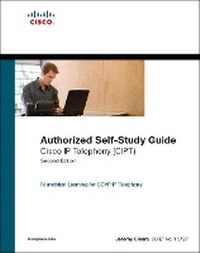
Cisco IP Telephony (CIPT) (Authorized Self-Study)
2nd Edition
Published on 2. November 2006
Book
Hardback
912 pages
978-1-58705-261-3 (ISBN)
Description
Foundation Learning for CCVP IP Telephony
Jeremy Cioara, CCIE (R) No. 11,727
Cisco IP Telephony (CIPT), Second Edition, is a Cisco (R)-authorized, self-paced learning tool for CCVP IP telephony foundation learning. This book provides you with the knowledge needed to install, configure, and maintain a Cisco IP telephony solution. By reading this book, you will gain a thorough understanding of Cisco Unified CallManager version 4.1, the call routing and signaling component for the Cisco IP telephony solution.
Cisco IP Telephony (CIPT) expands your knowledge of voice over IP (VoIP) and public switched telephone network (PSTN) components and technologies. This book teaches you how to describe, install, configure, and support Cisco Unified CallManager 4.1 in a Cisco network including such features as security and video; how to configure gateways, gatekeepers, and switches; and how to build route plans to place intra- and intercluster Cisco IP phone calls. Chapter review questions, detailed configuration examples, network diagrams, and thorough explanations help reinforce learning.
Whether you are preparing for CCVP certification or simply want to gain a better understanding of IP telephony and Cisco Unified CallManager, you will benefit from the foundation information presented in this book.
Cisco IP Telephony (CIPT), Second Edition, is part of a recommended learning path from Cisco Systems (R) that includes simulation and hands-on training from authorized Cisco Learning Partners and self-study products from Cisco Press. To find out more about instructor-led training, e-learning, and hands-on instruction offered by authorized Cisco Learning Partners worldwide, please visit www.cisco.com/go/authorizedtraining.
Jeremy D. Cioara, CCIE (R) No. 11,727, is the owner of AdTEC Networks and works as a network consultant, instructor, and author. He has been working in network technologies for more than a decade and has deployed networks worldwide. His current consulting work focuses on network and VoIP implementations.
Examine design strategies behind a Cisco Unified CallManager cluster, cluster replication, and Cisco Unified CallManager deployment models
Perform Cisco Unified CallManager server installations and upgrades
Learn the features of all Cisco IP Phones, the IP phone startup process, and audio codec communication
Add IP phone users and apply bulk moves, adds, and changes
Configure Cisco gateways and trunks
Design and configure Cisco Unified CallManager route plans
Implement telephony call restrictions and control
Effectively coordinate multisite deploymentsConfigure user features, Cisco Unified CallManager Attendant, and Cisco IP Manager Assistant
Secure the Windows operating system and Cisco Unified CallManager administration
Prevent toll fraud and harden the IP phone against attack
Configure Cisco Unified CallManager to support video
Monitor performance and configure alarms, traces, and CAR
This volume is in the Certification Self-Study Series offered by Cisco Press (R). Books in this series provide officially developed self-study solutions to help networking professionals understand technology implementations and prepare for the Cisco Career Certifications examinations.
Category: IP Communications
Covers: Cisco Unified CallManager v4.1
Jeremy Cioara, CCIE (R) No. 11,727
Cisco IP Telephony (CIPT), Second Edition, is a Cisco (R)-authorized, self-paced learning tool for CCVP IP telephony foundation learning. This book provides you with the knowledge needed to install, configure, and maintain a Cisco IP telephony solution. By reading this book, you will gain a thorough understanding of Cisco Unified CallManager version 4.1, the call routing and signaling component for the Cisco IP telephony solution.
Cisco IP Telephony (CIPT) expands your knowledge of voice over IP (VoIP) and public switched telephone network (PSTN) components and technologies. This book teaches you how to describe, install, configure, and support Cisco Unified CallManager 4.1 in a Cisco network including such features as security and video; how to configure gateways, gatekeepers, and switches; and how to build route plans to place intra- and intercluster Cisco IP phone calls. Chapter review questions, detailed configuration examples, network diagrams, and thorough explanations help reinforce learning.
Whether you are preparing for CCVP certification or simply want to gain a better understanding of IP telephony and Cisco Unified CallManager, you will benefit from the foundation information presented in this book.
Cisco IP Telephony (CIPT), Second Edition, is part of a recommended learning path from Cisco Systems (R) that includes simulation and hands-on training from authorized Cisco Learning Partners and self-study products from Cisco Press. To find out more about instructor-led training, e-learning, and hands-on instruction offered by authorized Cisco Learning Partners worldwide, please visit www.cisco.com/go/authorizedtraining.
Jeremy D. Cioara, CCIE (R) No. 11,727, is the owner of AdTEC Networks and works as a network consultant, instructor, and author. He has been working in network technologies for more than a decade and has deployed networks worldwide. His current consulting work focuses on network and VoIP implementations.
Examine design strategies behind a Cisco Unified CallManager cluster, cluster replication, and Cisco Unified CallManager deployment models
Perform Cisco Unified CallManager server installations and upgrades
Learn the features of all Cisco IP Phones, the IP phone startup process, and audio codec communication
Add IP phone users and apply bulk moves, adds, and changes
Configure Cisco gateways and trunks
Design and configure Cisco Unified CallManager route plans
Implement telephony call restrictions and control
Effectively coordinate multisite deploymentsConfigure user features, Cisco Unified CallManager Attendant, and Cisco IP Manager Assistant
Secure the Windows operating system and Cisco Unified CallManager administration
Prevent toll fraud and harden the IP phone against attack
Configure Cisco Unified CallManager to support video
Monitor performance and configure alarms, traces, and CAR
This volume is in the Certification Self-Study Series offered by Cisco Press (R). Books in this series provide officially developed self-study solutions to help networking professionals understand technology implementations and prepare for the Cisco Career Certifications examinations.
Category: IP Communications
Covers: Cisco Unified CallManager v4.1
More details
Edition
2nd edition
Language
English
Place of publication
Indianapolis
United States
Publishing group
Pearson Education (US)
Target group
College/higher education
Dimensions
Height: 238 mm
Width: 194 mm
Thickness: 58 mm
Weight
1670 gr
ISBN-13
978-1-58705-261-3 (9781587052613)
Copyright in bibliographic data and cover images is held by Nielsen Book Services Limited or by the publishers or by their respective licensors: all rights reserved.
Schweitzer Classification
Other editions
Previous edition
Persons
Jeremy D. Cioara
, CCIE no. 11727, CCVP, MCSE, CNE, is the owner of AdTEC Networks and
works as a network consultant, instructor, and author. He has been working in network
technologies for more than a decade and has deployed networks worldwide. His current consulting
work focuses on network and voice over IP (VoIP) implementations. Jeremy has written many
books on Cisco network technology, but has a true passion for educating individuals both in the
classroom and through e-learning environments. Jeremy currently lives with his wife in Phoenix,
AZ.
, CCIE no. 11727, CCVP, MCSE, CNE, is the owner of AdTEC Networks and
works as a network consultant, instructor, and author. He has been working in network
technologies for more than a decade and has deployed networks worldwide. His current consulting
work focuses on network and voice over IP (VoIP) implementations. Jeremy has written many
books on Cisco network technology, but has a true passion for educating individuals both in the
classroom and through e-learning environments. Jeremy currently lives with his wife in Phoenix,
AZ.
Content
Foreword
Introduction
Part I: Cisco CallManager Fundamentals
Chapter 1 Introduction to Cisco Unified Communications and Cisco Unified CallManager
Chapter 2 Cisco Unified CallManager Clustering and Deployment Options
Chapter 3 Cisco Unified CallManager Installation and Upgrades
Part II: IPT Devices and Users
Chapter 4 Cisco IP Phones and Other User Devices
Chapter 5 Configuring Cisco Unified CallManager to Support IP Phones
Chapter 6 Cisco IP Telephony Users
Chapter 7 Cisco Bulk Administration Tool
Chapter 8 Cisco Catalyst Switches
Chapter 9 Configuring Cisco Gateways and Trunks
Chapter 10 Cisco Unified CallManager Route Plan Basics
Chapter 11 Cisco Unified CallManager Advanced Route Plans
Chapter 12 Configuring Hunt Groups and Call Coverage
Chapter 13 Implementing Telephony Call Restrictions and Control
Chapter 14 Implementing Multiple-Site Deployments
Part IV: VoIP Features
Chapter 15 Media Resources
Chapter 16 Configuring User Features, Part 1
Chapter 17 Configuring User Features, Part 2
Chapter 18 Configuring Cisco Unified CallManager Attendant Console
Chapter 19 Configuring Cisco IP Manager Assistant
Part V: IPT Security
Chapter 20 Securing the Windows Operating System
Chapter 21 Securing Cisco Unified CallManager Administration
Chapter 22 Preventing Toll Fraud
Chapter 23 Hardening the IP Phone
Chapter 24 Understanding Cryptographic Fundamentals
Chapter 25 Understanding the Public Key Infrastructure
Chapter 26 Understanding Cisco IP Telephony Authentication and Encryption Fundamentals
Chapter 27 Configuring Cisco IP Telephony Authentication and Encryption
Part VI: IP Video
Chapter 28 Introducing IP Video Telephony
Chapter 29 Configuring Cisco VT Advantage
Part VII: IPT Management
Chapter 30 Introducing Database Tools and Cisco Unified CallManager Serviceability
Chapter 31 Monitoring Performance
Chapter 32 Configuring Alarms and Traces
Chapter 33 Configuring CAR
Chapter 34 Using Additional Management and Monitoring Tools
Part VIII: Appendix
Appendix A Answers to Review Questions
Introduction
Part I: Cisco CallManager Fundamentals
Chapter 1 Introduction to Cisco Unified Communications and Cisco Unified CallManager
Chapter 2 Cisco Unified CallManager Clustering and Deployment Options
Chapter 3 Cisco Unified CallManager Installation and Upgrades
Part II: IPT Devices and Users
Chapter 4 Cisco IP Phones and Other User Devices
Chapter 5 Configuring Cisco Unified CallManager to Support IP Phones
Chapter 6 Cisco IP Telephony Users
Chapter 7 Cisco Bulk Administration Tool
Chapter 8 Cisco Catalyst Switches
Chapter 9 Configuring Cisco Gateways and Trunks
Chapter 10 Cisco Unified CallManager Route Plan Basics
Chapter 11 Cisco Unified CallManager Advanced Route Plans
Chapter 12 Configuring Hunt Groups and Call Coverage
Chapter 13 Implementing Telephony Call Restrictions and Control
Chapter 14 Implementing Multiple-Site Deployments
Part IV: VoIP Features
Chapter 15 Media Resources
Chapter 16 Configuring User Features, Part 1
Chapter 17 Configuring User Features, Part 2
Chapter 18 Configuring Cisco Unified CallManager Attendant Console
Chapter 19 Configuring Cisco IP Manager Assistant
Part V: IPT Security
Chapter 20 Securing the Windows Operating System
Chapter 21 Securing Cisco Unified CallManager Administration
Chapter 22 Preventing Toll Fraud
Chapter 23 Hardening the IP Phone
Chapter 24 Understanding Cryptographic Fundamentals
Chapter 25 Understanding the Public Key Infrastructure
Chapter 26 Understanding Cisco IP Telephony Authentication and Encryption Fundamentals
Chapter 27 Configuring Cisco IP Telephony Authentication and Encryption
Part VI: IP Video
Chapter 28 Introducing IP Video Telephony
Chapter 29 Configuring Cisco VT Advantage
Part VII: IPT Management
Chapter 30 Introducing Database Tools and Cisco Unified CallManager Serviceability
Chapter 31 Monitoring Performance
Chapter 32 Configuring Alarms and Traces
Chapter 33 Configuring CAR
Chapter 34 Using Additional Management and Monitoring Tools
Part VIII: Appendix
Appendix A Answers to Review Questions