

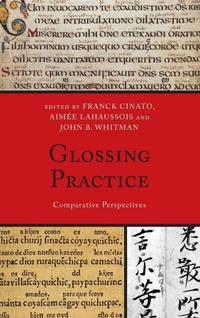
Glossing Practice
Comparative Perspectives
Published on 15. February 2023
Book
Hardback
272 pages
978-1-7936-1280-9 (ISBN)
Description
This volume is the first book to focus specifically on the topic of comparative glossing. It brings together new research on glossing practices from traditions in both the West and East Asia, with a focus on Japan. It also touches on the relation between glossing in the medieval manuscript tradition and the modern linguistic use of the gloss. Its purpose is to present a sample of the most recent studies on glossing as it is practiced across very different parts of the world, highlighting the many shared features found across space and time.
Glosses take many forms and serve numerous functions according to when and where they are produced. They constitute a cross-cultural phenomenon anchored in language, and are the manifestation of hermeneutic processes involved in the transfer of knowledge from one linguistic area to another. Glosses are an integral part of all the stages of this transfer, which is characterized by the necessity to decode and explain the message, encompassing basic grammatical commentary and wider exegetical discussions.
Glosses take many forms and serve numerous functions according to when and where they are produced. They constitute a cross-cultural phenomenon anchored in language, and are the manifestation of hermeneutic processes involved in the transfer of knowledge from one linguistic area to another. Glosses are an integral part of all the stages of this transfer, which is characterized by the necessity to decode and explain the message, encompassing basic grammatical commentary and wider exegetical discussions.
Reviews / Votes
This volume is a forceful demand to reorient our tools of investigation into objects of critical inquiry. The assembled essays-which range across granular microanalysis of individual texts; comparative juxtaposition of disparate eras, literary traditions, and methodologies; and the inductive positing of universals-together make a compelling case for comparative glossing as a vital new field of cross-disciplinary relevance. -- Brian Steininger, Princeton University Glosses may be small and insignificant to the eye, but for premodern readers they were the all-important keys that gave the reader access to books containing essential cultural knowledge. The linguistic and cultural practice of glossing was once widespread in East Asia, South Asia, Europe and elsewhere, and in this indispensable book, glosses at last get their first cross-cultural treatment in a range of stimulating essays that bring to life the glosses attached to texts in classical Chinese, Sanskrit, Latin and other languages. Glosses came into their own when written texts were alien, challenging or just plain difficult, but the global reach of this practice has hardly ever been addressed. Anybody working on knowledge transfer in premodern societies needs to understand how glosses worked to facilitate comprehension and render knowledge transfer possible and the essays in this book furnish cutting-edge research on the uses and functions of glosses. -- Peter Kornicki, University of Cambridge What is a gloss? Our language to talk about glosses and our thinking about them is fuzzy. Words added around a text or in between the lines are a universal practice in writing cultures across times and places, but they serve a multitude of purposes and take on as many shapes. In this book, the concept is thoroughly scrutinized, dissected into single components: functionalities, characteristics and typologies. Only then the real effort of comparing can take off and bring us truly new insights. And with that, this book breaks fresh ground. -- Mariken Teeuwen, Huygens Institute; Leiden University [The] editors are to be congratulated for the rich selection of stimulating papers they have brought together in Glossing Practice: Comparative Perspectives. It is to be hoped that the present volume will foster interest in the study of glossing traditions worldwide, whether taken in isolation in a first step or seen from a comparative perspective. * East Asian Publishing and Society *More details
Language
English
Place of publication
United States
Publishing group
Bloomsbury Publishing Plc
Target group
Professional and scholarly
Illustrations
30 b/w illustrations;18 tables;
Dimensions
Height: 235 mm
Width: 157 mm
Thickness: 21 mm
Weight
600 gr
ISBN-13
978-1-7936-1280-9 (9781793612809)
Copyright in bibliographic data and cover images is held by Nielsen Book Services Limited or by the publishers or by their respective licensors: all rights reserved.
Schweitzer Classification
Other editions
Additional editions
Glossing Practice
Comparative Perspectives
E-Book
01/2023
1st Edition
Lexington Books
€32.99
Available for download
Persons
Franck Cinato is full-time researcher at the French National Centre for Scientific Research.
Aimee Lahaussois is a linguist at the French National Centre for Scientific Research.
John B. Whitman is professor of linguistics at Cornell University and the Department of Crosslinguistic Studies at the National Institute for Japanese Language and Linguistics.
Aimee Lahaussois is a linguist at the French National Centre for Scientific Research.
John B. Whitman is professor of linguistics at Cornell University and the Department of Crosslinguistic Studies at the National Institute for Japanese Language and Linguistics.
Content
I. Comparative Glossing Practice
1. Continuity and Discontinuity: Glossing as a Dynamic System
2. The Five Services of Sanskrit Commentaries and Diomedes' Grammar Program
II. Glosses as Tools for Access to Knowledge
3. Glossing Glosses: Methods for Transcribing and Glossing Japanese kundoku Texts
4. Issues in Dictionaries Recording Kunten Glosses
5. Interconnecting Knowledge in Early Medieval Glosses
6. Auraicept na nEces and the Art of Medicine
III. Glosses and Linguistics
7. Dry-point Grammatical Glosses
8. The Pragmatics of Paratextual Paraphernalia
9. A Revised Typology for the St Gall Priscian Glosses
10. Glossing Practices in 1850-1911: Descriptions of Languages with Complex Verbal Morphology
1. Continuity and Discontinuity: Glossing as a Dynamic System
2. The Five Services of Sanskrit Commentaries and Diomedes' Grammar Program
II. Glosses as Tools for Access to Knowledge
3. Glossing Glosses: Methods for Transcribing and Glossing Japanese kundoku Texts
4. Issues in Dictionaries Recording Kunten Glosses
5. Interconnecting Knowledge in Early Medieval Glosses
6. Auraicept na nEces and the Art of Medicine
III. Glosses and Linguistics
7. Dry-point Grammatical Glosses
8. The Pragmatics of Paratextual Paraphernalia
9. A Revised Typology for the St Gall Priscian Glosses
10. Glossing Practices in 1850-1911: Descriptions of Languages with Complex Verbal Morphology