

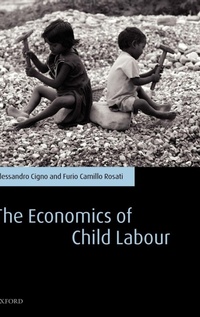
The Economics of Child Labour
Published on 28. July 2005
Book
Hardback
264 pages
978-0-19-926445-2 (ISBN)
Description
Children throughout the world are engaged in a great number of activities classifiable as work. These range from relatively harmless, even laudable, activities like helping parents in their domestic chores, to morally and physically dangerous ones like soldiering and prostitution. If we leave out the former, we are left with what are generally called "economic" activities. Only a small minority, less than 4 percent of all working children, are estimated to be engaged in what ILO defines as the "unconditional" worst forms of child labour. The absolute number of children estimated to be engaged in the latter is, however, a stunning 8.4 million.
Should we only be concerned about the worst forms of child labour? Most forms of child labour other than the worst ones have valuable learning-by-doing elements. Furthermore, child labour produces current income. If the family is credit rationed, child labour relaxes the liquidity constraint and increases current consumption. There is thus a trade-off between present and future consumption. To the extent that current consumption has a positive effect on future health (hence, on the child's future earning capacity and, more generally, utility), this trade-off may be lower than one might think.
This book provides a blend of theory, empirical analysis and policy discussion. The first three chapters develop a fairly comprehensive theory of child labour, and related variables such as fertility, and infant mortality. Chapter 4, concerned with the effects of trade, contains both theory and cross-country empirical evidence. The remaining chapters are country studies, aimed at illustrating and testing different aspects of the theory in different geographical contexts. These chapters apply the latest developments in microeconometric methodology for dealing with endogeneity, unobserved heterogeneity, and the evaluation of public intervention.
Should we only be concerned about the worst forms of child labour? Most forms of child labour other than the worst ones have valuable learning-by-doing elements. Furthermore, child labour produces current income. If the family is credit rationed, child labour relaxes the liquidity constraint and increases current consumption. There is thus a trade-off between present and future consumption. To the extent that current consumption has a positive effect on future health (hence, on the child's future earning capacity and, more generally, utility), this trade-off may be lower than one might think.
This book provides a blend of theory, empirical analysis and policy discussion. The first three chapters develop a fairly comprehensive theory of child labour, and related variables such as fertility, and infant mortality. Chapter 4, concerned with the effects of trade, contains both theory and cross-country empirical evidence. The remaining chapters are country studies, aimed at illustrating and testing different aspects of the theory in different geographical contexts. These chapters apply the latest developments in microeconometric methodology for dealing with endogeneity, unobserved heterogeneity, and the evaluation of public intervention.
Reviews / Votes
The book is a welcome addition to the literature. It should be of interest to development economists in general, and not merely those with research interests in child labour. * The Economic Society of Australia * A commendable job of surveying and sythesising the issues and controversies, both theoretical and empirical...rigorous and clear.The book is a welcome addition to the literature. * Indraneel Dasgupta, School of Economics, University of Nottingham * Alessandro Cigno and Furio Camillo Rosati convincingly demonstrate multiple policy choices that could, at the very least, reduce the worst forms of child labor...Overall, this book is a much-needed contribution to the body of work that examines child labor. The transparent methodology and econometric details found in the text and appendices lend credibility to the author's work.More details
Language
English
Place of publication
Oxford
United Kingdom
Target group
Professional and scholarly
Academic researchers, graduate students, policy makers including international agencies.
Illustrations
numerous diagrams and tables
Dimensions
Height: 240 mm
Width: 161 mm
Thickness: 19 mm
Weight
561 gr
ISBN-13
978-0-19-926445-2 (9780199264452)
Copyright in bibliographic data and cover images is held by Nielsen Book Services Limited or by the publishers or by their respective licensors: all rights reserved.
Schweitzer Classification
Persons
Alessandro Cigno is Professor of Economics at the University of Florence, President of CHILD, Fellow of CESifo and IZA, and an editor of the Journal of Population Economics. He has been a professor at the universities of Pisa, Hull and Birmingham. His visiting appointments include Munich, Paris (Science-Po), Argentina (Salta), Guatemala (Landivar), Wisconsin (Madison) and California (Santa Barbara). He has consulted for the British Council (India), Cooperazione Italiana, the EU Commission, UNICEF and the World Bank.
Furio Camillo Rosati is currently professor of Public Economics at the University of Rome "Tor Vergata" and director of the joint ILO- World Bank - UNICEF research project "Understanding Children's Work". He has worked extensively with several international organizations including the ILO, the EU and the World Bank.
Furio Camillo Rosati is currently professor of Public Economics at the University of Rome "Tor Vergata" and director of the joint ILO- World Bank - UNICEF research project "Understanding Children's Work". He has worked extensively with several international organizations including the ILO, the EU and the World Bank.
Content
Introduction ; 1. Prolegomena ; 2. Child Labour, Education and Saving ; 3. Fertility, Infant Mortality, and Gender ; 4. International Trade ; 5. Child Labour, Education, Nutrition and Fertility in Rural India ; 6. Child Labour Effects of Access to Basic Utilities: Evidence from Five Countries ; 7. Health Effects of Child Labour: Evidence from Guatemala and Rural Vietnam ; 8. Credit Markets and Child Labour: The Effects of Shocks, Credit Rationing, and Insurance ; 9. Further Evidence on Fertility, Education, and Child Labour ; Conclusion