

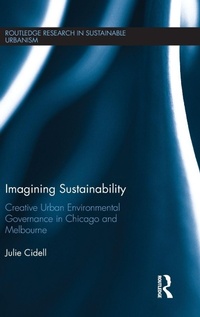
Imagining Sustainability
Creative urban environmental governance in Chicago and Melbourne
1st Edition
Published on 16. March 2017
Book
Hardback
174 pages
978-1-138-92607-3 (ISBN)
Description
Cities, rather than nations, have become the key sites for enacting environmental policies. This is due to the combination of growing urban populations and increased action on the part of local governments (generally attributed to national governments' failure to act on climate change).
Imagining Sustainability seeks to understand how actors in local government conceptualize sustainability and their role in producing it, and what difference that understanding makes to their physical, political, and social environments now and in the future. International comparisons can uncover new ideas and possibilities. Chicago and Melbourne are prime candidates for such a comparison: they are cities of the same age, they have similar historical trajectories as interior gateways followed by industrial growth and then deindustrialization, and they have demonstrated the same recent desire to be global champions of sustainability. Based on qualitative fieldwork in these two cities, this book uses Karen Barad's methodology of diffraction to read these case studies through each other. This methodology helps to understand not only what differences exist between these two places, but what effects those differences have on the urban environment.
This book will be of great interest to students and scholars of urban studies, urban planning and environmental policy and governance.
Imagining Sustainability seeks to understand how actors in local government conceptualize sustainability and their role in producing it, and what difference that understanding makes to their physical, political, and social environments now and in the future. International comparisons can uncover new ideas and possibilities. Chicago and Melbourne are prime candidates for such a comparison: they are cities of the same age, they have similar historical trajectories as interior gateways followed by industrial growth and then deindustrialization, and they have demonstrated the same recent desire to be global champions of sustainability. Based on qualitative fieldwork in these two cities, this book uses Karen Barad's methodology of diffraction to read these case studies through each other. This methodology helps to understand not only what differences exist between these two places, but what effects those differences have on the urban environment.
This book will be of great interest to students and scholars of urban studies, urban planning and environmental policy and governance.
More details
Series
Language
English
Place of publication
London
United Kingdom
Publishing group
Taylor & Francis Ltd
Target group
College/higher education
Illustrations
7 s/w Abbildungen, 6 s/w Photographien bzw. Rasterbilder, 1 s/w Tabelle
1 Tables, black and white; 6 Halftones, black and white; 7 Illustrations, black and white
Dimensions
Height: 240 mm
Width: 161 mm
Thickness: 14 mm
Weight
435 gr
ISBN-13
978-1-138-92607-3 (9781138926073)
Copyright in bibliographic data and cover images is held by Nielsen Book Services Limited or by the publishers or by their respective licensors: all rights reserved.
Schweitzer Classification
Other editions
Additional editions
Julie Cidell
Imagining Sustainability
Creative urban environmental governance in Chicago and Melbourne
Book
12/2018
1st Edition
Routledge
€70.90
Shipment within 15-20 days
Julie Cidell
Imagining Sustainability
Creative urban environmental governance in Chicago and Melbourne
E-Book
03/2017
Routledge
€64.49
Available for download
Julie Cidell
Imagining Sustainability
Creative urban environmental governance in Chicago and Melbourne
E-Book
03/2017
Routledge
€64.49
Available for download
Person
Julie L. Cidell is an Associate Professor of Geography & GIS at the University of Illinois, USA.
Content
Introduction: Environmental actors within local governance systems
The existing socio-environment
Envisioning the future through the sustainable imaginary
How the socio-environment is (re)produced
Conclusion
The existing socio-environment
Envisioning the future through the sustainable imaginary
How the socio-environment is (re)produced
Conclusion