

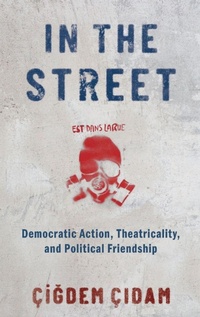
In the Street
Democratic Action, Theatricality, and Political Friendship
Published on 24. September 2021
Book
Hardback
264 pages
978-0-19-007168-4 (ISBN)
Description
If there is one thing that people agree about concerning the massive, leaderless, spontaneous protests that have spread across the globe over the past decade, it's that they were failures. The protesters, many claim, simply could not organize; nor could they formulate clear demands. As a result, they failed to bring about long-lasting change.
In the Street challenges this seemingly forgone conclusion. It argues that when analyses of such events are confined to a framework of success and failure, they lose sight of the on-the-ground efforts of political actors who demonstrate, if for a fleeting moment, that another way of being together is possible. The conception of democratic action developed here helps us see that events like Occupy Wall Street, the Gezi uprising, or the weeks-long protests that took place all around the US after George Floyd's killing by the police are best understood as democratic enactments created in and through "intermediating practices," which include contestation, deliberation, judging, negotiation, artistic production, and common use. Through these intermediating practices, people become "political friends"; they act in ways other than expected of them to reach out to others unlike themselves, establish relations with strangers, and constitute a common amidst disagreements. These democratic enactments are fleeting, but what remains in their aftermath are new political actors and innovative practices.
The book demonstrates that the current obsession with the "failure" of spontaneous protests is the outcome of a commonly accepted way of thinking about democratic action, which casts organization as a technical matter that precedes politics and moments of spontaneous popular action as sudden explosions. The origins of this widely shared understanding lie in Jean-Jacques Rousseau's conception of popular sovereignty, shaped by his rejection of theatricality and idealization of immediacy. Insofar as contemporary thinkers see democratic moments as the unmediated expressions of people's will and/or instantaneous eruptions, they, like Rousseau, reduce spontaneity to immediacy and erase the rich and creative practices of political actors. In the Street counters this Rousseauian influence by appropriating Aristotle's notion of "political friendship," and developing an alternative conceptualization of democratic action through a close reading of Antonio Negri, Juergen Habermas, and Jacques Ranciere and the global protests of 1968 that inspired these thinkers and their work.
In the Street challenges this seemingly forgone conclusion. It argues that when analyses of such events are confined to a framework of success and failure, they lose sight of the on-the-ground efforts of political actors who demonstrate, if for a fleeting moment, that another way of being together is possible. The conception of democratic action developed here helps us see that events like Occupy Wall Street, the Gezi uprising, or the weeks-long protests that took place all around the US after George Floyd's killing by the police are best understood as democratic enactments created in and through "intermediating practices," which include contestation, deliberation, judging, negotiation, artistic production, and common use. Through these intermediating practices, people become "political friends"; they act in ways other than expected of them to reach out to others unlike themselves, establish relations with strangers, and constitute a common amidst disagreements. These democratic enactments are fleeting, but what remains in their aftermath are new political actors and innovative practices.
The book demonstrates that the current obsession with the "failure" of spontaneous protests is the outcome of a commonly accepted way of thinking about democratic action, which casts organization as a technical matter that precedes politics and moments of spontaneous popular action as sudden explosions. The origins of this widely shared understanding lie in Jean-Jacques Rousseau's conception of popular sovereignty, shaped by his rejection of theatricality and idealization of immediacy. Insofar as contemporary thinkers see democratic moments as the unmediated expressions of people's will and/or instantaneous eruptions, they, like Rousseau, reduce spontaneity to immediacy and erase the rich and creative practices of political actors. In the Street counters this Rousseauian influence by appropriating Aristotle's notion of "political friendship," and developing an alternative conceptualization of democratic action through a close reading of Antonio Negri, Juergen Habermas, and Jacques Ranciere and the global protests of 1968 that inspired these thinkers and their work.
Reviews / Votes
In the Street expands our understanding of democracy, putting texts of political theory into an innovative conversation with the lived experience of citizens working to articulate opposition, express civic desires, and claim and occupy public space. By exploring how various subjects reconceptualize state power through mass action and by placing political friendship at the center of her analysis, Cidam reminds us that there is nothing futile about the shared struggle for a better world. * Cristina Beltran, New York University * Cigdem Cidam has written a brilliant analysis of democratic politics as spontaneous popular action, a hugely important-but far too rarely theorized-feature of protest politics. By means of insightful reinterpretations of a range of major political thinkers, along with careful attention to recent protest movements, Cidam's extraordinary study should be required reading for political theorists and philosophers, as well as scholars of protest politics and social movements. * William E. Scheuerman, Indiana University * We've heard it before from critics of popular uprisings: citizens must give up the vibrant spontaneity of street protests and adopt more durable forms of organization if they are to produce lasting 'results.' Using historical and contemporary examples, Cigdem Cidam expertly illuminates how this is a false choice. In the Street is an inspired guide to how political actors create bonds of commonality and equality among their ranks. Examining the art, rhetoric, and practices of protest, Cidam teaches readers how movements are reshaping our understanding of democracy today. * Ali Aslam, Mount Holyoke College * Cigdem Cidam's dazzling book shows how democratic theory's focus on the eruptive character of mass protests obscures the lived practices of activists that made those eruptions possible, in all of their messiness and conflict, and the lessons they can offer about the meaning of radical democracy today. Conceptually innovative and beautifully written, In the Street is a timely provocation to rethink the ways we talk about the praxis of protest. * Alexander Livingston, Cornell University *More details
Language
English
Place of publication
New York
United States
Target group
Professional and scholarly
Dimensions
Height: 240 mm
Width: 161 mm
Thickness: 19 mm
Weight
564 gr
ISBN-13
978-0-19-007168-4 (9780190071684)
Copyright in bibliographic data and cover images is held by Nielsen Book Services Limited or by the publishers or by their respective licensors: all rights reserved.
Schweitzer Classification
Other editions
Additional editions
E-Book
04/2021
1st Edition
OUP eBook
€43.49
Available for download
E-Book
04/2021
1st Edition
OUP eBook
€43.49
Available for download
Person
Cigdem Cidam is Associate Professor of Political Science at Union College.
Content
Acknowledgments
Prologue: Setting up the Stage: "Beauty is in the Street" in Istanbul
Chapter 1: Democratic Action, Spontaneity, and the Intermediating Practices of Political Friendship
Chapter 2: Jean-Jacques Rousseau: From the Unsettling Reality of the Theater to the Dream of Immediacy
Chapter 3: Antonio Negri: Insurgencies, the Multitude, and the Search for Permanence
Chapter 4: Juergen Habermas: Embracing Transience, Containing Unpredictability
Chapter 5: Jacques Ranciere: The Theatrical Paradigm and the Messiness of Democratic Politics
Chapter 6: Enacting Political Friendship in Gezi
Epilogue: Fanning the Spark of Hope
Prologue: Setting up the Stage: "Beauty is in the Street" in Istanbul
Chapter 1: Democratic Action, Spontaneity, and the Intermediating Practices of Political Friendship
Chapter 2: Jean-Jacques Rousseau: From the Unsettling Reality of the Theater to the Dream of Immediacy
Chapter 3: Antonio Negri: Insurgencies, the Multitude, and the Search for Permanence
Chapter 4: Juergen Habermas: Embracing Transience, Containing Unpredictability
Chapter 5: Jacques Ranciere: The Theatrical Paradigm and the Messiness of Democratic Politics
Chapter 6: Enacting Political Friendship in Gezi
Epilogue: Fanning the Spark of Hope