

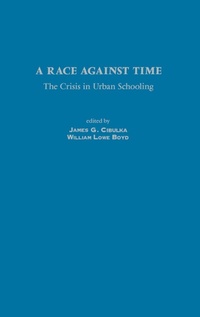
A Race Against Time
The Crisis in Urban Schooling
Published on 30. March 2003
Book
Hardback
272 pages
978-1-56750-640-2 (ISBN)
Description
We are in a race against time to save urban children from educational failure and to reform urban school systems before people give up on them. The authors examine the effectiveness of three reform approaches: systems reform, mayoral influence, and external state or federal intervention, using case studies from seven large cities, as well as state and national trends.
The social and economic transformation of large American cities after World War II laid the seeds for the crisis in urban education that has festered and grown since the 1950s. Decades of appalling test scores and failure rates, and of unsuccessful piecemeal efforts to improve urban education, have led the public and policymakers to embrace radical solutions to reform.
Three approaches to the reform of urban school governance are discussed and analyzed, using data from seven large cities (Baltimore, Boston, Chicago, Los Angeles, Philadelphia, Washington, D.C., and New York), national trends, and a statewide analysis of Maryland's school accountability system. The first approach, systems reform, focuses on improving the governance of urban education by overcoming policy fragmentation through standards for student performance, student assessments, and accountability, among other things. Strong mayoral roles offer a second reform approach that largely reverses the Progressive-era reforms of the last century separating schools from city politics. Its supporters believe urban mayors can restore accountability, stability, and political support for urban schools. The third reform approach assumes that external intervention by federal or state authorities is needed to restore accountability and improve system performance.
The social and economic transformation of large American cities after World War II laid the seeds for the crisis in urban education that has festered and grown since the 1950s. Decades of appalling test scores and failure rates, and of unsuccessful piecemeal efforts to improve urban education, have led the public and policymakers to embrace radical solutions to reform.
Three approaches to the reform of urban school governance are discussed and analyzed, using data from seven large cities (Baltimore, Boston, Chicago, Los Angeles, Philadelphia, Washington, D.C., and New York), national trends, and a statewide analysis of Maryland's school accountability system. The first approach, systems reform, focuses on improving the governance of urban education by overcoming policy fragmentation through standards for student performance, student assessments, and accountability, among other things. Strong mayoral roles offer a second reform approach that largely reverses the Progressive-era reforms of the last century separating schools from city politics. Its supporters believe urban mayors can restore accountability, stability, and political support for urban schools. The third reform approach assumes that external intervention by federal or state authorities is needed to restore accountability and improve system performance.
More details
Language
English
Place of publication
United States
Publishing group
Bloomsbury Publishing Plc
Target group
College/higher education
Dimensions
Height: 240 mm
Width: 161 mm
Thickness: 19 mm
Weight
567 gr
ISBN-13
978-1-56750-640-2 (9781567506402)
Copyright in bibliographic data and cover images is held by Nielsen Book Services Limited or by the publishers or by their respective licensors: all rights reserved.
Schweitzer Classification
Other editions
Additional editions
E-Book
03/2003
1st Edition
Praeger Publishers Inc
€82.99
Available for download
Persons
JAMES G. CIBULKA is Dean, College of Education, University of Kentucky. His research focuses on educational policy and politics, including urban education.
WILLIAM LOWE BOYD is Batschelet Chair Professor of Educational Administration and Professor-in-Charge of Graduate Programs in Educational Administration at Penn State University.
WILLIAM LOWE BOYD is Batschelet Chair Professor of Educational Administration and Professor-in-Charge of Graduate Programs in Educational Administration at Penn State University.
Content
Introduction Urban Education Reform: Competing Approaches by William Lowe Boyd and James G. Cibulka Systems Reforms of Urban School Systems Accountability at the Improv: Brief Sketches of School Reform in Los Angeles by Charles Taylor Kerchner and David Menefee-Libey Philadelphia's Children Achieving Initiative: The Promise and Challenge of Systemic Reform in an Urban School District by Jolley Bruce Christman, et al. Balancing Autonomy and Control in the New York City Public Schools: Using the Double ACE Model by Bruce D. Cooper and David C. Bloomfield Increasing Mayoral Influence Over Urban Schools Mayoral Takeover: The Different Directions Taken in Different Cities by Michael W. Kirst and Katrina E. Bulkley From Court Street to City Hall: Governance Change in the Boston Public Schools by Gary Yee Regime Change: Mayoral Takeover of the Chicago Public Schools by Dorothy Shipps Implementation of an Accountability Agenda in High Schools: Integrated Governance in the Chicago Public Schools by Kenneth K. Wong, et al. External Intervention to Improve Urban School Systems State and Federal Intervention to Improve Baltimore and Washington, D.C.,'s Public Schools by James G. Cibulka Conclusion Urban Education Reform Strategies: Comparative Analysis and Conclusions by James G. Cibulka and William Lowe Boyd References Index