

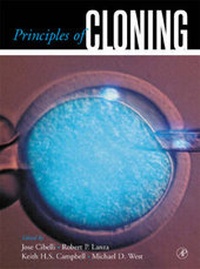
Principles of Cloning
Published on 14. September 2002
Book
Hardback
531 pages
978-0-12-174597-4 (ISBN)
Description
Principles of Cloning is the first comprehensive book on animal cloning since the creation of Dolly. The contributing authors are the principal investigators on each of the animal species cloned to date, and are expertly qualified to present the state-of-the-art information in their respective areas. Editors Cibelli, Lanza and West garnered worldwide spotlight late in 2001 when their company, Advanced Cell Technology, announced the successful engineering of the world's first cloned human embryo. The trio was featured in the US News & World Report December 2001 cover story, "The First Human Clone." The book presents the basic biological mechanisms of how cloning works and progresses to discuss current and potential applications in basic biology, agriculture, biotechnology, and medicine.
More details
Language
English
Place of publication
San Diego
United States
Publishing group
Elsevier Science Publishing Co Inc
Target group
Professional and scholarly
Dimensions
Height: 279 mm
Width: 216 mm
Weight
1590 gr
ISBN-13
978-0-12-174597-4 (9780121745974)
Copyright in bibliographic data and cover images is held by Nielsen Book Services Limited or by the publishers or by their respective licensors: all rights reserved.
Schweitzer Classification
Other editions
New editions
Jose Cibelli | Ian Wilmut | Rudolf Jaenisch
Principles of Cloning
Book
11/2013
2nd Edition
Academic Press
€230.50
Shipment within 15-20 days
Additional editions
Jose Cibelli | Robert P. Lanza | Keith Campbell
Principles of Cloning
E-Book
09/2002
1st Edition
Academic Press
€200.00
Available for download

Jose Cibelli | R. P. Lanza | Keith Campbell
Principles of Cloning
Book
08/2002
Academic Press
€245.12
Shipment within 15-20 days
Persons
Dr. Cibelli is Professor of Animal Biotechnology at Michigan State University. He heads the Cellular Reprogramming Laboratory in the Departments of Animal Science and Physiology since 2003. From 2010 to 2017 he was also the Scientific Director of LARCel, a laboratory of cellular reprogramming dedicated to generating human pluripotent cells under GMP conditions for preclinical studies in Andalucia, Spain. Dr. Cibelli is internationally recognized as one of the pioneers in the area of cellular reprogramming using oocyte-driven protocols. Dr. Cibelli together with his colleagues, were responsible for the generation of the world's first transgenic cloned calves, the first stem cells by nuclear transfer in bovine, the first embryonic stem cells by parthenogenesis in primates and the generation of the first cell line of iPSCs using oocyte factors alone. His work has been published un numerous scientific journals including Science, Nature Biotechnology, Nature Medicine, Nature Methods, PNAS, Cell Stem Cell and JAMA. Robert Lanza is an American scientist and author whose research spans the range of natural science, from biology to theoretical physics. TIME magazine recognized him as one of the "100 Most Influential People in the World,? and Prospect magazine named him one of the Top 50 "World Thinkers.? He has hundreds of scientific publications and over 30 books, including definitive references in the fields of stem cells, tissue engineering, and regenerative medicine. He's a former Fulbright Scholar and studied with polio-pioneer Jonas Salk and Nobel laureates Gerald Edelman (known for his work on the biological basis of consciousness) and Rodney Porter. He also worked closely (and co-authored papers in Science on self-awareness and symbolic communication) with noted Harvard psychologist BF Skinner. Dr. Lanza was part of the team that cloned the world's first human embryo, the first endangered species, and published the first-ever reports of pluripotent stem cell use in humans.
Content
List of Contributors.
Preface.
Introduction.
Historical Perspective.
PART ONE-BASIC BIOLOGICAL PROCESES
Activation of Mammalian Oocytes.
The Nucleus.
Nuclear Reprogramming: Biological and Technological Constraints.
Plasticity of somatic nucleus by epigenetic reprogramming via cell Hybridization.
Cell Cycle.
Determinants of Pluripotency in Mammals.
Cloning and Aging.
PART TWO-METHODS
Micromanipulation Techniques for Cloning.
Microinsemination and Nuclear Transfer with Male Germ Cells.
Development of viable mammalian embryos in vitro: Evolution of sequential media.
Genetic and Phenotypic Similarity Among Members of Mammalian Clonal Sets.
Genetic Modification and Cloning in Mammals.
Pregnancy and Neonatal Care of Clone Animals.
Donor Cell Type and Cloning Efficiency in Mammals.
PART THREE-CLONING BY SPECIES
The Cloning of Amphibians.
Cloning of Fish.
Cloning of Mice.
Cloning of Rabbits.
Nuclear Transfer in Swine.
Cloning of Cattle.
Cloning of Sheep.
Cloning of Goats.
PART FOUR-CURRENTLY SOUGHT AFTER SPECIES
Cloning of Endangered Species.
Cloning of Rats.
PART FIVE-NUCLEAR TRANSFER IN PRIMATES
Cloning in Non-Human Primates.
PART SIX-APPLICATIONS
Nuclear Transfer for Stem Cells (CRNT).
Current Research and Commercial Applications of Cloning Technology.
Transgenic Cloned Goats and the Production of Therapeutic Proteins.
PART SEVEN-ETHICAL AND LEGAL AFFAIRS
Ethical Implications of Cloning.
FINAL REMARKS
Mammalian Cloning- Challenges for the Future.
Preface.
Introduction.
Historical Perspective.
PART ONE-BASIC BIOLOGICAL PROCESES
Activation of Mammalian Oocytes.
The Nucleus.
Nuclear Reprogramming: Biological and Technological Constraints.
Plasticity of somatic nucleus by epigenetic reprogramming via cell Hybridization.
Cell Cycle.
Determinants of Pluripotency in Mammals.
Cloning and Aging.
PART TWO-METHODS
Micromanipulation Techniques for Cloning.
Microinsemination and Nuclear Transfer with Male Germ Cells.
Development of viable mammalian embryos in vitro: Evolution of sequential media.
Genetic and Phenotypic Similarity Among Members of Mammalian Clonal Sets.
Genetic Modification and Cloning in Mammals.
Pregnancy and Neonatal Care of Clone Animals.
Donor Cell Type and Cloning Efficiency in Mammals.
PART THREE-CLONING BY SPECIES
The Cloning of Amphibians.
Cloning of Fish.
Cloning of Mice.
Cloning of Rabbits.
Nuclear Transfer in Swine.
Cloning of Cattle.
Cloning of Sheep.
Cloning of Goats.
PART FOUR-CURRENTLY SOUGHT AFTER SPECIES
Cloning of Endangered Species.
Cloning of Rats.
PART FIVE-NUCLEAR TRANSFER IN PRIMATES
Cloning in Non-Human Primates.
PART SIX-APPLICATIONS
Nuclear Transfer for Stem Cells (CRNT).
Current Research and Commercial Applications of Cloning Technology.
Transgenic Cloned Goats and the Production of Therapeutic Proteins.
PART SEVEN-ETHICAL AND LEGAL AFFAIRS
Ethical Implications of Cloning.
FINAL REMARKS
Mammalian Cloning- Challenges for the Future.