

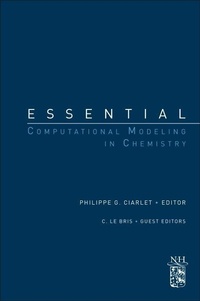
Essential Computational Modeling in Chemistry
A Derivative of Handbook of Numerical Analysis Special Volume: Computation Chemistry, Volume 10
Published on 7. December 2010
Book
Paperback/Softback
400 pages
978-0-444-53754-6 (ISBN)
Description
Essential Computational Modeling in Chemistry presents key contributions selected from the volume in the Handbook of Numerical Analysis: Computational Modeling in Chemistry Vol. 10(2005).
Computational Modeling is an active field of scientific computing at the crossroads between Physics, Chemistry, Applied Mathematics and Computer Science. Sophisticated mathematical models are increasingly complex and extensive computer simulations are on the rise. Numerical Analysis and scientific software have emerged as essential steps for validating mathematical models and simulations based on these models. This guide provides a quick reference of computational methods for use in understanding chemical reactions and how to control them. By demonstrating various computational methods in research, scientists can predict such things as molecular properties. The reference offers a number of techniques and the numerical analysis needed to perform rigorously founded computations.
Computational Modeling is an active field of scientific computing at the crossroads between Physics, Chemistry, Applied Mathematics and Computer Science. Sophisticated mathematical models are increasingly complex and extensive computer simulations are on the rise. Numerical Analysis and scientific software have emerged as essential steps for validating mathematical models and simulations based on these models. This guide provides a quick reference of computational methods for use in understanding chemical reactions and how to control them. By demonstrating various computational methods in research, scientists can predict such things as molecular properties. The reference offers a number of techniques and the numerical analysis needed to perform rigorously founded computations.
More details
Language
English
Place of publication
United States
Publishing group
Elsevier Science & Technology
Target group
Professional and scholarly
Scientists, Engineers, Computational Biologists, Medical Researchers, Computational Physicists, Biophysicists, Bioinformatics Specialists, Computational Chemists and other Biological or Behavioral Science Researchers who need to understand numerical techniques for various systems and applications.
Product notice
Paperback (trade)
Unsewn / adhesive bound
Illustrations
Approx. 102 illustrations (2 in full color)
Dimensions
Height: 236 mm
Width: 165 mm
Thickness: 20 mm
Weight
617 gr
ISBN-13
978-0-444-53754-6 (9780444537546)
Copyright in bibliographic data and cover images is held by Nielsen Book Services Limited or by the publishers or by their respective licensors: all rights reserved.
Schweitzer Classification
Other editions
Additional editions
Philippe G. Ciarlet
Essential Computational Modeling in Chemistry
E-Book
12/2010
Elsevier
€60.95
Available for download
Person
Content
1. The modeling and simulation of the liquid phase;
2. Computational approaches of relativistic models in quantum chemistry;
3. Quantum Monte Carlo methods for the solution of the Schroedinger equation for molecular systems;
4. Finite difference methods for ab initio electronic structure and quantum transport calculations of nanostructures;
5. Simulating chemical reactions in complex systems;
6. Biomolecular conformations can be identified as metastable sets of molecular dynamics;
7. Numerical methods for molecular time-dependent schroedinger equations - bridging the perturbative to nonperturbative regime;
8. Control of quantum dynamics: Concepts, procedures and future prospects;
2. Computational approaches of relativistic models in quantum chemistry;
3. Quantum Monte Carlo methods for the solution of the Schroedinger equation for molecular systems;
4. Finite difference methods for ab initio electronic structure and quantum transport calculations of nanostructures;
5. Simulating chemical reactions in complex systems;
6. Biomolecular conformations can be identified as metastable sets of molecular dynamics;
7. Numerical methods for molecular time-dependent schroedinger equations - bridging the perturbative to nonperturbative regime;
8. Control of quantum dynamics: Concepts, procedures and future prospects;