

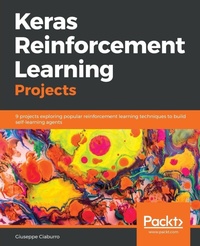
Keras Reinforcement Learning Projects
9 projects exploring popular reinforcement learning techniques to build self-learning agents
Published on 29. September 2018
Book
Paperback/Softback
288 pages
978-1-78934-209-3 (ISBN)
Description
A practical guide to mastering reinforcement learning algorithms using Keras
Key Features
Build projects across robotics, gaming, and finance fields, putting reinforcement learning (RL) into action
Get to grips with Keras and practice on real-world unstructured datasets
Uncover advanced deep learning algorithms such as Monte Carlo, Markov Decision, and Q-learning
Book DescriptionReinforcement learning has evolved a lot in the last couple of years and proven to be a successful technique in building smart and intelligent AI networks. Keras Reinforcement Learning Projects installs human-level performance into your applications using algorithms and techniques of reinforcement learning, coupled with Keras, a faster experimental library.
The book begins with getting you up and running with the concepts of reinforcement learning using Keras. You'll learn how to simulate a random walk using Markov chains and select the best portfolio using dynamic programming (DP) and Python. You'll also explore projects such as forecasting stock prices using Monte Carlo methods, delivering vehicle routing application using Temporal Distance (TD) learning algorithms, and balancing a Rotating Mechanical System using Markov decision processes.
Once you've understood the basics, you'll move on to Modeling of a Segway, running a robot control system using deep reinforcement learning, and building a handwritten digit recognition model in Python using an image dataset. Finally, you'll excel in playing the board game Go with the help of Q-Learning and reinforcement learning algorithms.
By the end of this book, you'll not only have developed hands-on training on concepts, algorithms, and techniques of reinforcement learning but also be all set to explore the world of AI.
What you will learn
Practice the Markov decision process in prediction and betting evaluations
Implement Monte Carlo methods to forecast environment behaviors
Explore TD learning algorithms to manage warehouse operations
Construct a Deep Q-Network using Python and Keras to control robot movements
Apply reinforcement concepts to build a handwritten digit recognition model using an image dataset
Address a game theory problem using Q-Learning and OpenAI Gym
Who this book is forKeras Reinforcement Learning Projects is for you if you are data scientist, machine learning developer, or AI engineer who wants to understand the fundamentals of reinforcement learning by developing practical projects. Sound knowledge of machine learning and basic familiarity with Keras is useful to get the most out of this book
Key Features
Build projects across robotics, gaming, and finance fields, putting reinforcement learning (RL) into action
Get to grips with Keras and practice on real-world unstructured datasets
Uncover advanced deep learning algorithms such as Monte Carlo, Markov Decision, and Q-learning
Book DescriptionReinforcement learning has evolved a lot in the last couple of years and proven to be a successful technique in building smart and intelligent AI networks. Keras Reinforcement Learning Projects installs human-level performance into your applications using algorithms and techniques of reinforcement learning, coupled with Keras, a faster experimental library.
The book begins with getting you up and running with the concepts of reinforcement learning using Keras. You'll learn how to simulate a random walk using Markov chains and select the best portfolio using dynamic programming (DP) and Python. You'll also explore projects such as forecasting stock prices using Monte Carlo methods, delivering vehicle routing application using Temporal Distance (TD) learning algorithms, and balancing a Rotating Mechanical System using Markov decision processes.
Once you've understood the basics, you'll move on to Modeling of a Segway, running a robot control system using deep reinforcement learning, and building a handwritten digit recognition model in Python using an image dataset. Finally, you'll excel in playing the board game Go with the help of Q-Learning and reinforcement learning algorithms.
By the end of this book, you'll not only have developed hands-on training on concepts, algorithms, and techniques of reinforcement learning but also be all set to explore the world of AI.
What you will learn
Practice the Markov decision process in prediction and betting evaluations
Implement Monte Carlo methods to forecast environment behaviors
Explore TD learning algorithms to manage warehouse operations
Construct a Deep Q-Network using Python and Keras to control robot movements
Apply reinforcement concepts to build a handwritten digit recognition model using an image dataset
Address a game theory problem using Q-Learning and OpenAI Gym
Who this book is forKeras Reinforcement Learning Projects is for you if you are data scientist, machine learning developer, or AI engineer who wants to understand the fundamentals of reinforcement learning by developing practical projects. Sound knowledge of machine learning and basic familiarity with Keras is useful to get the most out of this book
More details
Language
English
Place of publication
Birmingham
United Kingdom
Dimensions
Height: 235 mm
Width: 191 mm
Thickness: 16 mm
Weight
501 gr
ISBN-13
978-1-78934-209-3 (9781789342093)
Copyright in bibliographic data and cover images is held by Nielsen Book Services Limited or by the publishers or by their respective licensors: all rights reserved.
Schweitzer Classification
Other editions
Additional editions
Giuseppe Ciaburro | Sudharsan Ravichandiran | Suriyadeepan Ramamoorthy
Keras Reinforcement Learning Projects
9 projects exploring popular reinforcement learning techniques to build self-learning agents
E-Book
09/2024
1st Edition
Packt Publishing Limited
€38.99
Available for download
Persons
Giuseppe Ciaburro holds a PhD and two master's degrees. He works at the Built Environment Control Laboratory - Universita degli Studi della Campania "Luigi Vanvitelli". He has over 25 years of work experience in programming, first in the field of combustion and then in acoustics and noise control. His core programming knowledge is in MATLAB, Python and R. As an expert in AI applications to acoustics and noise control problems, Giuseppe has wide experience in researching and teaching. He has several publications to his credit: monographs, scientific journals, and thematic conferences. He was recently included in the world's top 2% scientists list by Stanford University (2022). Sudharsan Ravichandiran is a data scientist and artificial intelligence enthusiast. He holds a Bachelors in Information Technology from Anna University. His area of research focuses on practical implementations of deep learning and reinforcement learning including natural language processing and computer vision. He is an open-source contributor and loves answering questions on Stack Overflow. Suriyadeepan Ramamoorthy is a machine learning engineer from Puducherry. His research focuses on interpretability, uncertainty, and reasoning. At Saama Research Lab, he applies NLU and reinforcement learning techniques, to optimize the clinical trial process. He actively blogs about advances in deep learning. He is a free-software evangelist who is involved in community development activities at FSHM, Puducherry. Community networks, data visualization, and creative coding are some of his other notable pursuits.
Content
Table of Contents
Overview of Keras Reinforcement Learning
Simulating random walks
Optimal Portfolio Selection
Forecasting stock market prices
Delivery Vehicle Routing Application
Prediction and Betting Evaluations of coin flips using Markov decision processes
Build an optimized vending machine using Dynamic Programming
Robot control system using Deep Reinforcement Learning
Handwritten Digit Recognizer
Playing the board game Go
What is next?
Overview of Keras Reinforcement Learning
Simulating random walks
Optimal Portfolio Selection
Forecasting stock market prices
Delivery Vehicle Routing Application
Prediction and Betting Evaluations of coin flips using Markov decision processes
Build an optimized vending machine using Dynamic Programming
Robot control system using Deep Reinforcement Learning
Handwritten Digit Recognizer
Playing the board game Go
What is next?