

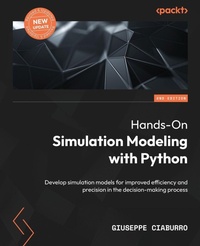
Hands-On Simulation Modeling with Python
Develop simulation models for improved efficiency and precision in the decision-making process, 2nd Edition
2nd Edition
Published on 30. November 2022
Book
Paperback/Softback
460 pages
978-1-80461-688-8 (ISBN)
Description
Learn to construct state-of-the-art simulation models with Python and enhance your simulation modelling skills, as well as create and analyze digital prototypes of physical models with ease
Key Features
Understand various statistical and physical simulations to improve systems using Python
Learn to create the numerical prototype of a real model using hands-on examples
Evaluate performance and output results based on how the prototype would work in the real world
Book DescriptionSimulation modelling is an exploration method that aims to imitate physical systems in a virtual environment and retrieve useful statistical inferences from it. The ability to analyze the model as it runs sets simulation modelling apart from other methods used in conventional analyses. This book is your comprehensive and hands-on guide to understanding various computational statistical simulations using Python. The book begins by helping you get familiarized with the fundamental concepts of simulation modelling, that'll enable you to understand the various methods and techniques needed to explore complex topics. Data scientists working with simulation models will be able to put their knowledge to work with this practical guide. As you advance, you'll dive deep into numerical simulation algorithms, including an overview of relevant applications, with the help of real-world use cases and practical examples. You'll also find out how to use Python to develop simulation models and how to use several Python packages. Finally, you'll get to grips with various numerical simulation algorithms and concepts, such as Markov Decision Processes, Monte Carlo methods, and bootstrapping techniques.
By the end of this book, you'll have learned how to construct and deploy simulation models of your own to overcome real-world challenges.
What you will learn
Get to grips with the concept of randomness and the data generation process
Delve into resampling methods
Discover how to work with Monte Carlo simulations
Utilize simulations to improve or optimize systems
Find out how to run efficient simulations to analyze real-world systems
Understand how to simulate random walks using Markov chains
Who this book is forThis book is for data scientists, simulation engineers, and anyone who is already familiar with the basic computational methods and wants to implement various simulation techniques such as Monte-Carlo methods and statistical simulation using Python.
Key Features
Understand various statistical and physical simulations to improve systems using Python
Learn to create the numerical prototype of a real model using hands-on examples
Evaluate performance and output results based on how the prototype would work in the real world
Book DescriptionSimulation modelling is an exploration method that aims to imitate physical systems in a virtual environment and retrieve useful statistical inferences from it. The ability to analyze the model as it runs sets simulation modelling apart from other methods used in conventional analyses. This book is your comprehensive and hands-on guide to understanding various computational statistical simulations using Python. The book begins by helping you get familiarized with the fundamental concepts of simulation modelling, that'll enable you to understand the various methods and techniques needed to explore complex topics. Data scientists working with simulation models will be able to put their knowledge to work with this practical guide. As you advance, you'll dive deep into numerical simulation algorithms, including an overview of relevant applications, with the help of real-world use cases and practical examples. You'll also find out how to use Python to develop simulation models and how to use several Python packages. Finally, you'll get to grips with various numerical simulation algorithms and concepts, such as Markov Decision Processes, Monte Carlo methods, and bootstrapping techniques.
By the end of this book, you'll have learned how to construct and deploy simulation models of your own to overcome real-world challenges.
What you will learn
Get to grips with the concept of randomness and the data generation process
Delve into resampling methods
Discover how to work with Monte Carlo simulations
Utilize simulations to improve or optimize systems
Find out how to run efficient simulations to analyze real-world systems
Understand how to simulate random walks using Markov chains
Who this book is forThis book is for data scientists, simulation engineers, and anyone who is already familiar with the basic computational methods and wants to implement various simulation techniques such as Monte-Carlo methods and statistical simulation using Python.
More details
Edition
2nd Revised edition
Language
English
Place of publication
Birmingham
United Kingdom
Target group
Professional and scholarly
Edition type
Revised edition
Dimensions
Height: 235 mm
Width: 191 mm
Thickness: 25 mm
Weight
852 gr
ISBN-13
978-1-80461-688-8 (9781804616888)
Copyright in bibliographic data and cover images is held by Nielsen Book Services Limited or by the publishers or by their respective licensors: all rights reserved.
Schweitzer Classification
Other editions
Additional editions
Giuseppe Ciaburro
Hands-On Simulation Modeling with Python,
Develop simulation models for improved efficiency and precision in the decision-making process
E-Book
05/2024
2nd Edition
Packt Publishing Limited
from
€35.99
Available for download
Person
Giuseppe Ciaburro holds a PhD in environmental technical physics, along with two master's degrees holds a master's degree in chemical engineering from Universita degli Studi di Napoli Federico II, and a master's degreeand in acoustic and noise control from Seconda Universita degli Studi di Napoli. He works at the Built Environment Control Laboratory - Universita degli Studi della Campania "Luigi Vanvitelli".He has over 15 20 years of work experience in programming, first in the field of combustion and then in acoustics and noise control. His core programming knowledge is in Python and R, and he has extensive experience of working with MATLAB. An expert in acoustics and noise control, Giuseppe has wide experience in teaching professional computer ITC courses (about 15 20 years), dealing with e-learning as an author. He has several publications to his credit: monographs, scientific journals, and thematic conferences. He is currently researching machine learning applications in acoustics and noise control. He was recently included in the world's top 2% scientists list by Stanford University.
Content
Table of Contents
Introducing simulation models
Understanding Randomness and Random Numbers
Probability and Data Generating Process
Working with Monte Carlo Simulations
Simulation-Based Markov Decision Process
Resampling methods
Improving and optimizing systems
Introducing evolutionary systems
Simulation models for Financial Engineering
Simulating Physical Phenomena by Neural Networks
Modeling and Simulation for Project Management
Simulation Model for Fault Diagnosis in dynamic system
What is next?
Introducing simulation models
Understanding Randomness and Random Numbers
Probability and Data Generating Process
Working with Monte Carlo Simulations
Simulation-Based Markov Decision Process
Resampling methods
Improving and optimizing systems
Introducing evolutionary systems
Simulation models for Financial Engineering
Simulating Physical Phenomena by Neural Networks
Modeling and Simulation for Project Management
Simulation Model for Fault Diagnosis in dynamic system
What is next?