

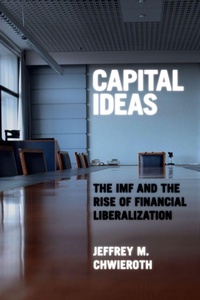
Capital Ideas
The IMF and the Rise of Financial Liberalization
Will be published approx. on 3. January 2010
Book
Paperback/Softback
352 pages
978-0-691-14232-6 (ISBN)
Description
The right of governments to employ capital controls has always been the official orthodoxy of the International Monetary Fund, and the organization's formal rules providing this right have not changed significantly since the IMF was founded in 1945. But informally, among the staff inside the IMF, these controls became heresy in the 1980s and 1990s, prompting critics to accuse the IMF of indiscriminately encouraging the liberalization of controls and precipitating a wave of financial crises in emerging markets in the late 1990s. In Capital Ideas, Jeffrey Chwieroth explores the inner workings of the IMF to understand how its staff's thinking about capital controls changed so radically. In doing so, he also provides an important case study of how international organizations work and evolve. Drawing on original survey and archival research, extensive interviews, and scholarship from economics, politics, and sociology, Chwieroth traces the evolution of the IMF's approach to capital controls from the 1940s through spring 2009 and the first stages of the subprime credit crisis.
He shows that IMF staff vigorously debated the legitimacy of capital controls and that these internal debates eventually changed the organization's behavior--despite the lack of major rule changes. He also shows that the IMF exercised a significant amount of autonomy despite the influence of member states. Normative and behavioral changes in international organizations, Chwieroth concludes, are driven not just by new rules but also by the evolving makeup, beliefs, debates, and strategic agency of their staffs.
He shows that IMF staff vigorously debated the legitimacy of capital controls and that these internal debates eventually changed the organization's behavior--despite the lack of major rule changes. He also shows that the IMF exercised a significant amount of autonomy despite the influence of member states. Normative and behavioral changes in international organizations, Chwieroth concludes, are driven not just by new rules but also by the evolving makeup, beliefs, debates, and strategic agency of their staffs.
Reviews / Votes
"This book ... usefully traces the evolution of the thinking about this issue at the International Monetary Fund, the international body most concerned with it."--Foreign Affairs "Combining archival research, interviews, and his own survey research, [Chwieroth] provides a compelling history of how the IMF gradually changed from supporting capital controls to opposing them... Chwieroth's work fills an important void in the literature."--Choice "This is a fascinating book... Every economist with an interest in international finance would learn from reading this book, and would enjoy doing so."--Geoffrey Wood, Journal of Financial History Review "Jeffrey M. Chwieroth provides the best inside view of the international organization that an outsider can offer... More organizational behavior than international economics, Capital Ideas is an important contribution to the literature on IO governance."--Anthony Clark, Journal of International and Global Studies "How do ideas travel and become shared beliefs? Or, more worryingly, how do 'causal beliefs become hardened into articles of faith' (p. 47)? And how do beliefs get turned into policies? In this intelligent, well-researched and thought-provoking book Jeffrey Chwieroth addresses these questions, using the IMF's approach to capital account liberalization as a case study... Capital Ideas is a truly multidisciplinary book whose author draws on economics, international political economy and sociology to explore how an organization fosters, promotes and disseminates ideas."--Paola Subacchi, International Affairs "[Capital Ideas] is an absorbing narrative of the varying IMF's intellectual processes at work. Many may find it academic in approach--and it is. Nevertheless, the book is an important read for those who wish to understand our economic environment to be better masters of our own destiny."--Srikanth Srinivas, Businessworld "All in all, the book offers a comprehensive explanation of the international financial flow: mechanisms, institutions, causes and effects... [I]ts language is clear and accessible to all."--Rodica Milena Zaharia, European Legacy "Chwieroth's book is captivating and persuasive because of a rare combination of interviews with former IMF staff, archival research, and original survey evidence, with an impressive overview of a diverse secondary literature."--Cristina Bodea, Perspectives on PoliticsMore details
Language
English
Place of publication
New Jersey
United States
Target group
College/higher education
Professional and scholarly
Product notice
Paperback (trade)
Illustrations
1 line illus. 6 tables.
Dimensions
Height: 234 mm
Width: 156 mm
Thickness: 20 mm
Weight
567 gr
ISBN-13
978-0-691-14232-6 (9780691142326)
Copyright in bibliographic data and cover images is held by Nielsen Book Services Limited or by the publishers or by their respective licensors: all rights reserved.
Schweitzer Classification
Other editions
Additional editions
Book
01/2010
Princeton University Press
€103.99
Article exhausted; check different version
E-Book
12/2009
1st Edition
Princeton University Press
€66.49
Available for download
Person
Jeffrey M. Chwieroth is senior lecturer in the Department of International Relations at the London School of Economics and Political Science.
Content
List of Figures and Tables ix Preface xi List of Abbreviations xvii CHAPTER ONE: Introduction 1 CHAPTER TWO: Normative Change from Within 23 CHAPTER THREE: Capital Ideas and Capital Controls 61 CHAPTER FOUR: Capital Controlled: The Early Postwar Era 105 CHAPTER FIVE: The Limits and Hollowness of Keynesianism in the 1960s 121 CHAPTER SIX: Formal Change and Informal Continuity: The Reform Negotiations of the 1970s 138 CHAPTER SEVEN: Capital Freed: Informal Change from the 1980s to the Mid-1990s 147 CHAPTER EIGHT: Capital in Crisis: Financial Turmoil in the Late 1990s 187 CHAPTER NINE: Norm Continuity and Organizational Legitimacy from the Asian Crisis to the Subprime Crisis 226 EPILOGUE: A Subprime "Crisis" for Capital Freedom? 255 Index 301