

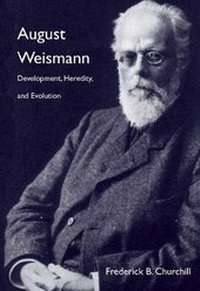
August Weismann
Development, Heredity, and Evolution
Will be published approx. on 9. June 2015
Book
Hardback
720 pages
978-0-674-73689-4 (ISBN)
Description
The evolutionist Ernst Mayr considered August Weismann "one of the great biologists of all time." Yet the man who formulated the germ plasm theory-that inheritance is transmitted solely through the nuclei of the egg and sperm cells-has not received an in-depth historical examination. August Weismann reintroduces readers to a towering figure in the life sciences. In this first full-length biography, Frederick Churchill situates Weismann in the swirling intellectual currents of his era and demonstrates how his work paved the way for the modern synthesis of genetics and evolution in the twentieth century.
In 1859 Darwin's tantalizing new idea stirred up a great deal of activity and turmoil in the scientific world, to a large extent because the underlying biological mechanisms of evolution through natural selection had not yet been worked out. Weismann's achievement was to unite natural history, embryology, and cell biology under the capacious dome of evolutionary theory. In his major work on the germ plasm (1892), which established the material basis of heredity in the "germ cells," Weismann delivered a crushing blow to Lamarck's concept of the inheritance of acquired traits.
In this deeply researched biography, Churchill explains the development of Weismann's pioneering work based on cytology and embryology and opens up an expanded history of biology from 1859 to 1914. August Weismann is sure to become the definitive account of an extraordinary life and career.
In 1859 Darwin's tantalizing new idea stirred up a great deal of activity and turmoil in the scientific world, to a large extent because the underlying biological mechanisms of evolution through natural selection had not yet been worked out. Weismann's achievement was to unite natural history, embryology, and cell biology under the capacious dome of evolutionary theory. In his major work on the germ plasm (1892), which established the material basis of heredity in the "germ cells," Weismann delivered a crushing blow to Lamarck's concept of the inheritance of acquired traits.
In this deeply researched biography, Churchill explains the development of Weismann's pioneering work based on cytology and embryology and opens up an expanded history of biology from 1859 to 1914. August Weismann is sure to become the definitive account of an extraordinary life and career.
Reviews / Votes
We come away from this monumental study with a much greater appreciation of this biologist, and an understanding of why [Ernst] Mayr designated him 'one of the great biologists of all time.' -- W. F. Bynum * Times Literary Supplement * A monumental study of an important but surprisingly little-studied biologist, August Weismann represents half a century of scholarly investment by historian of science Frederick Churchill... That anybody can write this kind of book these days is awe-inspiring. -- Jane Maienschein * Nature * [A] magisterial biography... It is hard to imagine a better match than between the late Frederick Churchill and the object of his lifelong affection... Will be the definitive biography of August Weismann for decades to come. -- Manfred D. Laubichler * Isis * Those who know the topic that science historian Churchill has been working on these past years have eagerly awaited this definitive biography of August Weismann (1834-1914), whose germ layer of heredity revolutionized the understanding of organismal evolution... The present book places Weismann at the center of the fields of heredity, evolution, and embryonic development, fields that dominated both late-19th- and late-20th-century biology. The scholarship is rock solid, the writing smooth as silk, and the importance of the book central to the flow of the intellectual history of natural science and society. Unreservedly recommended. -- B. K. Hall * Choice * This will be considered the definitive scientific biography of August Weismann, as well as a brilliant account of the golden age of embryology. -- Paul Farber, Distinguished Professor Emeritus, Oregon State University A courageous, meticulous study of a major figure. Churchill shows how Weismann turned from his study of natural history and butterflies to provide the grounding for our understanding of chromosomes and germ lines. A truly impressive volume. -- Jane Maienschein, author of <i>Whose View of Life?</i> and <i>Embryos under the Microscope</i>More details
Language
English
Place of publication
Cambridge, Mass
United States
Illustrations
16 color illustrations, 26 halftones
Dimensions
Height: 235 mm
Width: 162 mm
Thickness: 38 mm
Weight
771 gr
ISBN-13
978-0-674-73689-4 (9780674736894)
Copyright in bibliographic data and cover images is held by Nielsen Book Services Limited or by the publishers or by their respective licensors: all rights reserved.
Schweitzer Classification
Other editions
Additional editions
Frederick B. Churchill
August Weismann
E-Book
06/2015
1st Edition
Harvard University Press
€48.04
Available for download
Person
Frederick B. Churchill was Emeritus Professor of History and Philosophy of Science at Indiana University, Bloomington.