

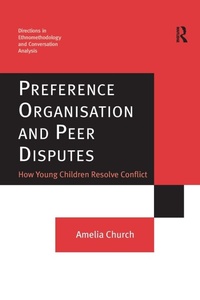
Preference Organisation and Peer Disputes
How Young Children Resolve Conflict
1st Edition
Published on 11. November 2016
Book
Paperback/Softback
292 pages
978-1-138-25531-9 (ISBN)
Description
How do children get their own way in arguments? What is the most effective way of pursuing one's own goals in preschool? 'Use your words' is an instruction frequently heard in nurseries and pre-schools encouraging young children to resolve the situation through verbal rather than physical means. Discourse is seen as the solution, yet, what words are the children supposed to use, and how do they go about resolving disputes? This fascinating book offers a conversation analysis of children's arguments, revealing disputing as a highly ordered, rule-governed activity, even amongst very young children. The author provides a rich theoretical discussion of the work in speech acts and conversational analysis, whilst offering a sophisticated review in relation to children's culture. It will be of great interest to conversation analysts within sociology and linguistics, as well as to educationalists and scholars of childhood.
Reviews / Votes
'A major advance in our emerging understanding of children's adversative discourse. This scholarly and engaging book highlights key findings on the nature of children's arguments, threats, and responses to potential conflict in detail. We see how children learn the skills necessary for overcoming emotionally charged conflict, gradually employing those conversational resources central to "face management" in talk-in-interaction. In doing so, Amelia Church makes a major contribution to the study of children's conversational skills.' Mike Forrester, University of Kent, UK 'This engaging and thought provoking study of preference organisation in young children's peer disputes offers fresh insights into how children engage in adversative talk and interaction in the preschool classroom. The study challenges traditional adult-held views about how children should act and shows how even very young children pursue their own political agendas. The book makes a substantial contribution to studies of child-child communication, childhood and institutional talk.' Susan Danby, Queensland University of Technology, AustraliaMore details
Series
Language
English
Place of publication
London
United Kingdom
Publishing group
Taylor & Francis Ltd
Target group
College/higher education
Dimensions
Height: 234 mm
Width: 156 mm
Thickness: 16 mm
Weight
450 gr
ISBN-13
978-1-138-25531-9 (9781138255319)
Copyright in bibliographic data and cover images is held by Nielsen Book Services Limited or by the publishers or by their respective licensors: all rights reserved.
Schweitzer Classification
Other editions
Additional editions
E-Book
03/2016
Routledge
€72.49
Available for download
E-Book
03/2016
Routledge
€72.49
Available for download
Book
03/2009
1st Edition
Routledge
€231.20
Shipment within 10-20 days
Person
Dr Amelia Church is Lecturer in Education at the University of Melbourne, Australia. She was previously Lecturer in Childhood Studies at the University of Wales, Swansea. She has worked as Research Fellow at the Education Foundation and the Schools Innovation Commission in Victoria, Australia, and is a conbritutor to the Longitudinal Study of Australian Children, an ongoing project at the Australian Institute of Family Studies.
Content
Chapter 1 Introduction; Chapter 2 Defining Child Conflict; Chapter 3 Conversation Analysis; Chapter 4 Peer Disputes; Chapter 5 Dispute Outcomes; Chapter 6 Preference and Dispute Outcomes; Chapter 7 How to Resolve Disputes;