

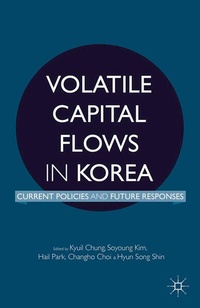
Volatile Capital Flows in Korea
Current Policies and Future Responses
Published on 17. December 2014
Book
Paperback/Softback
XXI, 271 pages
978-1-349-47728-9 (ISBN)
Description
Volatility in Korean Capital Markets summarizes the Korean experience of volatile capital flows, analyzes the economic consequences, evaluates the policy measures adopted, and suggests new measures for the future.
More details
Edition
1st ed. 2014
Language
English
Place of publication
New York
United States
Target group
Professional and scholarly
Illustrations
77 s/w Abbildungen
XXI, 271 p. 77 illus.
Dimensions
Height: 216 mm
Width: 140 mm
Thickness: 17 mm
Weight
376 gr
ISBN-13
978-1-349-47728-9 (9781349477289)
DOI
10.1057/9781137368768
Schweitzer Classification
Other editions
Additional editions
Book
12/2014
Palgrave MacMillan
€106.99
Shipment within 10-20 days
Persons
Naohiko Baba, Goldman Sachs Japan, Japan
Valentina Bruno, American University
Changho Choi , Bank of Korea
Kyuil Chung, Bank of Korea
Daeyup Lee, Bank of Korea
Seungwon Kim, Bank of Korea
Soyoung Kim, Seoul National University
Sunghyun H. Kim, Sungkyunkwan University
Hail Park, Bank of Korea
Ilhyock Shim, Bank for International Settlements
Hyun Song Shin, Princeton University, USA
Yunjong Wang, SK SUPEX Council
Doo Yong Yang, Kyung Hee University
Content
Preface Contributors Tables and Figures PART I: OVERVIEW 1. Overview of International Capital Flows; Kyuil Chung, Hail Park, and Changho Choi PART II: CAPITAL ACCOUNT LIBERALIZATION AND ITS CONSEQUENCES 2. Macroeconomic Effects of Capital Account Liberalization: the Case of Korea; Soyoung Kim, Sunghyun H. Kim, and Yunjong Wang 3. Do Capital Inflows Matter to Asset Prices? The Case of Korea; Soyoung Kim and Doo Yong Yang 4. Capital Flows in Korea after Capital Account Liberalization; Hail Park, Daeyup Lee, and Kyuil Chung PART III: POLICY RESPONSES BEFORE AND DURING THE CRISIS 5. Capital Inflows and Policy Responses: Lessons from Korea's Experience; Kyuil Chung and Seungwon Kim 6. Dislocations in the Won-Dollar Swap Markets during the Crisis of 2007-09; Naohiko Baba and Ilhyock Shim PART IV: MACROPRUDENTIAL POLICY AFTER THE CRISIS AND INSTITUTIONAL REFORM SUGGESTION 7. Why Macroprudential Policy? Brief Overview; Valentina Bruno and Hyun Song Shin 8. Assessing Macroprudential Policies in Korea; Changho Choi 9. Mitigating Systemic Spillovers from Currency Hedging; Kyuil Chung, Hail Park, and Hyun Song Shin PART V: EPILOGUE 10. The Second Phase of Global Liquidity and Its Impact on Emerging Economies; Hyun Song Shin Index