

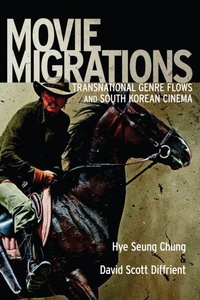
Movie Migrations
Transnational Genre Flows and South Korean Cinema
Published on 6. July 2015
Book
Paperback/Softback
306 pages
978-0-8135-6997-0 (ISBN)
Description
As the two billion YouTube views for "Gangnam Style" would indicate, South Korean popular culture has begun to enjoy new prominence on the global stage. Yet, as this timely new study reveals, the nation's film industry has long been a hub for transnational exchange, producing movies that put a unique spin on familiar genres, while influencing world cinema from Hollywood to Bollywood. Movie Migrations is not only an introduction to one of the world's most vibrant national cinemas, but also a provocative call to reimagine the very concepts of "national cinemas" and "film genre." Challenging traditional critical assumptions that place Hollywood at the center of genre production, Hye Seung Chung and David Scott Diffrient bring South Korean cinema to the forefront of recent and ongoing debates about globalization and transnationalism. In each chapter they track a different way that South Korean filmmakers have adapted material from foreign sources, resulting in everything from the Manchurian Western to The Host's reinvention of the Godzilla mythos. Spanning a wide range of genres, the book introduces readers to classics from the 1950s and 1960s Golden Age of South Korean cinema, while offering fresh perspectives on recent favorites like Oldboy and Thirst. Perfect not only for fans of Korean film, but for anyone curious about media in an era of globalization, Movie Migrations will give readers a new appreciation for the creative act of cross-cultural adaptation.
Reviews / Votes
"Deftly weaves together eclectic, interdisciplinary references, from transnational literary studies to political economy, translation and adaptation studies, film genre studies, and inter-Asian Pacific Rim cultural studies." (The Journal of Asian Studies) "Brimming with insight and detail, this is the go-to book for South Korean genre cinema, a remarkable achievement of scholarship, richly detailed with frame grabs and production stills ... Highly recommended." (CHOICE) "Movie Migrations offers insightful readings of the deep connections between Korean and foreign films. A model of transnational scholarship, it will revitalize genre studies." - Christina Klein (author of Cold War Orientalism) "A magnificent service to the scholarly analysis of South Korean cinema. This book is insightful, eloquent, and fully engaged. It has been researched and written with tremendous rigour and commitment." - Julian Stringer (University of Nottingham)More details
Series
Language
English
Place of publication
New Brunswick NJ
United States
Target group
College/higher education
Product notice
Paperback (trade)
Unsewn / adhesive bound
Illustrations
30 photographs, 1 figure, 2 ta
Dimensions
Height: 228 mm
Width: 151 mm
Thickness: 25 mm
Weight
506 gr
ISBN-13
978-0-8135-6997-0 (9780813569970)
Copyright in bibliographic data and cover images is held by Nielsen Book Services Limited or by the publishers or by their respective licensors: all rights reserved.
Schweitzer Classification
Persons
HYE SEUNG CHUNG is an associate professor of film and media studies in the department of communication studies at Colorado State University. She is the author of Hollywood Asian: Philip Ahn and the Politics of Cross-Ethnic Performance and Kim Ki-duk. DAVID SCOTT DIFFRIENT is the William E. Morgan Endowed Chair of Liberal Arts and associate professor of film and media studies in the department of communication studies at Colorado State University. He is the author of Omnibus Films: Theorizing Transauthorial Cinema.
Content
AcknowledgmentsIntroduction: South Korean Cinema's Transnational Trajectories
Part I From Classical Hollywood to the Korean Golden Age: Cinephilia, Modernization, and Postcolonial Genre Flows
1 Toward a Strategic Korean Cinephilia: A Transnational DEtournement of Hollywood Melodrama2 The Mamas and the Papas: Cross-Cultural Remakes, Literary Adaptations, and Cinematic "Parent" Texts3 The Nervous Laughter of Vanishing Fathers: Modernization Comedies of the 1960s4 Once upon a Time in Manchuria: Classic and Contemporary Korean Westerns
Part II From Cinematic Seoul to Global Hollywood: Cosmopolitanism, Empire, and Transnational Genre Flows
5 Reinventing the Historical Drama, De-Westernizing a French Classic: Genre, Gender, and the Transnational Imaginary in Untold Scandal6 From Gojira to Goemul: "Host" Cities and "Post" Histories in East Asian Monster Movies7 Extraordinarily Rendered: Oldboy, Transmedia Adaptation, and the US War on Terror8 A Thirst for Diversity: Trends in Korean "Multicultural Films," from Bandhobi to Where is Ronny?
Conclusion: Into "Spreadable" Spaces: Netflix, YouTube, and the Question of Cultural TranslatabilityNotesIndex
Part I From Classical Hollywood to the Korean Golden Age: Cinephilia, Modernization, and Postcolonial Genre Flows
1 Toward a Strategic Korean Cinephilia: A Transnational DEtournement of Hollywood Melodrama2 The Mamas and the Papas: Cross-Cultural Remakes, Literary Adaptations, and Cinematic "Parent" Texts3 The Nervous Laughter of Vanishing Fathers: Modernization Comedies of the 1960s4 Once upon a Time in Manchuria: Classic and Contemporary Korean Westerns
Part II From Cinematic Seoul to Global Hollywood: Cosmopolitanism, Empire, and Transnational Genre Flows
5 Reinventing the Historical Drama, De-Westernizing a French Classic: Genre, Gender, and the Transnational Imaginary in Untold Scandal6 From Gojira to Goemul: "Host" Cities and "Post" Histories in East Asian Monster Movies7 Extraordinarily Rendered: Oldboy, Transmedia Adaptation, and the US War on Terror8 A Thirst for Diversity: Trends in Korean "Multicultural Films," from Bandhobi to Where is Ronny?
Conclusion: Into "Spreadable" Spaces: Netflix, YouTube, and the Question of Cultural TranslatabilityNotesIndex