

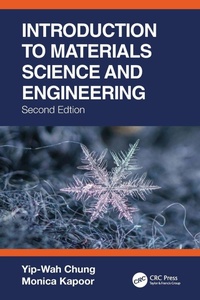
Introduction to Materials Science and Engineering
2nd Edition
Will be published approx. on 28. November 2025
Book
Paperback/Softback
370 pages
978-1-032-12175-8 (ISBN)
Description
Our civilization owes its most significant milestones to our use of materials. Metals gave us better agriculture and eventually the industrial revolution, silicon gave us the digital revolution, and we're just beginning to see what nanomaterials yield. Updated to reflect the many societal and technological changes in the field since publication of the first edition, Introduction to Materials Science and Engineering, Second Edition, offers an interdisciplinary view that emphasizes the importance of materials to engineering applications and builds the basis needed to select, modify, and create materials to meet specific criteria. The most outstanding feature of this book is the authors' unique and engaging application-oriented approach. By beginning each chapter with a real-life example, an experiment, or interesting facts, the authors wield an expertly crafted treatment that entertains and motivates as much as informs and educates. The discipline is linked to modern developments, such as semiconductor devices, nanomaterials, and thin films, while working systematically from atomic bonding and analytical methods to crystalline, electronic, mechanical, and magnetic properties as well as ceramics, polymers, corrosion, and phase diagrams.
Updates in the Second Edition
References to advances in the field, including computational thermodynamics, allowing computation of phase diagrams with great accuracy and new materials
Updated applications and technologies, such as electric vehicles and the use of magnetic fields as a processing tool
Revised, practical end-of-chapter problems that go beyond traditional plug-and-chug exercises to enhance learning
More examples with detailed solutions in each chapter
A new chapter highlighting how materials can impact four United Nations Sustainable Development Goals
This book is written for undergraduate students and readers interested in introductory materials science and engineering concepts. This concise textbook provides a strong foundation in materials science engineering and its applications. A solutions manual and PowerPoint lecture slides are available for adopting professors.
Updates in the Second Edition
References to advances in the field, including computational thermodynamics, allowing computation of phase diagrams with great accuracy and new materials
Updated applications and technologies, such as electric vehicles and the use of magnetic fields as a processing tool
Revised, practical end-of-chapter problems that go beyond traditional plug-and-chug exercises to enhance learning
More examples with detailed solutions in each chapter
A new chapter highlighting how materials can impact four United Nations Sustainable Development Goals
This book is written for undergraduate students and readers interested in introductory materials science and engineering concepts. This concise textbook provides a strong foundation in materials science engineering and its applications. A solutions manual and PowerPoint lecture slides are available for adopting professors.
More details
Edition
2nd edition
Language
English
Place of publication
London
United Kingdom
Publishing group
Taylor & Francis Ltd
Target group
College/higher education
Undergraduate
Illustrations
39 s/w Photographien bzw. Rasterbilder, 284 farbige Zeichnungen, 51 s/w Tabellen, 323 farbige Abbildungen
51 Tables, black and white; 284 Line drawings, color; 39 Halftones, black and white; 323 Illustrations, color
Dimensions
Height: 234 mm
Width: 156 mm
Thickness: 21 mm
Weight
588 gr
ISBN-13
978-1-032-12175-8 (9781032121758)
Copyright in bibliographic data and cover images is held by Nielsen Book Services Limited or by the publishers or by their respective licensors: all rights reserved.
Schweitzer Classification
Other editions
Additional editions
Yip-Wah Chung | Monica Kapoor
Introduction to Materials Science and Engineering
Book
04/2022
2nd Edition
CRC Press
€152.70
Shipment within 10-20 days
Yip-Wah Chung | Monica Kapoor
Introduction to Materials Science and Engineering
E-Book
04/2022
2nd Edition
CRC Press
€69.99
Available for download
Yip-Wah Chung | Monica Kapoor
Introduction to Materials Science and Engineering
E-Book
04/2022
2nd Edition
CRC Press
€69.99
Available for download
Persons
Yip-Wah Chung obtained his PhD in Physics from the University of California at Berkeley. He joined Northwestern University in 1977. He is currently Professor of Materials Science and Engineering and (by courtesy) Mechanical Engineering at Northwestern. He was named Fellow, ASM International; Fellow, AVS; and Fellow, Society of Tribologists and Lubrication Engineers. His other awards include the Ralph A Teetor Engineering Educator Award from SAE International, Innovative Research Award and Best Paper Award from the ASME Tribology Division, Technical Achievement Award from the National Storage Industry Consortium, and Bronze Bauhinia Star Medal from the Hong Kong Special Administrative Government. Dr. Chung served two years as program officer in surface engineering and materials design at the National Science Foundation. His most recent research activities are in low-friction surfaces, lubricant and thin-film design and characterization, and multifunctional alloys. His favorite hobbies are photography and recreational flying. He holds several Federal Aviation Administration ratings, including commercial multiengine instrument, commercial remote pilot, instrument ground instructor and advanced ground instructor.
Monica Kapoor obtained her PhD in materials science and Engineering from Northwestern University in the design and development of precipitation-strengthened steels. She is currently a Senior Metallurgical Scientist in Materials Technology at Novelis Global Research & Technology Center in Kennesaw, Georgia. Her current interests are in transitioning basic research into advanced processes and alloys, early-stage clustering in Al alloys, and atom probe tomography. After her PhD, she has worked at University of Alabama on high-strength-low-alloy steels and nanocrystalline metals. Subsequently, she joined the National Energy Technology Laboratory where she developed transient-liquid-phase bonding methods for Ni-based super alloys. Her area of expertise is in physical metallurgy of structural metals and advanced characterization techniques, specifically atom probe tomography. She has published twenty-plus publications in high impact factor peer-reviewed journals. She is also an avid reviewer and was recognized as the Reviewer of the Year 2016 by Scripta Materialia.
Monica Kapoor obtained her PhD in materials science and Engineering from Northwestern University in the design and development of precipitation-strengthened steels. She is currently a Senior Metallurgical Scientist in Materials Technology at Novelis Global Research & Technology Center in Kennesaw, Georgia. Her current interests are in transitioning basic research into advanced processes and alloys, early-stage clustering in Al alloys, and atom probe tomography. After her PhD, she has worked at University of Alabama on high-strength-low-alloy steels and nanocrystalline metals. Subsequently, she joined the National Energy Technology Laboratory where she developed transient-liquid-phase bonding methods for Ni-based super alloys. Her area of expertise is in physical metallurgy of structural metals and advanced characterization techniques, specifically atom probe tomography. She has published twenty-plus publications in high impact factor peer-reviewed journals. She is also an avid reviewer and was recognized as the Reviewer of the Year 2016 by Scripta Materialia.
Content
1. Introduction 2. Imperfections and Diffusion 3. Electrical Properties of Metals and Semiconductors 4. Mechanical Properties of Metals and Alloys 5. Phase Diagrams 6. Ceramics and Composites 7. Polymers 8. Corrosion and Oxidation of Metals and Alloys 9. Magnetic Properties 10. Thin Films 11. Contributing to Sustainable Developments