

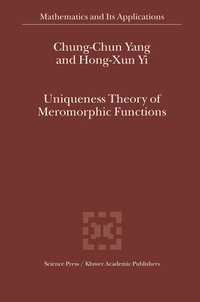
Uniqueness Theory of Meromorphic Functions
1st Edition
Published on 4. October 2004
Book
Hardback
VIII, 569 pages
978-1-4020-1448-2 (ISBN)
Description
This book is the first monograph in the field of uniqueness theory of meromorphic functions dealing with conditions under which there is the unique function satisfying given hypotheses. Developed by R. Nevanlinna, a Finnish mathematician, early in the 1920's, research in the field has developed rapidly over the past three decades with a great deal of fruitful results. This book systematically summarizes the most important results in the field, including many of the authors' own previously unpublished results. In addition, useful skills and simple proofs are introduced. This book is suitable for higher level and graduate students who have a basic grounding in complex analysis, but will also appeal to researchers in mathematics.
Reviews / Votes
From the reviews:
"The uniqueness theory of transcendental meromorphic functions goes back to R. Nevanlinna who proved that any non-constant meromorphic function can be determined by five values applying the value distribution theory established by himself. . This book is the first exposition systematically summarizing recent results, and also presenting useful skills in this field." (Katsuya Ishizaki, Zentralblatt MATH, Vol. 1070 (21), 2005)
More details
Series
Language
English
Place of publication
Dordrecht
Netherlands
Target group
Professional and scholarly
Research
Product notice
sewn/stitched
Cloth over boards
Illustrations
VIII, 569 p.
Dimensions
Height: 244 mm
Width: 169 mm
Thickness: 32 mm
Weight
1052 gr
ISBN-13
978-1-4020-1448-2 (9781402014482)
DOI
10.1007/978-94-017-3626-8
Schweitzer Classification
Other editions
Additional editions
Chung-Chun Yang | Hong-Xun Yi
Uniqueness Theory of Meromorphic Functions
Book
12/2010
Springer
€106.99
Shipment within 15-20 days
Content
1 Basic Nevanlinna theory.- 2 Unicity of functions of finite (lower) order.- 3 Five-value, multiple value and uniqueness.- 4 The four-value theorem.- 5 Functions sharing three common values.- 6 Three-value sets of meromorphic functions.- 7 Functions sharing one or two values.- 8 Functions sharing values with their derivatives.- 9 Two functions whose derivatives share values.- 10 Meromorphic functions sharing sets.