

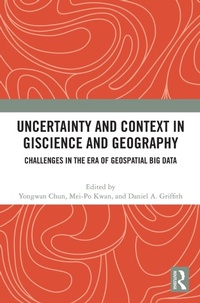
Uncertainty and Context in GIScience and Geography
Challenges in the Era of Geospatial Big Data
1st Edition
Published on 24. February 2021
Book
Hardback
170 pages
978-0-367-64299-0 (ISBN)
Description
Uncertainty and context pose fundamental challenges in GIScience and geographic research. Geospatial data are imbued with errors (e.g., measurement and sampling) and various types of uncertainty that often obfuscate any understanding of the effects of contextual or environmental influences on human behaviors and experiences. These errors or uncertainties include those attributable to geospatial data measurement, model specifications, delineations of geographic context in space and time, and the use of different spatiotemporal scales and zonal schemes when analyzing the effects of environmental influences on human behaviors or experiences. In addition, emerging sources of geospatial big data - including smartphone data, data collected by GPS, and various types of wearable sensors (e.g., accelerometers and air pollutant monitors), volunteered geographic information, and/ or location- based social media data (i.e., crowd- sourced geographic information) - inevitably contain errors, and their quality cannot be fully controlled during their collection or production.
Uncertainty and Context in GIScience and Geography: Challenges in the Era of Geospatial Big Data illustrates how cutting- edge research explores recent advances in this area, and will serve as a useful point of departure for GIScientists to conceive new approaches and solutions for addressing these challenges in future research. The seven core chapters in this book highlight many challenges and opportunities in confronting various issues of uncertainty and context in GIScience and geography, tackling different topics and approaches.
The chapters in this book were originally published as a special issue of the International Journal of Geographical Information Science.
Uncertainty and Context in GIScience and Geography: Challenges in the Era of Geospatial Big Data illustrates how cutting- edge research explores recent advances in this area, and will serve as a useful point of departure for GIScientists to conceive new approaches and solutions for addressing these challenges in future research. The seven core chapters in this book highlight many challenges and opportunities in confronting various issues of uncertainty and context in GIScience and geography, tackling different topics and approaches.
The chapters in this book were originally published as a special issue of the International Journal of Geographical Information Science.
More details
Language
English
Place of publication
London
United Kingdom
Publishing group
Taylor & Francis Ltd
Target group
College/higher education
Dimensions
Height: 250 mm
Width: 175 mm
Thickness: 14 mm
Weight
500 gr
ISBN-13
978-0-367-64299-0 (9780367642990)
Copyright in bibliographic data and cover images is held by Nielsen Book Services Limited or by the publishers or by their respective licensors: all rights reserved.
Schweitzer Classification
Other editions
Additional editions
Yongwan Chun | Mei-Po Kwan | Daniel A. Griffith
Uncertainty and Context in GIScience and Geography
Challenges in the Era of Geospatial Big Data
Book
09/2023
1st Edition
Routledge
€51.98
Shipment within 15-20 days
Yongwan Chun | Mei-Po Kwan | Daniel A. Griffith
Uncertainty and Context in GIScience and Geography
Challenges in the Era of Geospatial Big Data
E-Book
05/2021
1st Edition
Routledge
€59.49
Available for download
Yongwan Chun | Mei-Po Kwan | Daniel A. Griffith
Uncertainty and Context in GIScience and Geography
Challenges in the Era of Geospatial Big Data
E-Book
05/2021
1st Edition
Routledge
€59.49
Available for download
Persons
Yongwan Chun is Associate Professor of Geospatial Information Sciences (GIS) at the University of Texas at Dallas, USA. His research interests lie in GIS and spatial statistical approaches to solving geographical problems, including geographic flow modeling, space- time modeling, and uncertainty.
Mei- Po Kwan is Choh- Ming Li Professor of Geography and Resource Management and Director of the Institute of Space and Earth Information Science at the Chinese University of Hong Kong, China. Her research interests include environmental health, human mobility, sustainable cities, urban, transport and social issues in cities, and GIScience.
Daniel A. Griffith is Ashbel Smith Professor of Geospatial Information Sciences at the University of Texas at Dallas, USA, and has authored numerous books and academic articles, garnering him many awards. He pursues research at the interface between geography and mathematics, especially statistics. His current research emphasizes visualization, space- time analysis, and public health.
Mei- Po Kwan is Choh- Ming Li Professor of Geography and Resource Management and Director of the Institute of Space and Earth Information Science at the Chinese University of Hong Kong, China. Her research interests include environmental health, human mobility, sustainable cities, urban, transport and social issues in cities, and GIScience.
Daniel A. Griffith is Ashbel Smith Professor of Geospatial Information Sciences at the University of Texas at Dallas, USA, and has authored numerous books and academic articles, garnering him many awards. He pursues research at the interface between geography and mathematics, especially statistics. His current research emphasizes visualization, space- time analysis, and public health.
Content
Introduction
Yongwan Chun, Mei-Po Kwan and Daniel A. Griffith
1. Uncertainty in the effects of the modifiable areal unit problem under different levels of spatial autocorrelation: a simulation study
Sang-Il Lee, Monghyeon Lee, Yongwan Chun and Daniel A. Griffith
2. Spatial autocorrelation and data uncertainty in the American Community Survey: a critique
Paul H. Jung, Jean-Claude Thill and Michele Issel
3. Uncertainties in the geographic context of health behaviors: a study of substance users' exposure to psychosocial stress using GPS data
Mei-Po Kwan, Jue Wang, Matthew Tyburski, David H. Epstein, William J. Kowalczyk and Kenzie L. Preston
4. Exploring the uncertainty of activity zone detection using digital footprints with multi-scaled DBSCAN
Xinyi Liu, Qunying Huang and Song Gao
5. Same space - different perspectives: comparative analysis of geographic context through sketch maps and spatial video geonarratives
Andrew Curtis, Jacqueline W. Curtis, Jayakrishnan Ajayakumar, Eric Jefferis and Susanne Mitchell
6. Travel impedance agreement among online road network data providers
Eric M. Delmelle, Derek M. Marsh, C. Dony and Paul L. Delamater
7. A network approach to the production of geographic context using exponential random graph models
Steven M. Radil
Concluding Comments
Yongwan Chun, Mei-Po Kwan and Daniel A. Griffith
Yongwan Chun, Mei-Po Kwan and Daniel A. Griffith
1. Uncertainty in the effects of the modifiable areal unit problem under different levels of spatial autocorrelation: a simulation study
Sang-Il Lee, Monghyeon Lee, Yongwan Chun and Daniel A. Griffith
2. Spatial autocorrelation and data uncertainty in the American Community Survey: a critique
Paul H. Jung, Jean-Claude Thill and Michele Issel
3. Uncertainties in the geographic context of health behaviors: a study of substance users' exposure to psychosocial stress using GPS data
Mei-Po Kwan, Jue Wang, Matthew Tyburski, David H. Epstein, William J. Kowalczyk and Kenzie L. Preston
4. Exploring the uncertainty of activity zone detection using digital footprints with multi-scaled DBSCAN
Xinyi Liu, Qunying Huang and Song Gao
5. Same space - different perspectives: comparative analysis of geographic context through sketch maps and spatial video geonarratives
Andrew Curtis, Jacqueline W. Curtis, Jayakrishnan Ajayakumar, Eric Jefferis and Susanne Mitchell
6. Travel impedance agreement among online road network data providers
Eric M. Delmelle, Derek M. Marsh, C. Dony and Paul L. Delamater
7. A network approach to the production of geographic context using exponential random graph models
Steven M. Radil
Concluding Comments
Yongwan Chun, Mei-Po Kwan and Daniel A. Griffith