

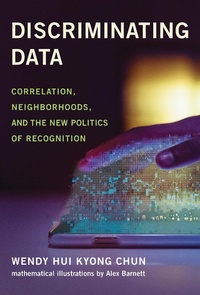
Discriminating Data
Correlation, Neighborhoods, and the New Politics of Recognition
Published on 5. March 2024
Book
Paperback/Softback
344 pages
978-0-262-54852-6 (ISBN)
Description
How big data and machine learning encode discrimination and create agitated clusters of comforting rage.
In Discriminating Data, Wendy Hui Kyong Chun reveals how polarization is a goal-not an error-within big data and machine learning. These methods, she argues, encode segregation, eugenics, and identity politics through their default assumptions and conditions. Correlation, which grounds big data's predictive potential, stems from twentieth-century eugenic attempts to "breed" a better future. Recommender systems foster angry clusters of sameness through homophily. Users are "trained" to become authentically predictable via a politics and technology of recognition. Machine learning and data analytics thus seek to disrupt the future by making disruption impossible.
Chun, who has a background in systems design engineering as well as media studies and cultural theory, explains that although machine learning algorithms may not officially include race as a category, they embed whiteness as a default. Facial recognition technology, for example, relies on the faces of Hollywood celebrities and university undergraduates-groups not famous for their diversity. Homophily emerged as a concept to describe white U.S. resident attitudes to living in biracial yet segregated public housing. Predictive policing technology deploys models trained on studies of predominantly underserved neighborhoods. Trained on selected and often discriminatory or dirty data, these algorithms are only validated if they mirror this data.
How can we release ourselves from the vice-like grip of discriminatory data? Chun calls for alternative algorithms, defaults, and interdisciplinary coalitions in order to desegregate networks and foster a more democratic big data.
In Discriminating Data, Wendy Hui Kyong Chun reveals how polarization is a goal-not an error-within big data and machine learning. These methods, she argues, encode segregation, eugenics, and identity politics through their default assumptions and conditions. Correlation, which grounds big data's predictive potential, stems from twentieth-century eugenic attempts to "breed" a better future. Recommender systems foster angry clusters of sameness through homophily. Users are "trained" to become authentically predictable via a politics and technology of recognition. Machine learning and data analytics thus seek to disrupt the future by making disruption impossible.
Chun, who has a background in systems design engineering as well as media studies and cultural theory, explains that although machine learning algorithms may not officially include race as a category, they embed whiteness as a default. Facial recognition technology, for example, relies on the faces of Hollywood celebrities and university undergraduates-groups not famous for their diversity. Homophily emerged as a concept to describe white U.S. resident attitudes to living in biracial yet segregated public housing. Predictive policing technology deploys models trained on studies of predominantly underserved neighborhoods. Trained on selected and often discriminatory or dirty data, these algorithms are only validated if they mirror this data.
How can we release ourselves from the vice-like grip of discriminatory data? Chun calls for alternative algorithms, defaults, and interdisciplinary coalitions in order to desegregate networks and foster a more democratic big data.
More details
Language
English
Place of publication
Cambridge (Massachusetts)
United States
Publishing group
MIT Press Ltd
Product notice
Paperback (trade)
Unsewn / adhesive bound
Illustrations
69 BLACK AND WHITE ILLUS.
Dimensions
Height: 218 mm
Width: 140 mm
Thickness: 23 mm
Weight
444 gr
ISBN-13
978-0-262-54852-6 (9780262548526)
Copyright in bibliographic data and cover images is held by Nielsen Book Services Limited or by the publishers or by their respective licensors: all rights reserved.
Schweitzer Classification
Other editions
Additional editions
Wendy Hui Kyong Chun
Discriminating Data
Correlation, Neighborhoods, and the New Politics of Recognition
E-Book
11/2021
MIT Press
€27.49
Available for download
Persons
Wendy Hui Kyong Chun is Simon Fraser University's Canada 150 Research Chair in New Media and Professor of Communication and Director of the SFU Digital Democracies Institute. She is the author of Control and Freedom, Programmed Visions, and Updating to Remain the Same, all published by the MIT Press.
Alex Barnett is Group Leader for Numerical Analysis at the Center for Computational Mathematics at the Flatiron Institute in New York. He has published more than 50 research papers in scientific computing, differential equations, fluids, waves, imaging, physics, neuroscience, and statistics.
Alex Barnett is Group Leader for Numerical Analysis at the Center for Computational Mathematics at the Flatiron Institute in New York. He has published more than 50 research papers in scientific computing, differential equations, fluids, waves, imaging, physics, neuroscience, and statistics.
Content
Preface ix
Introduction: How to Destroy the World, One Solution at a Time 1
Red Pill Toxicity, or Liberation Envy 29
1 Correlating Eugenics 35
The Transgressive Hypothesis 75
2 Homophily, or the Swarming of the Segregated Neighborhood 81
3 Algorithmic Authenticity 139
Correlating Ideology, or What Lies at the Surface 173
4 Recognizing Recognition 185
The Space Between Us 231
Coda: Living in Difference 239
Acknowledgments 255
Notes 259
References for Mathematical Illustrations 317
Index 319
Introduction: How to Destroy the World, One Solution at a Time 1
Red Pill Toxicity, or Liberation Envy 29
1 Correlating Eugenics 35
The Transgressive Hypothesis 75
2 Homophily, or the Swarming of the Segregated Neighborhood 81
3 Algorithmic Authenticity 139
Correlating Ideology, or What Lies at the Surface 173
4 Recognizing Recognition 185
The Space Between Us 231
Coda: Living in Difference 239
Acknowledgments 255
Notes 259
References for Mathematical Illustrations 317
Index 319