

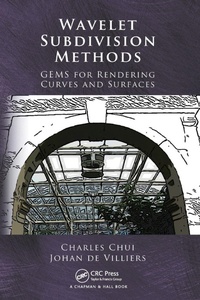
Wavelet Subdivision Methods
GEMS for Rendering Curves and Surfaces
1st Edition
Published on 25. November 2019
Book
Paperback/Softback
479 pages
978-0-367-45231-5 (ISBN)
Description
Prevalent in animation movies and interactive games, subdivision methods allow users to design and implement simple but efficient schemes for rendering curves and surfaces. Adding to the current subdivision toolbox, Wavelet Subdivision Methods: GEMS for Rendering Curves and Surfaces introduces geometry editing and manipulation schemes (GEMS) and covers both subdivision and wavelet analysis for generating and editing parametric curves and surfaces of desirable geometric shapes. The authors develop a complete constructive theory and effective algorithms to derive synthesis wavelets with minimum support and any desirable order of vanishing moments, along with decomposition filters.
Through numerous examples, the book shows how to represent curves and construct convergent subdivision schemes. It comprehensively details subdivision schemes for parametric curve rendering, offering complete algorithms for implementation and theoretical development as well as detailed examples of the most commonly used schemes for rendering both open and closed curves. It also develops an existence and regularity theory for the interpolatory scaling function and extends cardinal B-splines to box splines for surface subdivision.
Keeping mathematical derivations at an elementary level without sacrificing mathematical rigor, this book shows how to apply bottom-up wavelet algorithms to curve and surface editing. It offers an accessible approach to subdivision methods that integrates the techniques and algorithms of bottom-up wavelets.
Through numerous examples, the book shows how to represent curves and construct convergent subdivision schemes. It comprehensively details subdivision schemes for parametric curve rendering, offering complete algorithms for implementation and theoretical development as well as detailed examples of the most commonly used schemes for rendering both open and closed curves. It also develops an existence and regularity theory for the interpolatory scaling function and extends cardinal B-splines to box splines for surface subdivision.
Keeping mathematical derivations at an elementary level without sacrificing mathematical rigor, this book shows how to apply bottom-up wavelet algorithms to curve and surface editing. It offers an accessible approach to subdivision methods that integrates the techniques and algorithms of bottom-up wavelets.
More details
Language
English
Place of publication
London
United Kingdom
Publishing group
Taylor & Francis Ltd
Target group
Professional and scholarly
Professional Practice & Development
Dimensions
Height: 234 mm
Width: 156 mm
Thickness: 26 mm
Weight
723 gr
ISBN-13
978-0-367-45231-5 (9780367452315)
Copyright in bibliographic data and cover images is held by Nielsen Book Services Limited or by the publishers or by their respective licensors: all rights reserved.
Schweitzer Classification
Other editions
Additional editions

E-Book
08/2010
1st Edition
CRC Press
€89.99
Available for download
Book
08/2010
1st Edition
CRC Press
€257.50
Article not available at the moment

E-Book
08/2010
1st Edition
CRC Press
€89.99
Available for download
Persons
Charles Chui is a Curators' Professor in the Department of Mathematics and Computer Science at the University of Missouri in St. Louis, and a consulting professor of statistics at Stanford University in California. Dr. Chui's research interests encompass applied and computational mathematics, with an emphasis on splines, wavelets, mathematics of imaging, and fast algorithms.
Johan de Villiers is a professor in the Department of Mathematical Sciences, Mathematics Division at Stellenbosch University in South Africa. Dr. de Villiers's research interests include computational mathematics, with an emphasis on wavelet and subdivision analysis.
Johan de Villiers is a professor in the Department of Mathematical Sciences, Mathematics Division at Stellenbosch University in South Africa. Dr. de Villiers's research interests include computational mathematics, with an emphasis on wavelet and subdivision analysis.
Content
OVERVIEW. BASIS FUNCTIONS FOR CURVE REPRESENTATION. CURVE SUBDIVISION SCHEMES. BASIS FUNCTIONS GENERATED BY SUBDIVISION MATRICES. QUASI-INTERPOLATION. CONVERGENCE AND REGULARITY ANALYSIS. ALGEBRAIC POLYNOMIAL IDENTITIES. INTERPOLATORY SUBDIVISION. WAVELETS FOR SUBDIVISION. SURFACE SUBDIVISION. EPILOGUE. SUPPLEMENTARY READINGS. INDEX.