

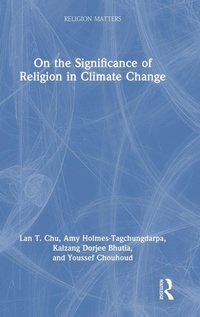
On the Significance of Religion in Climate Change
1st Edition
Published on 13. February 2025
Book
Hardback
92 pages
978-1-032-33258-1 (ISBN)
Description
This book explores the role of religion in discussions about climate change and, particularly, the development of responses to climate change on global, state, institutional, and local levels. It considers examples of the ways that different religious traditions, including Indigenous, Muslim, Buddhist, and Christian communities, have responded to the different effects of climate change by using different methodological approaches, including political science and international relations (e.g. public opinion polls and constructivism); religious studies scholarship on climate change, including an overview of religion and ecology as a subdiscipline in religious studies; and environmental humanities approaches.
This volume interrogates the diverse ways religion both acts and is acted upon by different actors, including institutions and nation states, in response to climate change. Within single traditions, different actors advocate for planetary care and concern, while their co-religionists may remain passive or deny climate change as a phenomenon.
This book unravels the complexities of how different religions approach climate change and recommends that religions are taken seriously in the development of climate change mitigation strategies at different scales.
The Open Access version of this book, available at http://www.taylorfrancis.com, has been made available under a Creative Commons Attribution-Non Commercial-No Derivatives (CC BY-NC-ND) 4.0 license
This volume interrogates the diverse ways religion both acts and is acted upon by different actors, including institutions and nation states, in response to climate change. Within single traditions, different actors advocate for planetary care and concern, while their co-religionists may remain passive or deny climate change as a phenomenon.
This book unravels the complexities of how different religions approach climate change and recommends that religions are taken seriously in the development of climate change mitigation strategies at different scales.
The Open Access version of this book, available at http://www.taylorfrancis.com, has been made available under a Creative Commons Attribution-Non Commercial-No Derivatives (CC BY-NC-ND) 4.0 license
More details
Series
Language
English
Place of publication
London
United Kingdom
Publishing group
Taylor & Francis Ltd
Target group
College/higher education
Postgraduate and Undergraduate Advanced
Dimensions
Height: 240 mm
Width: 161 mm
Thickness: 10 mm
Weight
329 gr
ISBN-13
978-1-032-33258-1 (9781032332581)
Copyright in bibliographic data and cover images is held by Nielsen Book Services Limited or by the publishers or by their respective licensors: all rights reserved.
Schweitzer Classification
Other editions
Additional editions
Lan T. Chu | Amy Holmes-Tagchungdarpa | Kalzang Bhutia
On the Significance of Religion in Climate Change
Book
02/2025
1st Edition
Routledge
€32.90
Shipment within 10-20 days
Lan T. Chu | Amy Holmes-Tagchungdarpa | Kalzang Bhutia
On the Significance of Religion in Climate Change
E-Book
02/2025
1st Edition
Routledge
€0.00
Available for download
Lan T. Chu | Amy Holmes-Tagchungdarpa | Kalzang Bhutia
On the Significance of Religion in Climate Change
E-Book
02/2025
1st Edition
Routledge
€0.00
Available for download
Persons
Lan T. Chu is a Professor of Diplomacy and World Affairs at Occidental College.
Amy Holmes-Tagchungdarpa is an Associate Professor of Religious Studies and Asian Studies at Occidental College.
Kalzang Dorjee Bhutia is a research associate in the Hidden Stories: New Approaches to the Local and Global History of the Book project at the University of Toronto and Princeton University.
Youssef Chouhoud is an Associate Professor of Political Science affiliated with the Reiff Center for Human Rights and Conflict Resolution at Christopher Newport University.
Amy Holmes-Tagchungdarpa is an Associate Professor of Religious Studies and Asian Studies at Occidental College.
Kalzang Dorjee Bhutia is a research associate in the Hidden Stories: New Approaches to the Local and Global History of the Book project at the University of Toronto and Princeton University.
Youssef Chouhoud is an Associate Professor of Political Science affiliated with the Reiff Center for Human Rights and Conflict Resolution at Christopher Newport University.
Content
1. Summary of Implications for Academics, Policymakers, and Practitioners across and between Religious and Secular Contexts 2. Why Religion Matters for Responding to Climate Change: An Introduction 3. Relating to the Rising Waters and Warming Land: Indigenous Religions and Climate Change 4. Doctrine, Praxis, and Public Opinion: Islam's Call for Environmental Stewardship and the Varied Ways It Is Answered (and Ignored) 5. Compassion and Interdependence in the Age of Changing Climates: Buddhist Understandings of Human-Environmental Relationships in the Anthropocene 6. Concerned About Climate: The Catholic Church, Environmental Stewardship, and the Challenge to Brazil's Bolsonaro 7. Now What? Implications for Academics, Policymakers, and Practitioners Across and Between Religious and Secular Contexts