

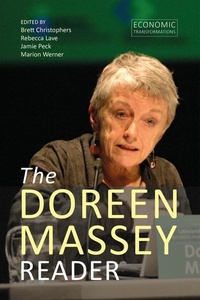
The Doreen Massey Reader
Published on 31. July 2018
Book
Paperback/Softback
368 pages
978-1-911116-83-7 (ISBN)
Description
Doreen Massey (1944-2016) changed geography. Her ideas on space, region, labour, identity, ethics and capital transformed the field itself, while also attracting a wide audience in sociology, planning, political economy, cultural studies, gender studies and beyond. The significance of her contributions is difficult to overstate. Far from a dry defence of disciplinary turf, her claim that "geography matters" possessed both scholarly substance and political salience.
Through her most influential concepts - such as power-geometries and a "global sense of place" - she insisted on the active role of regions and places not simply in bearing the brunt of political-economic restructuring, but in reshaping the uneven geographies of global capitalism and the horizons of politics. In capturing how global forces articulated with the particularities of place, Massey's work, right up until her death, was an inspiration for critical social sciences and political activists alike. It integrated theory and politics in the service of challenging and transforming both.
This collection of Massey's writings brings together for the first time the full span of her formative contributions, showcasing the continuing relevance of her ideas to current debates on globalization, immigration, nationalism and neoliberalism, among other topics. With introductions from the editors, the collection represents an unrivalled distillation of the range and depth of Massey's thinking. It is sure to remain an essential touchstone for social theory and critical geography for generations to come.
Through her most influential concepts - such as power-geometries and a "global sense of place" - she insisted on the active role of regions and places not simply in bearing the brunt of political-economic restructuring, but in reshaping the uneven geographies of global capitalism and the horizons of politics. In capturing how global forces articulated with the particularities of place, Massey's work, right up until her death, was an inspiration for critical social sciences and political activists alike. It integrated theory and politics in the service of challenging and transforming both.
This collection of Massey's writings brings together for the first time the full span of her formative contributions, showcasing the continuing relevance of her ideas to current debates on globalization, immigration, nationalism and neoliberalism, among other topics. With introductions from the editors, the collection represents an unrivalled distillation of the range and depth of Massey's thinking. It is sure to remain an essential touchstone for social theory and critical geography for generations to come.
More details
Series
Language
English
Place of publication
Newcastle upon Tyne
United Kingdom
Target group
College/higher education
Professional and scholarly
Product notice
Paperback (trade)
Dimensions
Height: 234 mm
Width: 156 mm
Thickness: 15 mm
Weight
567 gr
ISBN-13
978-1-911116-83-7 (9781911116837)
Copyright in bibliographic data and cover images is held by Nielsen Book Services Limited or by the publishers or by their respective licensors: all rights reserved.
Schweitzer Classification
Other editions
Additional editions
Brett Christophers | Rebecca Lave | Jamie Peck
The Doreen Massey Reader
E-Book
07/2018
1st Edition
Agenda Publishing
from
€69.99
Available for download
Brett Christophers | Rebecca Lave | Jamie Peck
The Doreen Massey Reader
E-Book
07/2018
1st Edition
Agenda Publishing
from
€69.99
Available for download
Persons
Brett Christophers is Professor of Human Geography at Uppsala University, Sweden. He is Editor of Environment and Planning A and his books include, most recently, The Great Leveler: Capitalism and Competition in the Court of Law (2016).
Rebecca Lave is an Associate Professor at Indiana University, Bloomington. She is the author of Fields and Streams: Stream Restoration, Neoliberalism, and the Future of Environmental Expertise (2012) and co-editor of the Handbook of Political Economy of Science (2017) and the Handbook of Critical Physical Geography (2017).
Jamie Peck is Canada Research Chair in Urban and Regional Political Economy and Professor of Geography at the University of British Columbia. He is Managing Editor of Environment and Planning A and the author or editor of more than a dozen books.
Marion Werner is an Associate Professor in the Department of Geography at the State University of New York, Buffalo. She is the author of Global Displacements: The Making of Uneven Development in the Caribbean (2016).
Rebecca Lave is an Associate Professor at Indiana University, Bloomington. She is the author of Fields and Streams: Stream Restoration, Neoliberalism, and the Future of Environmental Expertise (2012) and co-editor of the Handbook of Political Economy of Science (2017) and the Handbook of Critical Physical Geography (2017).
Jamie Peck is Canada Research Chair in Urban and Regional Political Economy and Professor of Geography at the University of British Columbia. He is Managing Editor of Environment and Planning A and the author or editor of more than a dozen books.
Marion Werner is an Associate Professor in the Department of Geography at the State University of New York, Buffalo. She is the author of Global Displacements: The Making of Uneven Development in the Caribbean (2016).
Content
1. Out of place: Doreen Massey, radical geographerJamie Peck, Marion Werner, Rebecca Lave and Brett Christophers
Part 1 - Region2. Towards a critique of industrial location theory (1973)3. Labour must take over land (1973) (with Richard Barras and Andrew Broadbent)4. The analysis of capitalist landownership: an investigation of the case of Great Britain (1977)5. Regionalism: some current issues (1978)6. A woman's place? (1984) (with Linda McDowell)7. The changing geography of trade unions (1989) (with Joe Painter)
Part 2 - Place8. Beyond the coalfields: the work of the miners' support groups (1985) (with Hilary Wainwright)9. Power-geometry and a progressive sense of place (1993)10. A place called home? (1992)11. Masculinity, dualisms and high technology (1995)12. The geography of power (2000)13. Globalisation: what does it mean for geography? (2002)
Part 3 - Space14. New directions in space (1985)15. Flexible sexism (1991)16. Reflections on gender and geography (1995)17. Politics and space/time (1992)18. Reflections on debates over a decade (1995)19. Philosophy and politics of spatiality: some considerations (1999)20. Concepts of space and power in theory and in political practice (2009)
Part 1 - Region2. Towards a critique of industrial location theory (1973)3. Labour must take over land (1973) (with Richard Barras and Andrew Broadbent)4. The analysis of capitalist landownership: an investigation of the case of Great Britain (1977)5. Regionalism: some current issues (1978)6. A woman's place? (1984) (with Linda McDowell)7. The changing geography of trade unions (1989) (with Joe Painter)
Part 2 - Place8. Beyond the coalfields: the work of the miners' support groups (1985) (with Hilary Wainwright)9. Power-geometry and a progressive sense of place (1993)10. A place called home? (1992)11. Masculinity, dualisms and high technology (1995)12. The geography of power (2000)13. Globalisation: what does it mean for geography? (2002)
Part 3 - Space14. New directions in space (1985)15. Flexible sexism (1991)16. Reflections on gender and geography (1995)17. Politics and space/time (1992)18. Reflections on debates over a decade (1995)19. Philosophy and politics of spatiality: some considerations (1999)20. Concepts of space and power in theory and in political practice (2009)