

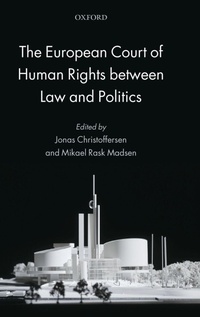
The European Court of Human Rights between Law and Politics
BET LAW POL C
Published on 9. June 2011
Book
Hardback
256 pages
978-0-19-969449-5 (ISBN)
Description
The European Court of Human Rights between Law and Politics provides a comprehensive analysis of the origins and development of one of the most striking supranational judicial institutions. The book brings together leading scholars and practitioners to cast new light on the substantial jurisprudence and ongoing political reform of the Court. The broad analysis based on historical, legal, and social science perspectives provides new insights into the institutional crisis of the Court and identifies the lessons that can be learned for the future of the European Convention on Human Rights and Fundamental Freedoms.
The European Court of Human Rights is in many ways is an unparalleled success. The Court embarked, during the 1970s, upon the development of a progressive and genuinely European jurisprudence. In the post-Cold War era, it went from being the guarantor of human rights solely in Western Europe to becoming increasingly involved in the transition to democracy and the rule of law in Eastern Europe. Now the protector of the human rights of some 800 million Europeans from 47 different countries, the European system is once again deeply challenged - this time by a massive case load and by the Member States' increased reluctance towards the Court. This book paves the way for a better understanding of the system and hence a better basis for choosing the direction of the next stage of development.
The European Court of Human Rights is in many ways is an unparalleled success. The Court embarked, during the 1970s, upon the development of a progressive and genuinely European jurisprudence. In the post-Cold War era, it went from being the guarantor of human rights solely in Western Europe to becoming increasingly involved in the transition to democracy and the rule of law in Eastern Europe. Now the protector of the human rights of some 800 million Europeans from 47 different countries, the European system is once again deeply challenged - this time by a massive case load and by the Member States' increased reluctance towards the Court. This book paves the way for a better understanding of the system and hence a better basis for choosing the direction of the next stage of development.
Reviews / Votes
This book brings together leading academics and practitioners to give a new perspective on the ECtHR and its on-going reform...By examining the ECtHR in its historical, legal and socio-political context, this book seeks to provide a better understanding of what has facilitated and impeded the ECtHR to date and the likely impact of these factors going forward ...well-written, well-edited and readable. * Jeanette Ashton, British Yearbook of International Law * This book brings together leading academics and practitioners to give a new perspective on the ECtHR and its on-going reform...By examining the ECtHR in its historical, legal and socio-political context, this book seeks to provide a better understanding of what has facilitated and impeded the ECtHR to date and the likely impact of these factors going forward ...well-written, well-edited and readable. * Jeanette Ashton, British Yearbook of International LawBirgit Peters, Nordic Journal of Human Rights * Its purchase is highly recommended and should be a must for those actually involved in the reform process: at the Court, at the Parliamentary Assembly, at government departments, but also for anyone interested in the work of the Court and its functioning. * Birgit Peters, Nordic Journal of Human Rights * All in all, The European Court of Human Rights between Law and Politics is a welcome addition to the growing corpus of multi- and interdisciplinary research on the Court. Its chapters usefully summarise some of the Courts key development trajectories, highlight the current problems that have emerged, especially in light of the caseload explosion, and intelligently address some of the implications for the future of the ECHR system, including possible reforms. * Andreas von Staden, Human Rights Law Review * There are some bold, some might say brave, suggestions which mark the book out from previous similar works * Journal of the Commonwealth Lawyers' Association 2011 * ^iThe European Court of Human Rights between Law and Politics^r offers a timely interdisciplinary analysis of the current need for reform of the European Court of Human Rights through the analytical framework of the institution's origins and function. * Rachel Clare Herron, Legal Studies *More details
Language
English
Place of publication
Oxford
United Kingdom
Target group
College/higher education
Professional and scholarly
Dimensions
Height: 240 mm
Width: 161 mm
Thickness: 18 mm
Weight
552 gr
ISBN-13
978-0-19-969449-5 (9780199694495)
Copyright in bibliographic data and cover images is held by Nielsen Book Services Limited or by the publishers or by their respective licensors: all rights reserved.
Schweitzer Classification
Other editions
Additional editions
Jonas Christoffersen | Mikael Rask Madsen
The European Court of Human Rights between Law and Politics
Book
09/2013
Oxford University Press
€61.26
Shipment within 15-20 days
Jonas Christoffersen | Mikael Rask Madsen
The European Court of Human Rights between Law and Politics
E-Book
09/2013
1st Edition
OUP eBook
€26.49
Available for download
Jonas Christoffersen | Mikael Rask Madsen
The European Court of Human Rights between Law and Politics
E-Book
06/2011
OUP eBook
€26.49
Available for download
Persons
Dr. jur. Jonas Christoffersen is Executive Director of the Danish Institute for Human Rights (Denmark's National Human Rights Institution). He was previously Assistant Professor in Human Rights Law at the University of Copenhagen, a temporary judge at the High Court of Eastern Denmark, and a clerk at the Supreme Court of Denmark. He is also an advocate admitted to the Danish Bar and the High Courts of Denmark.
Dr. Mikael Rask Madsen is Professor of European Law and Integration and Director of the Centre for Studies in Legal Culture at the University of Copenhagen. He was formerly at the Ecole des Hautes Etudes en Sciences Sociales in Paris. He has been a visitor at numerous universities, including University of Strasbourg, Oxford University, and University of California at Berkeley.
Dr. Mikael Rask Madsen is Professor of European Law and Integration and Director of the Centre for Studies in Legal Culture at the University of Copenhagen. He was formerly at the Ecole des Hautes Etudes en Sciences Sociales in Paris. He has been a visitor at numerous universities, including University of Strasbourg, Oxford University, and University of California at Berkeley.
Content
1. Introduction: The European Court of Human Rights between Law and Politics ; PART I - POLITICS AND INSTITUTIONALISATION ; 2. The Birth of the European Convention on Human Rights ; 3. The Protracted Institutionalisation of the Strasbourg Court: From the Diplomacy of Law to Integrationist Jurisprudence ; 4. Politics, Judicial Behaviour, and Institutional Design ; 5. Civil Society and the European Court of Human Rights ; 6. The European Court of Human Rights after 50 Years ; PART II - LAW AND LEGITIMIZATION ; 7. The Reform of the Convention System: Institutional Restructuring and the (Geo-)Politics of Human Rights ; 8. Constitutional v. International? When Unified Reformatory Rationales Mismatch the Plural Paths of Legitimacy of ECHR Law ; 9. Diplomatic Intrusions, Dialogues and Fragile Equilibriums: The European Court as a Constitutional Actor of the European Union ; 10. Individual and Constitutional Justice: Can the Dynamics of ECHR Adjudication be Reversed? ; 11. Rethinking the European Court of Human Rights