

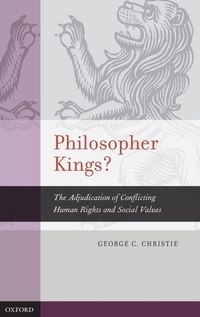
Philosopher Kings?
The Adjudication of Conflicting Human Rights and Social Values
1st Edition
Published on 10. March 2011
Book
Hardback
212 pages
978-0-19-534115-7 (ISBN)
Description
Philosopher Kings? The Adjudication of Conflicting Human Rights and Social Values, by George C. Christie, examines the attempts by courts to sort out conflicts involving freedom of expression, including religious expression, on the one hand, and rights to privacy and other important social values on the other. It approaches the subject from a comparative perspective, using principally cases decided by European and United States courts.
A significant part of this book analyzes conflicts between freedom of expression and the right to privacy. In a world in which, freedom of expression and privacy are said to be of equal value, the book explores whether it is possible to develop, through case-by-case adjudication, a legal regime which can give clear direction as to what expression is or is not permitted. Otherwise, if such a regime proves impossible, in the guise of recognizing the equal value of expression and privacy, privacy may become de facto the preferred value.
A significant part of this book analyzes conflicts between freedom of expression and the right to privacy. In a world in which, freedom of expression and privacy are said to be of equal value, the book explores whether it is possible to develop, through case-by-case adjudication, a legal regime which can give clear direction as to what expression is or is not permitted. Otherwise, if such a regime proves impossible, in the guise of recognizing the equal value of expression and privacy, privacy may become de facto the preferred value.
More details
Language
English
Place of publication
New York
United States
Target group
College/higher education
Law students, law professors, readers generally interested in privacy and free speech rights.
Dimensions
Height: 240 mm
Width: 161 mm
Thickness: 16 mm
Weight
485 gr
ISBN-13
978-0-19-534115-7 (9780195341157)
Copyright in bibliographic data and cover images is held by Nielsen Book Services Limited or by the publishers or by their respective licensors: all rights reserved.
Schweitzer Classification
Other editions
Additional editions
E-Book
03/2011
1st Edition
OUP eBook
€50.49
Available for download
Person
George C. Christie is James B. Duke Professor of Law at the Duke University School of Law. He has degrees from Columbia and Harvard, and a diploma in International Law from Cambridge. In addition to a long career in academia, he has been at various times a lawyer in private practice as well as assistant general counsel for the United States Agency for International Development.
His chief academic interests are in the areas of torts and jurisprudence, in both of which he has published widely. His monograph: The Notion of an Ideal Audience in Legal Argument was published in 2000 and then translated and published in French in 2005. An earlier monograph: Law, Norms and Authority was published in 1982. His current interest in problems encountered in the adjudication of human rights is part of his wider interest in comparative legal reasoning.
His chief academic interests are in the areas of torts and jurisprudence, in both of which he has published widely. His monograph: The Notion of an Ideal Audience in Legal Argument was published in 2000 and then translated and published in French in 2005. An earlier monograph: Law, Norms and Authority was published in 1982. His current interest in problems encountered in the adjudication of human rights is part of his wider interest in comparative legal reasoning.
Content
Preface
Part One-Prolegomena
Chapter I-Introduction
Chapter II- "Rights" Discourse
Chapter III-Structural Impediments to Consistent Application of "Universal" Human Rights
Part Two-The Difficult Issues
Chapter IV-The Enlarged View of Rights in Contemporary Constitutions and Human Rights Conventions-The Notion of Defeasible Rights
Chapter V-Litigation Involving a Conflict of Rights, Each of Equal Value
Part Three-The Limited Help from Philosophy and the Social Sciences
Chapter VI-The Epistemology of Judicial Decision Making
Chapter VII- The Unsuccessful Attempt to Find a Philosophical "North Star" to Aid in Judicial Decision Making
Chapter VIII-The Use of Balancing Tests and Factor Analysis-The Inevitable
Tendency to Resort to Bright-Line Tests
Part Four-Case-by-Case Adjudication
Chapter IX-An Overview of Case-by-Case Adjudication, Its Possible Goals, and the Influence of Legal Traditions
Chapter X-The Optimal Conditions for Case-by-Case Adjudication and Its Limits
Chapter XI-Case-by-Case Adjudication of Contentious Human Rights Controversies
Part Five-Conclusion
Chapter XII-What If We Must Choose?
Table of Cases
Index
Part One-Prolegomena
Chapter I-Introduction
Chapter II- "Rights" Discourse
Chapter III-Structural Impediments to Consistent Application of "Universal" Human Rights
Part Two-The Difficult Issues
Chapter IV-The Enlarged View of Rights in Contemporary Constitutions and Human Rights Conventions-The Notion of Defeasible Rights
Chapter V-Litigation Involving a Conflict of Rights, Each of Equal Value
Part Three-The Limited Help from Philosophy and the Social Sciences
Chapter VI-The Epistemology of Judicial Decision Making
Chapter VII- The Unsuccessful Attempt to Find a Philosophical "North Star" to Aid in Judicial Decision Making
Chapter VIII-The Use of Balancing Tests and Factor Analysis-The Inevitable
Tendency to Resort to Bright-Line Tests
Part Four-Case-by-Case Adjudication
Chapter IX-An Overview of Case-by-Case Adjudication, Its Possible Goals, and the Influence of Legal Traditions
Chapter X-The Optimal Conditions for Case-by-Case Adjudication and Its Limits
Chapter XI-Case-by-Case Adjudication of Contentious Human Rights Controversies
Part Five-Conclusion
Chapter XII-What If We Must Choose?
Table of Cases
Index