

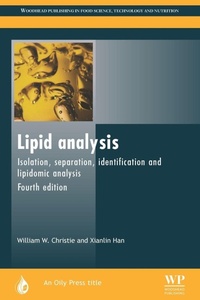
Lipid Analysis
Isolation, Separation, Identification and Lipidomic Analysis
4th Edition
Published on 19. August 2016
Book
Paperback/Softback
448 pages
978-0-08-101465-3 (ISBN)
Description
This well-known and highly successful book was first published in 1973 and has been completely re-written in subsequent editions (published in 1982 and 2003). This new Fourth Edition has become necessary because of the pace of developments in mass spectrometry of intact lipids, which has given recognition of lipid analysis and 'lipidomics' as a distinct science. To bring the book up to date with these developments, author William W. Christie is joined by co-author Xianlin Han. Although devoting considerable space to mass spectrometry and lipidomics, Lipid analysis remains a practical guide, in one volume, to the complexities of the analysis of lipids. As in past editions, it is designed to act as a primary source, of value at the laboratory bench rather than residing on a library shelf.
Lipid analysis deals with the isolation, separation, identification and structural analysis of glycerolipids, including triacylglycerols, phospholipids, sphingolipids, and the various hydrolysis products of these. The chapters follow a logical sequence from the extraction of lipids to the isolation and characterization of particular lipid classes and of molecular species of each, and to the mass spectrometric analysis of lipids and lipidomics.
The new influence of mass spectrometry is due mainly to the development of electrospray ionization (ESI) and matrix-assisted laser desorption/ionization (MALDI). Most emphasis in this book is placed on ESI, which is enabling structural characterization of different lipid classes and the identification of novel lipids and their molecular species.
Lipid analysis deals with the isolation, separation, identification and structural analysis of glycerolipids, including triacylglycerols, phospholipids, sphingolipids, and the various hydrolysis products of these. The chapters follow a logical sequence from the extraction of lipids to the isolation and characterization of particular lipid classes and of molecular species of each, and to the mass spectrometric analysis of lipids and lipidomics.
The new influence of mass spectrometry is due mainly to the development of electrospray ionization (ESI) and matrix-assisted laser desorption/ionization (MALDI). Most emphasis in this book is placed on ESI, which is enabling structural characterization of different lipid classes and the identification of novel lipids and their molecular species.
More details
Series
Edition
4th edition
Language
English
Place of publication
Oxford
United Kingdom
Publishing group
Elsevier Science & Technology
Target group
Professional and scholarly
Product notice
Paperback (trade)
Dimensions
Height: 231 mm
Width: 157 mm
Thickness: 27 mm
Weight
628 gr
ISBN-13
978-0-08-101465-3 (9780081014653)
Copyright in bibliographic data and cover images is held by Nielsen Book Services Limited or by the publishers or by their respective licensors: all rights reserved.
Schweitzer Classification
Other editions
Additional editions
Book
01/2010
4th Edition
Woodhead Publishing Ltd
€252.55
Withdrawn from sale
Previous edition

W. W. Christie
Lipid Analysis: v. 15
Isolation, Separation, Identification and Structural Analysis of Lipids
Book
01/2003
3rd Edition
Oily Press Ltd
€215.41
Article exhausted; check for reprint
Persons
William W. Christie, Scottish Crop Research Institute and Mylnefield Research Services, Scotland. Xianlin Han, Washington University School of Medicine, USA.
Content
Part 1 introducing lipids and their analysis: Lipids: Their structures and occurrence; Chromatographic analysis of lipids: General principles; Lipid extraction, storage and sample handling. Part 2 chromatographic separation and analysis of individual lipid classes: Analysis of simple lipid classes; Chromatographic analysis of phospholipids and glycosyldiacylglycerols; Chromatographic analysis of sphingolipids. Part 3 analysis of fatty acids: Preparation of derivatives of fatty acids; Gas chromatographic analysis of fatty acid derivatives; Isolation of fatty acids and identification by spectroscopic and related techniques. Part 4 chromatographic analysis of molecular species of lipids: Molecular species of triacylglycerols, diacylglycerols derived from complex lipids, and related lipids; Chromatographic analysis of molecular species of intact phospholipids and glycolipids; Positional distributions of fatty acids in glycerolipids. Part 5 mass spectrometric analysis of lipids in lipidomics: Introduction to mass spectrometric analysis of lipids in lipidomics; Characterization of lipids by electrospray ionization mass spectrometry; Practical identification of individual lipid species in lipid extracts of biological samples; Quantification of lipid molecular species by electrospray ionization mass spectrometry.