


Language Evolution
Published on 24. July 2003
Book
Hardback
414 pages
978-0-19-924483-6 (ISBN)
Description
What is it that makes us human?
This is one of the most challenging and important questions we face. Our species' defining characteristic is language - we appear to be unique in the natural world in having such an incredibly open-ended system for putting thoughts into words. If we are to truly understand ourselves as a species we must understand the origins of this strange and unique ability. To do so, we need to answer some of the most intriguing questions in contemporary scientific research: Where did language come from? How did it evolve? Why are we unique in possessing it?
This book, for the first time, brings together the leading thinkers who are trying to unlock the puzzle of language evolution. Here we see the latest ideas and theories from fields as diverse as anthropology, archaeology, artificial life, biology, cognitive science, linguistics, neuroscience, and psychology. In a series of seventeen well-written and accessible chapters we get an unrivalled view of the state of the art in this exciting area. Current controversies are revealed and new perspectives uncovered, in a clear and readable guide to the latest theories.
This collection marks a major step forward in our quest to understand the origins and evolution of human language. In doing so it sheds new light on the process of evolution, the workings of the brain, the structure of language, and - most importantly - what it means to be human.
Language Evolution is essential reading for researchers and students working in the areas covered, and has been used as a textbook for courses in the field. It will also attract the general reader who wants to know more about this fascinating subject.
This is one of the most challenging and important questions we face. Our species' defining characteristic is language - we appear to be unique in the natural world in having such an incredibly open-ended system for putting thoughts into words. If we are to truly understand ourselves as a species we must understand the origins of this strange and unique ability. To do so, we need to answer some of the most intriguing questions in contemporary scientific research: Where did language come from? How did it evolve? Why are we unique in possessing it?
This book, for the first time, brings together the leading thinkers who are trying to unlock the puzzle of language evolution. Here we see the latest ideas and theories from fields as diverse as anthropology, archaeology, artificial life, biology, cognitive science, linguistics, neuroscience, and psychology. In a series of seventeen well-written and accessible chapters we get an unrivalled view of the state of the art in this exciting area. Current controversies are revealed and new perspectives uncovered, in a clear and readable guide to the latest theories.
This collection marks a major step forward in our quest to understand the origins and evolution of human language. In doing so it sheds new light on the process of evolution, the workings of the brain, the structure of language, and - most importantly - what it means to be human.
Language Evolution is essential reading for researchers and students working in the areas covered, and has been used as a textbook for courses in the field. It will also attract the general reader who wants to know more about this fascinating subject.
Reviews / Votes
Some time since we and the chimpanzees went our separate evolutionary ways, probably towards the very end of that 6 million year period, an innovation occurred whose only precedent was arguably the DNA code itself. Language arose in our ancestors, and there had been nothing like it. Of course other species communicate, many of them vocally, but none of this comes close to the open-ended, generative capacity, the huge vocabulary, the nuanced subtlety, the permanent recordability of language. As an outsider, it is with real fascination that I have read this compendium. One of the merits of any book is its capacity to stimulate the reader to think beyond its confines. This, and other merits are possessed by Language Evolution in abundance. * Richard Dawkins * This book offers the current states of the art on the subject of language evolution, covering just about every scientific discipline that has a stake in answering the questions it raises. * Pragmatics * Language Evolution is a brave attempt at a state-of-the-art survey of language origin research at the beginning of the millennium. * Andrew Carstairs-McCarthy, Science * The evolutionary origins of language should intrigue anyone interested in the relationship of humans to other species. For them, Language Evolution will provide a useful starting point. * Andrew Carstairs-McCarthy, Science * In the beginning there was no language. Now there is. Language Evolution describes the passage as a wonderful voyage of discovery. * Nurturing Potential *More details
Series
Language
English
Place of publication
Oxford
United Kingdom
Target group
Professional and scholarly
Illustrations
line drawings and photographs
Dimensions
Height: 240 mm
Width: 161 mm
Thickness: 27 mm
Weight
787 gr
ISBN-13
978-0-19-924483-6 (9780199244836)
Copyright in bibliographic data and cover images is held by Nielsen Book Services Limited or by the publishers or by their respective licensors: all rights reserved.
Schweitzer Classification
Other editions
Additional editions
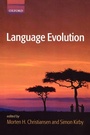
Morten H. Christiansen | Simon Kirby
Language Evolution
Book
07/2003
Oxford University Press
€80.20
Shipment within 15-20 days
Persons
Morten H. Christiansen is Assistant Professor of Psychology at Cornell University. He is co-editor of Connectionist Psycholinguistics published by Ablex in 2001.
Simon Kirby is a British Academy Research Fellow at the University of Edinburgh: his book, Function, Selection, and Innateness was published by OUP in 1999.
Simon Kirby is a British Academy Research Fellow at the University of Edinburgh: his book, Function, Selection, and Innateness was published by OUP in 1999.
Content
1. Language Evolution: The Hardest Problem in Science? ; 2. Language as an Adaptation to the Cognitive Niche ; 3. The Language Mosaic and its Evolution ; 4. What can the Field of Linguistics Tell Us About the Origins of Language? ; 5. Symbol and Structure: A Comprehensive Framework for Language Evolution ; 6. On the Different Origins of Symbols and Grammar ; 7. Universal Grammar and Semiotic Constraints ; 8. The Archaeological Evidence of Language Origins: States of the Art ; 9. What are the Uniquely Human Components of the Language Faculty? ; 10. The Evolving Mirror System: A Neural Basis for Language Readiness ; 11. From Hand to Mouth: the Gestural Origins of Language ; 12. The Origin and Subsequent Evolution of Language ; 13. Launching Language: the Gestural Origin of Discrete Infinity ; 14. Motor Control, Speech, and the Evolution of Human Language ; 15. From Language Learning to Language Evolution ; 16. Grammatical Assimilation ; 17. Language, Learning, and Evolution