

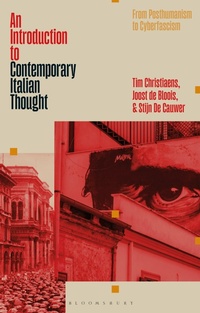
An Introduction to Contemporary Italian Thought
From Posthumanism to Cyberfascism
Will be published approx. on 22. January 2026
Book
Hardback
248 pages
978-1-350-40760-2 (ISBN)
Description
Over the past three decades, Italian thought has emerged as a major field within continental philosophy. But what are the latest developments since Italian theory rose to a peak of popularity in the 2000s? This book offers an accessible and incisive introduction to contemporary Italian thought, revealing above all its continued relevance to some of the most pressing political, social and ethical conflicts today.
Broadening the idea of Italian thought beyond biopolitics, An Introduction to Contemporary Italian Thought engages with a number of leading and upcoming philosophers, including Silvia Federici, Rosi Braidotti, Donatella di Cesare, Emanuele Coccia, Sandro Mezzadra, Franco 'Bifo' Berardi and Federico Luisetti. It demonstrates how Italian theory resonates in a wide variety of current debates, from digital technology, pandemics and populism to cyberfascism, environmentalism and decolonization. This not only uncovers the fruitfulness of Italian philosophy but further allows for fresh perspectives on debates dominated by well-trodden and often dated arguments. In consideration of populism, for instance, this book does not so much examine Donald Trump but rather turns to Silvio Berlusconi and Giorgia Meloni, just as its discussions of the digitization of work look beyond Silicon Valley to working conditions in EU and Global South from the perspective of Italian (post)workerism, and the Anthropocene is considered in light of radical zoological egalitarianism as it emerges in contemporary Italian thought.
Tackling head-on the complex and porous notion of what constitutes 'Italian thought', Christiaens, De Bloois and De Cauwer bring new understanding to contemporary Italian theory and, with it, novel perspectives on current critical issues.
Broadening the idea of Italian thought beyond biopolitics, An Introduction to Contemporary Italian Thought engages with a number of leading and upcoming philosophers, including Silvia Federici, Rosi Braidotti, Donatella di Cesare, Emanuele Coccia, Sandro Mezzadra, Franco 'Bifo' Berardi and Federico Luisetti. It demonstrates how Italian theory resonates in a wide variety of current debates, from digital technology, pandemics and populism to cyberfascism, environmentalism and decolonization. This not only uncovers the fruitfulness of Italian philosophy but further allows for fresh perspectives on debates dominated by well-trodden and often dated arguments. In consideration of populism, for instance, this book does not so much examine Donald Trump but rather turns to Silvio Berlusconi and Giorgia Meloni, just as its discussions of the digitization of work look beyond Silicon Valley to working conditions in EU and Global South from the perspective of Italian (post)workerism, and the Anthropocene is considered in light of radical zoological egalitarianism as it emerges in contemporary Italian thought.
Tackling head-on the complex and porous notion of what constitutes 'Italian thought', Christiaens, De Bloois and De Cauwer bring new understanding to contemporary Italian theory and, with it, novel perspectives on current critical issues.
Reviews / Votes
An essential guide to Italian thought blending historical insights with contemporary debates on biopolitics, posthumanism, and environmentalism. Perfect for anyone exploring Italian intellectual traditions and their impact on contemporary socio-political discourse. * Federica Pedriali, Professor of Literary Metatheory and Modern Italian Studies, University of Edinburgh, UK * This introduction to contemporary Italian thought not only broadens its boundaries, but shifts the point of observation to the new global horizon in which we live. In this perspective, excellently articulated by the editors, alongside the paradigms of biopolitics and workerism, the great themes of the posthuman and postcolonial, of digitalization and environmentalism assume ever greater importance. The gaze towards the 'outside' that has characterized Italian Thought from the beginning is thus being filled with new contents and new languages. * Roberto Esposito, Professor of Theoretical Philosophy, Scuola Normale Superiore, Italy * In this remarkable study, Tim Christiaens, Joost de Bloois, and Stijn De Cauwer significantly increase our understanding of a body of contemporary thought that is as undoubtedly influential as it is difficult to pin down. While grounded in the foundational contributions of well-known figures like Agamben, Negri, and Esposito, this work shows how a wide range of thinkers within the Italian diaspora have intervened into contemporary debates on biopolitics, neofascism, and other urgent issues. * Adam Kotsko, North Central College, USA * An Introduction to Contemporary Italian Thought represents an original contribution and an important development in the debate on Italian thought. While drawing on its main categories and taking stock of the debate so far, this book updates and renews it, bringing Italian thought into confrontation with the current issues that most characterize the contemporary world. * Dario Gentili, Roma Tre University, Italy * Tim Christiaens, Joost de Bloois, and Stijn De Cauwer have offered us a gift: they have captured and celebrated an original intellectual tradition of critical theory, "Italian Thought," that no one before them was able to frame with the same clarity and insightfulness. Whereas most scholarship privileges abstract philosophical genealogies, with this book, Tim Christiaens, Joost de Bloois, and Stijn De Cauwer reveal ways of practicing theory nurtured by reality, an influential and eccentric mode of thinking that inspires debates across disciplines, well beyond Italy. What emerges from this engaging introduction to Italian Thought is a constellation of thinkers united by an "interventionist" desire to reimagine theory from within the contemporary forms of life, labor, communication, and political action. An Introduction to Contemporary Italian Thought weaves the threads of a heterogeneous philosophy without dogmas, guided exclusively by the attraction of the social, technological, and ecological forces it cannot contain. From biopolitics to geopower, from cyberfascism to migrations, the unruly dynamics of the present take center stage in this powerful book, page after page, and remake concepts. * Federico Luisetti, Professor of Italian Studies and Environmental Humanities, University of St. Gallen, Switzerland *More details
Language
English
Place of publication
London
United Kingdom
Publishing group
Bloomsbury Publishing PLC
Target group
College/higher education
Dimensions
Height: 222 mm
Width: 145 mm
Thickness: 17 mm
Weight
448 gr
ISBN-13
978-1-350-40760-2 (9781350407602)
Copyright in bibliographic data and cover images is held by Nielsen Book Services Limited or by the publishers or by their respective licensors: all rights reserved.
Schweitzer Classification
Persons
Tim Christiaens is Assistant Professor of Economic Ethics at Tilburg University, the Netherlands.
Joost de Bloois is Associate Professor of Cultural and Literary Analysis at the University of Amsterdam, the Netherlands.
Stijn De Cauwer is Assistant Professor at the Leiden University Centre for the Arts in Society, the Netherlands.
Joost de Bloois is Associate Professor of Cultural and Literary Analysis at the University of Amsterdam, the Netherlands.
Stijn De Cauwer is Assistant Professor at the Leiden University Centre for the Arts in Society, the Netherlands.
Content
Introduction: What is Italian Thought?
1. Biopolitics in Post-Pandemic Times
2. Beyond Biopolitics? Italian Thought, Posthumanism and Environmentalism
3. The General Intellect: The Digitalization of Work as Class Struggle
4. Cyberfascism: The Elective Affinity between Fascism and Social Media
5. Identity, Migration, Postcoloniality
Conclusion: Towards a Politics of Invisible Cities
References
Index
1. Biopolitics in Post-Pandemic Times
2. Beyond Biopolitics? Italian Thought, Posthumanism and Environmentalism
3. The General Intellect: The Digitalization of Work as Class Struggle
4. Cyberfascism: The Elective Affinity between Fascism and Social Media
5. Identity, Migration, Postcoloniality
Conclusion: Towards a Politics of Invisible Cities
References
Index