

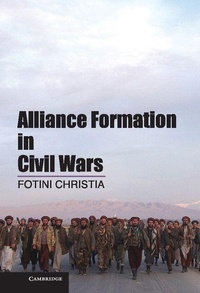
Alliance Formation in Civil Wars
Published on 12. November 2012
Book
Hardback
360 pages
978-1-107-02302-4 (ISBN)
Description
Some of the most brutal and long-lasting civil wars of our time involve the rapid formation and disintegration of alliances among warring groups, as well as fractionalization within them. It would be natural to suppose that warring groups form alliances based on shared identity considerations - such as Christian groups allying with Christian groups - but this is not what we see. Two groups that identify themselves as bitter foes one day, on the basis of some identity narrative, might be allies the next day and vice versa. Nor is any group, however homogeneous, safe from internal fractionalization. Rather, looking closely at the civil wars in Afghanistan and Bosnia and testing against the broader universe of fifty-three cases of multiparty civil wars, Fotini Christia finds that the relative power distribution between and within various warring groups is the primary driving force behind alliance formation, alliance changes, group splits and internal group takeovers.
Reviews / Votes
'Although some may argue that Christia's neo-realist framework is not comprehensive because it undervalues the ideological and psychological dimensions of civil wars, the author's argument is both persuasive and fundamental to understanding alliance formation and disintegration. The author's observation in the book's conclusion that the alliance shifts in Iraq's Anbar province in favour of the Iraqi government (and then against it) have been driven by relative power considerations seems to be borne out by events since the book's publication. Anyone interested in or responsible for policies aimed at resolving multi-party civil wars stands to gain from close consideration of Christia's argument.' H. R. McMaster, SurvivalMore details
Language
English
Place of publication
Cambridge
United Kingdom
Target group
Professional and scholarly
College/higher education
Illustrations
15 Tables, unspecified; 11 Maps; 19 Line drawings, unspecified
Dimensions
Height: 235 mm
Width: 157 mm
Thickness: 26 mm
Weight
735 gr
ISBN-13
978-1-107-02302-4 (9781107023024)
Copyright in bibliographic data and cover images is held by Nielsen Book Services Limited or by the publishers or by their respective licensors: all rights reserved.
Schweitzer Classification
Other editions
Additional editions
Fotini Christia
Alliance Formation in Civil Wars
Book
11/2012
Cambridge University Press
€42.00
Shipment within 15-20 days
Fotini Christia
Alliance Formation in Civil Wars
E-Book
11/2012
1st Edition
Cambridge University Press
€29.49
Available for download
Fotini Christia
Alliance Formation in Civil Wars
E-Book
11/2012
Cambridge University Press
€24.49
Available for download
Person
Fotini Christia is Associate Professor of Political Science at Massachusetts Institute of Technology. She received her Ph.D. in Public Policy at Harvard University in 2008. Her research interests deal with issues of ethnicity, conflict and cooperation in the Muslim world. She has done extensive ethnographic, survey and experimental research in Bosnia-Herzegovina and is presently working on a field experiment in Afghanistan that addresses the effects of development aid on post-conflict governance and state building. Her current Afghanistan research project, on which she is co-principal investigator, draws upon a randomized impact evaluation of a $1 billion community-driven development program. Professor Christia has received support for her research from the Harvard Academy for International and Area Studies, the London School of Economics International Growth Center, the UN's World Food Program and the World Bank, among other institutions. She has published work in publications such as Science, Comparative Politics and the Middle East Journal. She has also written on her experiences in Afghanistan, Iran, the West Bank and Gaza and Uzbekistan for Foreign Affairs, The New York Times, the Washington Post and the Boston Globe. She graduated magna cum laude with a joint B.A. in Economics and Operations Research from Columbia College and an MA in international affairs from the School of International and Public Affairs at Columbia University.
Content
Part I. Context and Theory: 1. Literature and research design; 2. A theory of warring group alliances and fractionalization in multi-party civil wars; Part II. Afghanistan: 3. The Afghan Intra-Mujahedin War, 1992-8; 4. The Afghan Communist-Mujahedin War, 1978-89; 5. The theory at the commander level in Afghanistan, 1978-98; Part III. Bosnia and Herzegovina: 6. The Bosnian Civil War, 1992-5; 7. The Bosnian Civil War, 1941-5; Part IV. Further Extensions: 8. Quantitative testing on the universe of cases of multi-party civil wars.