


The Breakthrough Manifesto
Description
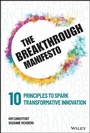
Innovation is a process by which new ideas, services, and sources of value are brought to life. Yet approaches to the pursuit of innovation are often far from novel, relying on stale methodologies applied against well-defined problem sets. Or worse, left to hope or happenstance.
Transformative innovation requires something else. Not just methodologies, but mindsets. Not just focusing on known challenges, but on unknown opportunities. Not just hoping for breakthrough by default but realizing breakthrough by design.
In The Breakthrough Manifesto, a renowned business innovation leader teams up with a social-personality psychologist to offer that something else-a collection of 10 visionary principles to obliterate barriers to change and ignite a whole new level of creative problem-solving. Drawing upon decades of experience working with the world's best-known organizations and their teams, the authors provide practical advice that goes beyond "business as usual" for successfully tackling intractable challenges.
Bursting with behavioral science, stories from the field, and pragmatic strategies, The Breakthrough Manifesto explores why these principles are critical for the current times and how they can spark breakthrough and unlock potential for you and your teams. Whether you're an executive or manager, product or service designer, educator or student, this book is a must-read for anyone inspired to change the world or transform their own place in it.
<b>Building a Better Path to Breakthrough, By Design</b>
Innovation is a process by which new ideas, services, and sources of value are brought to life. Yet approaches to the pursuit of innovation are often far from novel, relying on stale methodologies applied against well-defined problem sets. Or worse, left to hope or happenstance.
Transformative innovation requires something else. Not just methodologies, but mindsets. Not just focusing on known challenges, but on unknown opportunities. Not just hoping for breakthrough by default but realizing breakthrough by design.
In <i>The Breakthrough Manifesto</i>, a renowned business innovation leader teams up with a social-personality psychologist to offer that something else-a collection of 10 visionary principles to obliterate barriers to change and ignite a whole new level of creative problem-solving. Drawing upon decades of experience working with the world's best-known organizations and their teams, the authors provide practical advice that goes beyond "business as usual" for successfully tackling intractable challenges.
Bursting with behavioral science, stories from the field, and pragmatic strategies, <i>The Breakthrough Manifesto</i> explores why these principles are critical for the current times and how they can spark breakthrough and unlock potential for you and your teams. Whether you're an executive or manager, product or service designer, educator or student, this book is a must-read for anyone inspired to change the world or transform their own place in it.
More details
Other editions
Additional editions
Persons
SUZANNE VICKBERG is a social-personality psychologist and Chief Researcher for the Deloitte Greenhouse (R) Experience, focused on exploring the behavioral dynamics underpinning individual and team engagement and creative problem-solving.
<b>KIM CHRISTFORT</b> is the Chief Innovation Leader and founder of the Deloitte Greenhouse<sup> (R)</sup> Experience group, focused on pushing the frontiers of experiential engagement to help clients reveal opportunity and create meaningful impact.
<b>SUZANNE VICKBERG</b> is a social-personality psychologist and Chief Researcher for the Deloitte Greenhouse<sup> (R)</sup> Experience, focused on exploring the behavioral dynamics underpinning individual and team engagement and creative problem-solving.
Content
Welcome to Breakthrough
CHAPTER 1:
Silence Your Cynic
Toxic Effect #1: Death to Innovation
Toxic Effect #2: Bye, Bye Diverse Ideas
Toxic Effect #3: Shackles on the Mind
CHAPTER 2:
Strip Away Everything
Check Yourself
Question Orthodoxies
Don't Believe Everything You Hear
CHAPTER 3:
Live with the Problem
Look Before You Leap
Try Passive Percolation
Spend Your Time Wisely
CHAPTER 4:
Check Your Edge
Expand Your Thinking
Pursue the Unexpected
Stretch Yourself
CHAPTER 5:
Enlist a Motley Crew
Get Truly Motley
Enlist All Members
Row Like a Crew
CHAPTER 6:
Get Real
Find Your Equilibrium
Be Yourself But Keep Evolving
Get Real Together
CHAPTER 7:
Make a Mess
Produce a Prototype
Co-create
Build For Buy-in
CHAPTER 8:
Don't Play 'Nice'
Strike the Right Note
Make It Worth It
Anticipate Differences
CHAPTER 9:
Dial Up the Drama
Set the Stage
Immerse Yourself
Make Em Laugh
CHAPTER 10:
Make Change
Change
Iterate and Adapt
Make a Dent
Contents
Putting the Principles into Practice:
Breakthrough Methods
Silence Your Cynic Methods
1. Interrogate Yourself
2. Ask What If...?
3. Change Your Mind(set)
4. Get Physical
5. Buddy Up
Strip Away Everything Methods
1. Flip Orthodoxies
2. Defy Constraints
3. Sleuth for Truth
4. Search for UFOs (Unidentified Fact Options)
5. Reuse and Repurpose
Live with the Problem Methods
1. Act like a Toddler
2. Change the Lens
3. Try Question-storming
4. Stretch Out Your Brainstorming
5. Sleep On It
Check Your Edge Methods
1. Plot Your Portfolio
2. Think Three Bears
3. Play Mad Libs
4. Mix It Up
4. Push Yourself
Enlist a Motley Crew Methods
1. Reveal Your Superpower
2. Assess Your Team's Diversity
3. Mind the Gap
4. Interrupt Cascades
5. Celebrate Slogans
Get Real Methods
1. Start a Vulnerability Loop
2. Flag Highs and Lows
3. Explore Trust
4. Ask Deeper Questions
5. Listen
Make a Mess Methods
1. Go Marshmallow!
2. Make a Metaphor
3. Immerse Yourself
4. Stream Your Consciousness
5. Doodle Do
Don't Play 'Nice' Methods
1. Save a Seat for the Elephant
2. Go To Extremes
3. Find Your Achille's Heel
4. Like, Wish, and Wonder
5. Frame Feedback
Dial Up the Drama Methods
1. Kick It Around
2. Color Me Breakthrough
3. Light It Up
4. Make a Playlist
5. Be a Character
Make Change Methods
1. Navel-gaze
2. Establish Rituals
3. Motivate With Nudges
4. Plan for Scenarios
5. Find Your Why
References
Acknowledgements
A Note from the Authors
About the Authors