

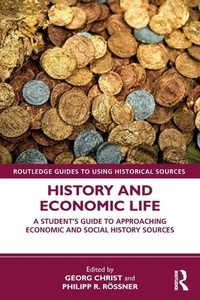
History and Economic Life
A Student's Guide to Approaching Economic and Social History Sources
1st Edition
Published on 12. March 2020
Book
Paperback/Softback
254 pages
978-1-138-58123-4 (ISBN)
Description
History and Economic Life offers students a wide-ranging introduction to both quantitative and qualitative approaches to interpreting economic history sources from the Middle Ages to the Twentieth Century.
Having identified an ever-widening gap between the use of qualitative sources by cultural historians and quantitative sources by economic historians, the book aims to bridge the divide by making economic history sources more accessible to students and the wider public, and highlighting the need for a complementary rather than exclusive approach. Divided into two parts, the book begins by equipping students with a toolbox to approach economic history sources, considering the range of sources that might be of use and introducing different ways of approaching them. The second part consists of case studies that examine how economic historians use such sources, helping readers to gain a sense of context and understanding of how these sources can be used. The book thereby sheds light on important debates both within and beyond the field, and highlights the benefits gained when combining qualitative and quantitative approaches to source analysis.
Introducing sources often avoided in culturally-minded history or statistically-minded economic history courses respectively, and advocating a combined quantitative and qualitative approach, it is an essential resource for students undertaking source analysis within the field.
Having identified an ever-widening gap between the use of qualitative sources by cultural historians and quantitative sources by economic historians, the book aims to bridge the divide by making economic history sources more accessible to students and the wider public, and highlighting the need for a complementary rather than exclusive approach. Divided into two parts, the book begins by equipping students with a toolbox to approach economic history sources, considering the range of sources that might be of use and introducing different ways of approaching them. The second part consists of case studies that examine how economic historians use such sources, helping readers to gain a sense of context and understanding of how these sources can be used. The book thereby sheds light on important debates both within and beyond the field, and highlights the benefits gained when combining qualitative and quantitative approaches to source analysis.
Introducing sources often avoided in culturally-minded history or statistically-minded economic history courses respectively, and advocating a combined quantitative and qualitative approach, it is an essential resource for students undertaking source analysis within the field.
Reviews / Votes
'A valuable and very welcome introduction to the rich variety of approaches to research in economic history'.Martin Chick, Professor of Economic History, University of Edinburgh, UK
More details
Series
Language
English
Place of publication
London
United Kingdom
Publishing group
Taylor & Francis Ltd
Target group
College/higher education
Illustrations
6 s/w Abbildungen, 11 s/w Tabellen
11 Tables, black and white; 6 Illustrations, black and white
Dimensions
Height: 234 mm
Width: 156 mm
Thickness: 15 mm
Weight
415 gr
ISBN-13
978-1-138-58123-4 (9781138581234)
Copyright in bibliographic data and cover images is held by Nielsen Book Services Limited or by the publishers or by their respective licensors: all rights reserved.
Schweitzer Classification
Other editions
Additional editions
Georg Christ | Philipp R. Roessner
History and Economic Life
A Student's Guide to Approaching Economic and Social History Sources
Book
03/2020
1st Edition
Routledge
€207.90
Shipment within 10-20 days
Georg Christ | Philipp R. Roessner
History and Economic Life
A Student's Guide to Approaching Economic and Social History Sources
E-Book
02/2020
1st Edition
Routledge
€52.99
Available for download
Georg Christ | Philipp R. Roessner
History and Economic Life
A Student's Guide to Approaching Economic and Social History Sources
E-Book
02/2020
1st Edition
Routledge
€52.99
Available for download
Persons
Georg Christ is a Senior Lecturer in Medieval and Early Modern History at the University of Manchester, UK. His research focuses on the late medieval eastern Mediterranean and Veneto-Mamluk trade and political relations, the history of knowledge management and the late medieval socio-economic transition.
Philipp R. Roessner is a Senior Lecturer in Early Modern History at the University of Manchester, UK, and Member of the Young Academy, Saxon Academy of Sciences. His publications and research interests are in late medieval and early modern German cultural and monetary history, history of capitalism, history of the Reformation, eighteenth-century Scotland, history of political economy and pre-classical economic reasoning (Cameralism, 'mercantilism').
Philipp R. Roessner is a Senior Lecturer in Early Modern History at the University of Manchester, UK, and Member of the Young Academy, Saxon Academy of Sciences. His publications and research interests are in late medieval and early modern German cultural and monetary history, history of capitalism, history of the Reformation, eighteenth-century Scotland, history of political economy and pre-classical economic reasoning (Cameralism, 'mercantilism').
Content
Introduction: Why and how do we read economic history sources? Part 1: Toolbox 1 The Study of Economic History Methods and Sources 2 What do we analyse - typology of sources 3 How to read economic history sources quantitatively 4 How do we analyse sources: Source analysis - the qualitative method Part 2: Case Studies 5 Origins of Capitalism: Transcultural Trade or Pepper Travelling from India to England 6 Origins of Capitalism II: Medieval urban property markets: Thirteenth-century Coventry revisited 7 Counting cows and coins: Monitoring the economy through port records, and trade statistics in the early modern period 8 Historical account books as a source for quantitative history 9 History through objects: The Example of Coins 10 The news and numbers: A guide to using digitized newspapers 11 Monsieur le Directeur: Letters and 'Ordinary' Investors in Modern France