

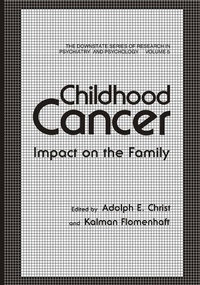
Childhood Cancer
Impact on the Family
Published on 12. June 2012
Book
Paperback/Softback
302 pages
978-1-4684-7268-4 (ISBN)
Description
The past decade has brought extraordinary gains in the outlook for children stricken with cancer. Though cancer remains a leading cause of death for children and young adults, more victims of child hood cancer today will survive than will die. The therapeutic advances and the optimism they instill have prompted researchers and clinicians to analyze the impact of cancer upon young patients and their famil,ies and to devise more effective intervention strategies. Hope and survival, juxtaposed with the continuing high mortality associated with certain forms of the illness, add new challenges to management of the psychosocial aspects of cancer. To respond to these challenges we need research as rigorous as that which continues to make inroads in treating the physical illness. This specific concern for the needs of children suffering from cancer and their families has paralleled an increasing sensitivity on the part of the medical community and the public at large to the limitations of specialized, high technology health care practices.
More details
Series
Edition
Softcover reprint of the original 1st ed. 1984
Language
English
Place of publication
New York
United States
Target group
Professional and scholarly
Research
Product notice
Paperback (trade)
Unsewn / adhesive bound
Illustrations
302 p.
Dimensions
Height: 254 mm
Width: 178 mm
Thickness: 18 mm
Weight
605 gr
ISBN-13
978-1-4684-7268-4 (9781468472684)
DOI
10.1007/978-1-4684-7266-0
Schweitzer Classification
Other editions
Additional editions
E-Book
12/2012
Springer
€96.29
Available for download
Book
02/1984
1st Edition
Kluwer Academic/Plenum Publishers
€85.55
Article exhausted; check different version
Content
Psychosocial Challenges in Childhood Cancer.- Section.- Psychogenic Etiology and Prognosis of Cancer-Current Status of Theory.- Discussion: Psychogenesis, Stress, Immunity and Cancer Etiology and Prognosis.- Section.- Complexity of Cancer Etiologies.- Section.- Clinical Cancer Research: Patient, Parent and Physician Interactions.- Discussion: Documentation of Effectiveness of Psychosocial Interventions.- Section.- The Staffing Conference in Pediatric Oncology.- Discussion: Not Everyone is Ready to Bring It up in the Classroom.- Section.- Therapeutic Strategies at Psychosocial Crisis Points in the Treatment of Childhood Cancer.- Discussion: The Crises of Survival.- Section.- Human Responses to Cancer: An Ecological Approach.- Discussion: Is a Marriage between Psychoanalysis and Systems Theory Ecologically Sound?.- Section.- Cross-Cultural Perspectives to Childhood Cancer.- Discussion: Importance of Cultural and Religious Experience.- Section.- Home Care for the Child with Cancer.- Discussion: Feasibility and Desirability.- Section.- Coping with Survivorship in Childhood Cancer: Family Problems.- Discussion: Not Easily Forgotten?.- Section.- The Elusive Neuropsychiatrie Symptoms.- Discussion: Damage to the Developing Brain and Subtle Psychiatric Consequences: Implications of the Case of Milton.- Section.- Psychosocial Issues and Future Directions: General Discussion.- List of Contributors.