

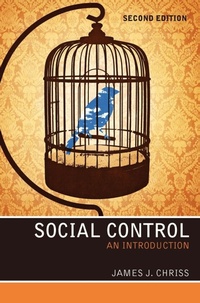
Social Control
An Introduction
2nd Edition
Published on 7. December 2012
Book
Hardback
258 pages
978-0-7456-5438-6 (ISBN)
Description
What is social control? How do social controls become part of everyday life? What role does the criminal justice system play in exerting control? Is the diagnosis and treatment of mental illness a form of social control? Do we need more social controls to prevent terrorist atrocities?
In this new edition of his popular and engaging introduction, James J. Chriss carefully guides readers through the debates about social control. The book provides a comprehensive guide to historical debates and more recent controversies, examining in detail the criminal justice system, medicine, everyday life, and national security.
Assuming no specialist knowledge on the part of readers, Chriss uses a rich range of contemporary examples to illustrate the ways in which social control is exerted and maintained. The updated edition includes new and expanded discussion of the 2011 Tucson shootings, post-9/11 counterterrorism laws in the transition from the Bush to the Obama administrations, the death of bin Laden, racial profiling, housing segregation and white flight, hate crimes, (counter)surveillance and flash mobs, the diagnosis of conditions such as ADHD, and agents of socialization in the areas of work and consumption, religion, the family, and the mass media.
This new edition of Social Control: An Introduction will be essential reading for students taking courses in deviance and social control, and will also appeal to those studying criminology, the sociology of law, and medical sociology.
In this new edition of his popular and engaging introduction, James J. Chriss carefully guides readers through the debates about social control. The book provides a comprehensive guide to historical debates and more recent controversies, examining in detail the criminal justice system, medicine, everyday life, and national security.
Assuming no specialist knowledge on the part of readers, Chriss uses a rich range of contemporary examples to illustrate the ways in which social control is exerted and maintained. The updated edition includes new and expanded discussion of the 2011 Tucson shootings, post-9/11 counterterrorism laws in the transition from the Bush to the Obama administrations, the death of bin Laden, racial profiling, housing segregation and white flight, hate crimes, (counter)surveillance and flash mobs, the diagnosis of conditions such as ADHD, and agents of socialization in the areas of work and consumption, religion, the family, and the mass media.
This new edition of Social Control: An Introduction will be essential reading for students taking courses in deviance and social control, and will also appeal to those studying criminology, the sociology of law, and medical sociology.
Reviews / Votes
'Chriss reminds us that social control, the flip side of deviance, is central to social life; all societies practice it, from the pinnacle of the power structure to all of us at the grassroots, in our interactions with others on a one-to-one basis. His discussion is both broad and specific to particular key realms: Chriss has done an admirable job of analyzing how social control operates in the contemporary world, with terrorism, ADHD, and racialized social relations supplying key examples.'Erich Goode, Stony Brook University
'The author is widely read in the field of social control, and is to be commended for his coverage of a broad range of material. While the focus is on sociological materials, the author has included relevant concepts and research from related fields, and the connections among disparate literatures reflect insight and originality. The quality of the content is excellent - I thoroughly enjoyed reading it.'
John DeLamater, University of Wisconsin-Madison
'For a century now, scholars have tried to conceptualize control as a central notion in sociology. The second edition of James Chriss's Social Control continues the grand tradition begun by Ward and Ross, deftly weaving in classical and contemporary thought and using current events to illustrate medical, legal, and informal control. This is essential reading for all social scientists, young and old.'
Matthias Gross, Helmholtz Centre for Environmental Research, UFZ, Leipzig
'Social Control provides a theoretical diverse and timely discussion of the way the government, medical system, and citizens attempt to regulate behavior in modern society. Chriss draws on wide range of scholarly work in criminology and sociology and presents numerous examples from contemporary America to support his central points.'
James Tucker, University of New Hampshire
"A comprehensive guide to historical debates and more recent controversies, examining in detail the criminal justice system, medicine, everyday life, and national security."
Expofairs
More details
Edition
2nd edition
Language
English
Place of publication
Oxford
United Kingdom
Publishing group
John Wiley and Sons Ltd
Target group
Professional and scholarly
Product notice
sewn/stitched
Cloth over boards
Dimensions
Height: 244 mm
Width: 170 mm
Thickness: 18 mm
Weight
685 gr
ISBN-13
978-0-7456-5438-6 (9780745654386)
Copyright in bibliographic data and cover images is held by Nielsen Book Services Limited or by the publishers or by their respective licensors: all rights reserved.
Schweitzer Classification
Other editions
New editions
Book
09/2022
Polity Press
€74.50
Shipment within 15-20 days
Additional editions
Book
12/2012
2nd Edition
Polity Press
Unfortunately, price unknown
Article exhausted; check for reprint
Previous edition

Book
12/2007
Polity Press
€88.20
Article exhausted; check for reprint
Person
James J. Chriss is Professor in the Department of Sociology and Criminology at Cleveland State University
Content
Introduction
PART I UNDERSTANDING SOCIAL CONTROL
1. What is Social Control?
2. A Typology of Social Control
3. Informal Control
4. Medical Control
5. Legal Control
PART II CASE STUDIES IN SOCIAL CONTROL
6. Informal Control: Housing Segregation, the Code of the Street, and the Dark Side of Emerging Adulthood
7. Medical Control: ADHD, Selective Mutism, and Violence as a Disease
8. Legal Control: Racial Profiling, Hate Crimes, and the Growth in Imprisonment
9. Terrorism and Social Control
10. Conclusion: The Future of Social Control?
Notes
References
PART I UNDERSTANDING SOCIAL CONTROL
1. What is Social Control?
2. A Typology of Social Control
3. Informal Control
4. Medical Control
5. Legal Control
PART II CASE STUDIES IN SOCIAL CONTROL
6. Informal Control: Housing Segregation, the Code of the Street, and the Dark Side of Emerging Adulthood
7. Medical Control: ADHD, Selective Mutism, and Violence as a Disease
8. Legal Control: Racial Profiling, Hate Crimes, and the Growth in Imprisonment
9. Terrorism and Social Control
10. Conclusion: The Future of Social Control?
Notes
References