

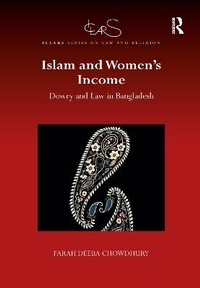
Islam and Women's Income
Dowry and Law in Bangladesh
1st Edition
Published on 30. June 2020
Book
Paperback/Softback
146 pages
978-0-367-59554-8 (ISBN)
Description
This book examines the interrelationship between law, culture, patriarchy and religion in the context of contemporary Bangladesh. It explores the role of Islam in society and politics generally, and its influence on gender equality in particular. The work focuses on the situation of married women. Taking a socio-legal approach, it analyses the changing nature of the dowry practice and its relation to women's increasing paid labour force activity. Despite anti-dowry legislation, it is argued here that the dowry system continues in the form of the appropriation of wives' income. The work calls for legal recognition of this action and the amendment of the Dowry Prohibition Act 1980 as a result of the changing social realities that are taking place in the lives of Bangladeshi women. An Islamic approach is applied to equality between men and women in addressing and analysing these issues. The book includes international comparisons on gender equality and discusses the role of the Convention on the Elimination of All Forms of Descrimination Against Women (CEDAW), as well as the dowry system in South Asia.
The book will be of interest to academics and researchers working in the areas of law and religion, gender studies and international development.
The book will be of interest to academics and researchers working in the areas of law and religion, gender studies and international development.
Reviews / Votes
This book offers an original Islamic interpretation of formal and substantive equality as requiring Bangladeshi husbands to stop appropriating wives' earnings and to pay them maintenance and dower. Drawing on a deep understanding of national values, the author recommends Bangladesh criminalize income appropriation under existing anti-dowry legislation which does not apply to dower and could significantly improve the lives of working wives. Beverley Baines, Professor, Faculty of Law, Queen's University.Islam and Women`s Income (highlight title) provides a devastating critique of Bangladesh`s dowry system, which both reinforces patriarchal power and reduces married women`s control over their earned income. Indeed, Chowdhury develops a powerful argument for the importance of critically assessing the way cultural practices can interact with economic, political and legal forces to reinforce and legitimate gender inequality. This is a shocking and depressing story, but an essential read for scholars, development experts, policy makers and citizens concerned with developing a more gender equal world. Jane Parpart, Research Professor, University of Massachusetts Boston, Conflict Resolution, Human Security and Global Governance.
More details
Series
Language
English
Place of publication
London
United Kingdom
Publishing group
Taylor & Francis Ltd
Target group
College/higher education
Postgraduate
Dimensions
Height: 246 mm
Width: 174 mm
Weight
300 gr
ISBN-13
978-0-367-59554-8 (9780367595548)
Copyright in bibliographic data and cover images is held by Nielsen Book Services Limited or by the publishers or by their respective licensors: all rights reserved.
Schweitzer Classification
Other editions
Additional editions
Book
12/2016
1st Edition
Routledge
€232.60
Shipment within 10-20 days
E-Book
12/2016
1st Edition
Routledge
€59.49
Available for download
E-Book
12/2016
1st Edition
Routledge
€59.49
Available for download
Person
Farah Deeba Chowdhury is a Scholar in Residence at the Global Labour Research Centre, York University, Canada. She has served as an Associate Professor in the Department of Political Science at the University of Rajshahi, Bangladesh and has also held an SSHRC Postdoctoral Fellowship in the Department of Gender Studies at Queen's University, Canada. She specializes in the areas of Islam, gender and law; gender and work; gender and politics; and gender and development. She has published widely on these topics.
Content
Introduction; Theoretical and Conceptual Issues; Equality Debates in the West; Equality Within Islam: Formal and Substantive; Methodology; Overview of Remaining Chapters; Women and Islam in Bangladesh; The Politics of Islam in Bangladeshi Society; Women, Islam and Society in Bangladesh; Women in the Popular Books on Islam in Bangladesh; Misinterpretation of Islam and Husband-Wife Relationships in Bangladesh; Muslim Family Law in Bangladesh; Dower and Maintenance in Bangladesh; Divorce; Polygamy; Child Custody and Guardianship; Inheritance Law; CEDAW, Islamic Law and Women in Bangladesh; CEDAW and Islamic Law; CEDAW and Muslim Countries; CEDAW, Islam and Politics in Bangladesh; Same Responsibilities Between Men and Women; Dowry, Women and Law in Bangladesh; The Dowry System in South Asia; The Emergence of Dowry in Bangladesh; Men's Expectations from Their Wives or Wives' Family During Marriage; Dowry and Law in Bangladesh; Women, Income and Dowry in Bangladesh.; ; Women and Employment; Women's Income and Dowry in Bangladesh; The Strategies That Husbands Employ to Control Wives' Income; Conclusion