

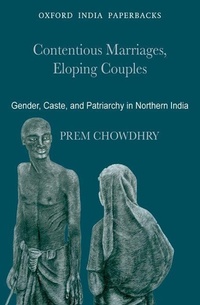
Contentious Marriages, Eloping Couples
Gender, Caste, and Patriarchy in Northern India
Published on 13. August 2009
Book
Paperback/Softback
358 pages
978-0-19-806361-2 (ISBN)
Description
This book deals with the widespread phenomenon of contentious marriages and elopements in rural and semi-urban north India, specifically in the state of Haryana. Such challenges to norms and customs have escalated in recent times, and have become more complex due to the changing dynamics of power between, and within, caste groups. As the runaway couples question the authority of family, caste, and community, the traditional powers have become more dictatorial and often reacted with violence.
The study shows how the colonial order strengthened caste endogamy and posed a serious challenge to inter-caste marriage. It also focuses on the intervention of the caste panchayats, and seeks to explain both how and why these patriarchal bodies wield extra-judicial power despite post-colonial changes in law and polity. Further, the book demonstrates how the state colludes with the traditional forces to de-legitimize attempts to break out of the traditional system, thus often overriding the legal rights and human rights of individuals. The volume also discusses the implications of the Hindu Succession Act of 1956 for women. It also shows how the emergence of a restricted marriage market, skewed sex ratio, an escalating dowry economy, and extensive unemployment have created a crisis of masculinity, power, and domination.
The book takes an inter-disciplinary approach and draws insights from sociology, gender studies, history, popular culture, politics, and law towards understanding the concepts of caste, community, and honour in contemporary Indian society. It is based on extensive fieldwork, interviews, official and legal documents, and archival material. It will be of interest to scholars of sociology, history, popular culture, politics, law, and gender studies.
The study shows how the colonial order strengthened caste endogamy and posed a serious challenge to inter-caste marriage. It also focuses on the intervention of the caste panchayats, and seeks to explain both how and why these patriarchal bodies wield extra-judicial power despite post-colonial changes in law and polity. Further, the book demonstrates how the state colludes with the traditional forces to de-legitimize attempts to break out of the traditional system, thus often overriding the legal rights and human rights of individuals. The volume also discusses the implications of the Hindu Succession Act of 1956 for women. It also shows how the emergence of a restricted marriage market, skewed sex ratio, an escalating dowry economy, and extensive unemployment have created a crisis of masculinity, power, and domination.
The book takes an inter-disciplinary approach and draws insights from sociology, gender studies, history, popular culture, politics, and law towards understanding the concepts of caste, community, and honour in contemporary Indian society. It is based on extensive fieldwork, interviews, official and legal documents, and archival material. It will be of interest to scholars of sociology, history, popular culture, politics, law, and gender studies.
More details
Series
Language
English
Place of publication
New Delhi
India
Target group
College/higher education
Professional and scholarly
Product notice
Paperback (trade)
Unsewn / adhesive bound
Dimensions
Height: 206 mm
Width: 147 mm
Thickness: 25 mm
Weight
295 gr
ISBN-13
978-0-19-806361-2 (9780198063612)
Copyright in bibliographic data and cover images is held by Nielsen Book Services Limited or by the publishers or by their respective licensors: all rights reserved.
Schweitzer Classification
Person
Prem Chowdhry is an independent researcher and Former Fellow of the Nehru Memorial Museum and Library, New Delhi.
Content
ACKNOWLEDGEMENTS, INTRODUCTION; ; 1. Colonial period: Creeping Rigidity; ; 2. Post-colonial Haryana: Caste Endogamy and Traditional Panchayats; ; 3. Inter-Caste Marriages: Defying Cultural Norms ; 4. Cases of Runaway Marriage: State Intervention ; 5. Controlling Remarriage: Post-Colonial Strengthening of the Levirate ; 6. Understanding Local Perceptions: Caste Stereotypes and Cultural Explanations; ; 7. Social Factors: Political Economy of Contentious Marriages ; EPILOGUE: COMPLEXITIES AND CONCERNS; GLOSSARY; BIBLIOGRAPHY; INDEX