

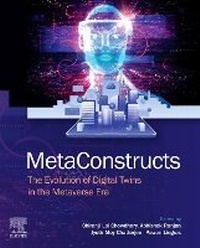
MetaConstructs
The Evolution of Digital Twins in the Metaverse Era
Will be published approx. on 1. March 2026
Book
Paperback/Softback
400 pages
978-0-443-40678-2 (ISBN)
Description
Digital twins integrate IoT, artificial intelligence, machine learning, and analytics with a graphic and/or spatial representation to make animate digital simulation models that can change and develop as their physical counterpart does. A digital twin learns and updates itself continuously using real-time data from sensors on the physical asset to represent operating, environmental, and working conditions in near real-time.
The metaverse technology represents a comprehensive virtual world, where everything and everyone interacts similarly to what we would do in the real world. The concept of metaverse has gained a lot of prominence after several cryptocurrency networks adopted the technology. With the metaverse technology, a virtual reality becomes a persistent virtual environment that exists even when you are not engaging with it.
The digital twin in IoT (Internet of things) and the metaverse are the next big step in our technological evolution as these two technologies continue to shorten the gap between the human and the digital world. MetaConstructs: The Evolution of Digital Twins in the Metaverse Era provides information on emerging fields of next-generation digital twins with a special emphasis on emerging developments and applications of the metaverse, IoT, artificial intelligence, deep learning techniques, virtual reality, augmented reality, internet of medical things (IoMT), optimization techniques, decision making, and cloud computing.
The book provides a conceptual framework and roadmap for decision-makers for this transformation. It can be useful for undergraduate and postgraduate students who have studied artificial intelligence, federated learning, ML/DL, computational intelligence, IoT, cloud computing, and genetic algorithms in their academic curriculum. This book will be useful for students to develop and deploy their skills to achieve a thorough knowledge of analytics and in-depth education experience to focus on their unique interests. Acknowledging the huge demands of professionals in the industry today, this book has been designed to create trained Computer Science graduates to fulfil the requirements of the industry.
The metaverse technology represents a comprehensive virtual world, where everything and everyone interacts similarly to what we would do in the real world. The concept of metaverse has gained a lot of prominence after several cryptocurrency networks adopted the technology. With the metaverse technology, a virtual reality becomes a persistent virtual environment that exists even when you are not engaging with it.
The digital twin in IoT (Internet of things) and the metaverse are the next big step in our technological evolution as these two technologies continue to shorten the gap between the human and the digital world. MetaConstructs: The Evolution of Digital Twins in the Metaverse Era provides information on emerging fields of next-generation digital twins with a special emphasis on emerging developments and applications of the metaverse, IoT, artificial intelligence, deep learning techniques, virtual reality, augmented reality, internet of medical things (IoMT), optimization techniques, decision making, and cloud computing.
The book provides a conceptual framework and roadmap for decision-makers for this transformation. It can be useful for undergraduate and postgraduate students who have studied artificial intelligence, federated learning, ML/DL, computational intelligence, IoT, cloud computing, and genetic algorithms in their academic curriculum. This book will be useful for students to develop and deploy their skills to achieve a thorough knowledge of analytics and in-depth education experience to focus on their unique interests. Acknowledging the huge demands of professionals in the industry today, this book has been designed to create trained Computer Science graduates to fulfil the requirements of the industry.
More details
Language
English
Place of publication
Philadelphia
United States
Target group
Professional and scholarly
Dimensions
Height: 235 mm
Width: 191 mm
Weight
630 gr
ISBN-13
978-0-443-40678-2 (9780443406782)
Copyright in bibliographic data and cover images is held by Nielsen Book Services Limited or by the publishers or by their respective licensors: all rights reserved.
Schweitzer Classification
Other editions
Additional editions
Chiranji Lal Chowdhary | Abhishek Ranjan | Jyotir Moy Chatterjee
MetaConstructs
The Evolution of Digital Twins in the Metaverse Era
E-Book
02/2026
Elsevier
€185.99
Available for download
Persons
Dr. Chiranji Lal Chowdhary is an Associate Professor at the School of Computer Science Engineering and Information Systems, within the
Vellore Institute of Technology, Vellore in India. Dr. Abhishek Ranjan is Deputy Vice Chancellor at Botho University, Gaborone in Botswana. Jyotir Moy Chatterjee is currently an Assistant Professor in Department of Computer Science and Engineering at Graphic Era (Deemed to be University), in Dehradun, India. He also serves as a Visiting Faculty member in Information Technology at Lord Buddha Education Foundation, which is affiliated with the Asia Pacific University of Technology & Innovation in Kathmandu, Nepal. His research interests focus on advancements in Machine Learning and Deep Learning.
Dr. Pawan Lingras, is a Professor in the Department of Math and Computing Science, Saint Mary's University, Halifax, Nova Scotia, in Canada.
Vellore Institute of Technology, Vellore in India. Dr. Abhishek Ranjan is Deputy Vice Chancellor at Botho University, Gaborone in Botswana. Jyotir Moy Chatterjee is currently an Assistant Professor in Department of Computer Science and Engineering at Graphic Era (Deemed to be University), in Dehradun, India. He also serves as a Visiting Faculty member in Information Technology at Lord Buddha Education Foundation, which is affiliated with the Asia Pacific University of Technology & Innovation in Kathmandu, Nepal. His research interests focus on advancements in Machine Learning and Deep Learning.
Dr. Pawan Lingras, is a Professor in the Department of Math and Computing Science, Saint Mary's University, Halifax, Nova Scotia, in Canada.
Content
1. Privacy, Security, and Ethical Considerations
2. AI/ML for Digital Twins Enabled Metaverse
3. Digital Twins in Healthcare Development of an Accurate Machine Learning Model for Health Monitoring Through Digital Twins
4. Revolutionizing Health Care: The Role of Digital Twins in Personalized Medicine
5. Digital Twin and Education: A revolutionary pathway to learning
6. Bridging Real and Virtual Worlds Through Digital Twins and the Metaverse in Cultural Heritage Preservation
8. Convergence of Metaverse and Digital Twins: Evolution, Integration, and Future Challenges in Virtual-Physical Systems
9. Quantum Computing for Digital Twins and the Metaverse
10. AI/ML with Digital Twin enabled Metaverse
11. Enhancing Robotic Surgery with Neuromorphic Computing
2. AI/ML for Digital Twins Enabled Metaverse
3. Digital Twins in Healthcare Development of an Accurate Machine Learning Model for Health Monitoring Through Digital Twins
4. Revolutionizing Health Care: The Role of Digital Twins in Personalized Medicine
5. Digital Twin and Education: A revolutionary pathway to learning
6. Bridging Real and Virtual Worlds Through Digital Twins and the Metaverse in Cultural Heritage Preservation
8. Convergence of Metaverse and Digital Twins: Evolution, Integration, and Future Challenges in Virtual-Physical Systems
9. Quantum Computing for Digital Twins and the Metaverse
10. AI/ML with Digital Twin enabled Metaverse
11. Enhancing Robotic Surgery with Neuromorphic Computing