

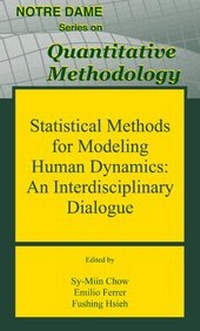
Statistical Methods for Modeling Human Dynamics
1st Edition
Published on 10. December 2009
Book
Paperback/Softback
248 pages
978-1-84872-826-4 (ISBN)
Description
This interdisciplinary volume features contributions from researchers in the fields of psychology, neuroscience, statistics, computer science, and physics. State-of-the-art techniques and applications used to analyze data obtained from studies in cognition, emotion, and electrophysiology are reviewed along with techniques for modeling in real time and for examining lifespan cognitive changes, for conceptualizing change using item response, nonparametric and hierarchical models, and control theory-inspired techniques for deriving diagnoses in medical and psychotherapeutic settings. The syntax for running the analyses presented in the book is provided at www.psypress.com/chow. Most of the programs are written in R while others are for Matlab, SAS, Win-BUGS, and DyFA.
Readers will appreciate a review of the latest methodological techniques developed in the last few years. Highlights include an examination of:
statistical and mathematical modeling techniques for the analysis of brain imaging such as EEGs, fMRIs, and other neuroscience data
dynamic modeling techniques for intensive repeated measurement data
panel modeling techniques for fewer time points data
state-space modeling techniques for psychological data
techniques used to analyze reaction time data
Each chapter features an introductory overview of the techniques needed to understand the chapter, a summary, and numerous examples. Each self-contained chapter can be read on its own and in any order. Divided into three major sections, the book examines techniques for examining within-person derivations in change patterns, intra-individual change, and inter-individual differences in change and interpersonal dynamics. Intended for advanced students and researchers, this book will appeal to those interested in applying state-of-the-art dynamic modeling techniques to the the study of neurological, developmental, cognitive, and social/personality psychology, as well as neuroscience, computer science, and engineering.
Readers will appreciate a review of the latest methodological techniques developed in the last few years. Highlights include an examination of:
statistical and mathematical modeling techniques for the analysis of brain imaging such as EEGs, fMRIs, and other neuroscience data
dynamic modeling techniques for intensive repeated measurement data
panel modeling techniques for fewer time points data
state-space modeling techniques for psychological data
techniques used to analyze reaction time data
Each chapter features an introductory overview of the techniques needed to understand the chapter, a summary, and numerous examples. Each self-contained chapter can be read on its own and in any order. Divided into three major sections, the book examines techniques for examining within-person derivations in change patterns, intra-individual change, and inter-individual differences in change and interpersonal dynamics. Intended for advanced students and researchers, this book will appeal to those interested in applying state-of-the-art dynamic modeling techniques to the the study of neurological, developmental, cognitive, and social/personality psychology, as well as neuroscience, computer science, and engineering.
More details
Series
Language
English
Place of publication
London
United Kingdom
Publishing group
Taylor & Francis Ltd
Target group
College/higher education
Product notice
Paperback (UK-B)
ISBN-13
978-1-84872-826-4 (9781848728264)
Copyright in bibliographic data and cover images is held by Nielsen Book Services Limited or by the publishers or by their respective licensors: all rights reserved.
Schweitzer Classification
Other editions
Additional editions
Sy-Miin Chow | Emilio Ferrer | Fushing Hsieh
Statistical Methods for Modeling Human Dynamics
An Interdisciplinary Dialogue
E-Book
02/2011
1st Edition
Routledge
€225.99
Available for download
Sy-Miin Chow | Emilio Ferrer | Fushing Hsieh
Statistical Methods for Modeling Human Dynamics
An Interdisciplinary Dialogue
E-Book
02/2011
1st Edition
Routledge
€225.99
Available for download
Persons
University of Notre Dame University of California, Davis, USA
Content
Introduction and Section Overview. Part 1: Parametric and Exploratory Approaches for Extracting Within-Person Nonstationarities P. C. M. Molenaar, N. Ram, Dynamic Modeling and Optimal Control of Intra-Individual Variation: A Computational Paradigm for Non-Ergodic Psychological Processes. M. Tarvainen, Dynamic Spectral Analysis of Biomedical Signals with Application to EEG and Heart Rate Variability. B. Gao, H. Ombao, M. R. Ho, Cluster Analysis for Non-Stationary Time Series. R. Prado, Characterizing Latent Structure in Brain Signals. H. Ombao, R. Prado, A Closer Look at Two Approaches for Analysis and Classification of Non-Stationary Time Series. Part 2: Representing and Extracting Intraindividual Change S. Boker, P. R. Deboeck, C. Edler, P. Keep, Generalized Local Linear Approximation of Derivatives from Time Series. P. R. Doebeck, S. M. Boker, Unbiased, Smoothing-Corrected Estimation of Oscillators in Psychology. P. F. Craigmile, M. Peruggia, T. Van Zandt, Detrending Response Times Series. G. Zhang, M. W. Browne, Dynamic Factor Analysis with Ordinal Manifest Variables. R. P. Bowles, Measuring Intraindividual Variability with Intratask Change Using Item Response Models. Part 3: Modeling Interindividual Differences in Chang and Interpersonal Dynamics R. Cudeck, J. Harring, Developing a Random Coefficient Model for Nonlinear Repeated Measures Data. F. Hamagami, Z. J. Zhang, J. McArdle, A Bayesian Discrete Dynamic System by Latent Difference Score Structural Equations Models for Multivariate Repeated Measures Data. L. Wang, Z. Zhang, R. Estabrook, Longitudinal Mediation Analysis of Training Intervention Effects. F. Hsieh, S. Chen, S. Chow, E. Ferrer, Exploring Intra-Individual, Inter-Individual and Inter-Variable Dynamics in Dyadic Interactions.