

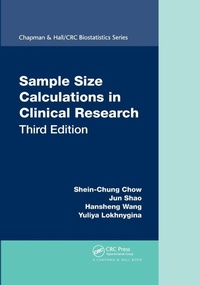
Sample Size Calculations in Clinical Research
3rd Edition
Published on 30. September 2020
Book
Paperback/Softback
510 pages
978-0-367-65776-5 (ISBN)
Description
Praise for the Second Edition:
"... this is a useful, comprehensive compendium of almost every possible sample size formula. The strong organization and carefully defined formulae will aid any researcher designing a study." -Biometrics
"This impressive book contains formulae for computing sample size in a wide range of settings. One-sample studies and two-sample comparisons for quantitative, binary, and time-to-event outcomes are covered comprehensively, with separate sample size formulae for testing equality, non-inferiority, and equivalence. Many less familiar topics are also covered ..." - Journal of the Royal Statistical Society
Sample Size Calculations in Clinical Research, Third Edition presents statistical procedures for performing sample size calculations during various phases of clinical research and development. A comprehensive and unified presentation of statistical concepts and practical applications, this book includes a well-balanced summary of current and emerging clinical issues, regulatory requirements, and recently developed statistical methodologies for sample size calculation.
Features:
Compares the relative merits and disadvantages of statistical methods for sample size calculations
Explains how the formulae and procedures for sample size calculations can be used in a variety of clinical research and development stages
Presents real-world examples from several therapeutic areas, including cardiovascular medicine, the central nervous system, anti-infective medicine, oncology, and women's health
Provides sample size calculations for dose response studies, microarray studies, and Bayesian approaches
This new edition is updated throughout, includes many new sections, and five new chapters on emerging topics: two stage seamless adaptive designs, cluster randomized trial design, zero-inflated Poisson distribution, clinical trials with extremely low incidence rates, and clinical trial simulation.
"... this is a useful, comprehensive compendium of almost every possible sample size formula. The strong organization and carefully defined formulae will aid any researcher designing a study." -Biometrics
"This impressive book contains formulae for computing sample size in a wide range of settings. One-sample studies and two-sample comparisons for quantitative, binary, and time-to-event outcomes are covered comprehensively, with separate sample size formulae for testing equality, non-inferiority, and equivalence. Many less familiar topics are also covered ..." - Journal of the Royal Statistical Society
Sample Size Calculations in Clinical Research, Third Edition presents statistical procedures for performing sample size calculations during various phases of clinical research and development. A comprehensive and unified presentation of statistical concepts and practical applications, this book includes a well-balanced summary of current and emerging clinical issues, regulatory requirements, and recently developed statistical methodologies for sample size calculation.
Features:
Compares the relative merits and disadvantages of statistical methods for sample size calculations
Explains how the formulae and procedures for sample size calculations can be used in a variety of clinical research and development stages
Presents real-world examples from several therapeutic areas, including cardiovascular medicine, the central nervous system, anti-infective medicine, oncology, and women's health
Provides sample size calculations for dose response studies, microarray studies, and Bayesian approaches
This new edition is updated throughout, includes many new sections, and five new chapters on emerging topics: two stage seamless adaptive designs, cluster randomized trial design, zero-inflated Poisson distribution, clinical trials with extremely low incidence rates, and clinical trial simulation.
Reviews / Votes
Praise for the Second Edition:"... this is a useful, comprehensive compendium of almost every possible sample size formula. The strong organization and carefully defined formulae will aid any researcher designing a study." -Biometrics
"This impressive book contains formulae for computing sample size in a wide range of settings. One-sample studies and two-sample comparisons for quantitative, binary, and time-to-event outcomes are covered comprehensively, with separate sample size formulae for testing equality, non-inferiority, and equivalence. Many less familiar topics are also covered ..." - Journal of the Royal Statistical Society
"The book is nicely set out with an introduction to the basic idea of each topic, followed by various formulae that lead to power calculations . . . In all, I consider this book to be well written, and it touches on quite a number of more recent topics in sample size determination. Consequently, it will be a useful addition to clinical statisticians as a point of reference to solve more complex issues in power calculations during the design of a clinical trial." - Steve Su, International Society for Clinical Biostatistics
Sample Size Calculations in Clinical Research, Third Edition presents statistical procedures for performing sample size calculations during various phases of clinical research and development. A comprehensive and unified presentation of statistical concepts and practical applications, this book includes a well-balanced summary of current and emerging clinical issues, regulatory requirements, and recently developed statistical methodologies for sample size calculation.
Features:
Compares the relative merits and disadvantages of statistical methods for sample size calculations
Explains how the formulae and procedures for sample size calculations can be used in a variety of clinical research and development stages
Presents real-world examples from several therapeutic areas, including cardiovascular medicine, the central nervous system, anti-infective medicine, oncology, and women's health
Provides sample size calculations for dose response studies, microarray studies, and Bayesian approaches
This new edition is updated throughout, includes many new sections, and five new chapters on emerging topics: two stage seamless adaptive designs, cluster randomized trial design, zero-inflated Poisson distribution, clinical trials with extremely low incidence rates, and clinical trial simulation. Praise for the Second Edition:
"... this is a useful, comprehensive compendium of almost every possible sample size formula. The strong organization and carefully defined formulae will aid any researcher designing a study." -Biometrics
"This impressive book contains formulae for computing sample size in a wide range of settings. One-sample studies and two-sample comparisons for quantitative, binary, and time-to-event outcomes are covered comprehensively, with separate sample size formulae for testing equality, non-inferiority, and equivalence. Many less familiar topics are also covered ..." - Journal of the Royal Statistical Society"The book is nicely set out with an introduction to the basic idea of each topic, followed by various formulae that lead to power calculations . . . In all, I consider this book to be well written, and it touches on quite a number of more recent topics in sample size determination. Consequently, it will be a useful addition to clinical statisticians as a point of reference to solve more complex issues in power calculations during the design of a clinical trial." - Steve Su, International Society for Clinical Biostatistics
Sample Size Calculations in Clinical Research, Third Edition presents statistical procedures for performing sample size calculations during various phases of clinical research and development. A comprehensive and unified presentation of statistical concepts and practical applications, this book includes a well-balanced summary of current and emerging clinical issues, regulatory requirements, and recently developed statistical methodologies for sample size calculation.
Features:
Compares the relative merits and disadvantages of statistical methods for sample size calculations
Explains how the formulae and procedures for sample size calculations can be used in a variety of clinical research and development stages
Presents real-world examples from several therapeutic areas, including cardiovascular medicine, the central nervous system, anti-infective medicine, oncology, and women's health
Provides sample size calculations for dose response studies, microarray studies, and Bayesian approaches
This new edition is updated throughout, includes many new sections, and five new chapters on emerging topics: two stage seamless adaptive designs, cluster randomized trial design, zero-inflated Poisson distribution, clinical trials with extremely low incidence rates, and clinical trial simulation.
More details
Series
Edition
3rd edition
Language
English
Place of publication
Oxford
United Kingdom
Publishing group
Taylor & Francis Ltd
Target group
Professional and scholarly
Professional Practice & Development
Dimensions
Height: 254 mm
Width: 178 mm
Thickness: 28 mm
Weight
953 gr
ISBN-13
978-0-367-65776-5 (9780367657765)
Copyright in bibliographic data and cover images is held by Nielsen Book Services Limited or by the publishers or by their respective licensors: all rights reserved.
Schweitzer Classification
Other editions
Additional editions
Shein-Chung Chow | Jun Shao | Hansheng Wang
Sample Size Calculations in Clinical Research
Book
08/2017
3rd Edition
CRC Press
€205.30
Shipment within 10-20 days
Shein-Chung Chow | Jun Shao | Hansheng Wang
Sample Size Calculations in Clinical Research
E-Book
08/2017
3rd Edition
Chapman & Hall/CRC
€58.99
Available for download
Shein-Chung Chow | Jun Shao | Hansheng Wang
Sample Size Calculations in Clinical Research
E-Book
08/2017
3rd Edition
Chapman & Hall/CRC
€59.49
Available for download
Persons
Shein-Chung Chow, PhD, is a professor in the Department of Biostatistics and Bioinformatics at Duke University School of Medicine. Dr. Chow is also an adjunct professor at Duke-National University of Singapore Graduate Medical School, an adjunct professor at North Carolina State University, and founding director of the Global Clinical Trial and Research Center in Tianjin, China. He is editor-in-chief of the Journal of Biopharmaceutical Statistics and editor-in-chief of the Chapman & Hall/CRC Biostatistics Series. He is the author or co-author of more than 250 papers and 24 books, including Adaptive Design Methods in Clinical Trials, Second Edition, Handbook of Adaptive Designs in Pharmaceutical and Clinical Development, and Controversial Statistical Issues in Clinical Trials. A fellow of the ASA and member of the ISI, Dr. Chow has received the ASA Chapter Service Recognition Award, the DIA Outstanding Service Award, and the ICSA Extraordinary Achievement Award.
Dr. Lokhnygina is an Assistant Professor of Biostatistics and Bioinformatics at Duke University and a faculty member at Duke Clinical Research Institute. Her primary research interests are in statistical methods for multicenter clinical trials, particularly in application to cardiovascular and diabetes research.
Dr. Lokhnygina is an Assistant Professor of Biostatistics and Bioinformatics at Duke University and a faculty member at Duke Clinical Research Institute. Her primary research interests are in statistical methods for multicenter clinical trials, particularly in application to cardiovascular and diabetes research.
Content
Introduction. Considerations Prior to Sample Size Calculation. Comparing Means. Large Sample Tests for Proportions. Exact Tests for Proportions. Tests for Goodness-of-Fit and Contingency Tables. Comparing Time-to-Event Data. Group Sequential Methods. Comparing Variabilities. Bioequivalence Testing. Dose Resonse Studies. Microarray Studies. Bayesian Sample Size Calculation. Nonparametrics. Cluster Randomized Design. Sample Size Calculation for Two-Stage Adaptive Design. Sample Size for Clinical Trials with Extremely Low Incidence Rates. Clinical Trial Simulation for Sample Size Estimation. Sample Size Calculation in Other Areas.