

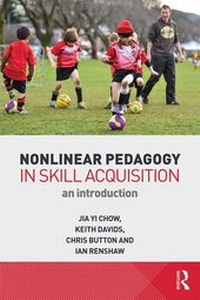
Nonlinear Pedagogy in Skill Acquisition
An Introduction
1st Edition
Published on 30. November 2015
Book
Paperback/Softback
242 pages
978-0-415-74439-3 (ISBN)
Description
Nonlinear pedagogy is a powerful paradigm for understanding human movement and for designing effective teaching, coaching and training programs in sport, exercise and physical education. It addresses the inherent complexity in the learning of movement skills, viewing the learner, the learning environment and the teacher or coach as a complex interacting system, with the constraints of individual practice tasks providing the platform for functional movement behaviours to emerge. This is the first book to explain this profoundly important new approach to skill acquisition, introducing key theoretical ideas and best practice for students, teachers and coaches.
The first section of the book offers a general theoretical framework to explain processes of skill acquisition and the learning of movement skills. The book then defines nonlinear pedagogy, and outlines its key principles of practice. It offers a thorough and critical appraisal of the optimal use of instructional constraints and practice design, and discusses methods for creating challenging and supportive individualised learning environments at developmental, sub-elite and elite levels of performance. Every chapter contains cases and examples from sport and exercise contexts, providing guidance on practice activities and lessons. Nonlinear Pedagogy in Skill Acquisition is an essential companion for any degree level course in skill acquisition, motor learning, sport science, sport pedagogy, sports coaching practice, or pedagogy or curriculum design in physical education.
The first section of the book offers a general theoretical framework to explain processes of skill acquisition and the learning of movement skills. The book then defines nonlinear pedagogy, and outlines its key principles of practice. It offers a thorough and critical appraisal of the optimal use of instructional constraints and practice design, and discusses methods for creating challenging and supportive individualised learning environments at developmental, sub-elite and elite levels of performance. Every chapter contains cases and examples from sport and exercise contexts, providing guidance on practice activities and lessons. Nonlinear Pedagogy in Skill Acquisition is an essential companion for any degree level course in skill acquisition, motor learning, sport science, sport pedagogy, sports coaching practice, or pedagogy or curriculum design in physical education.
More details
Language
English
Place of publication
London
United Kingdom
Publishing group
Taylor & Francis Ltd
Target group
College/higher education
Illustrations
10 s/w Tabellen, 19 s/w Zeichnungen, 2 s/w Photographien bzw. Rasterbilder
10 Tables, black and white; 19 Line drawings, black and white; 2 Halftones, black and white
Dimensions
Height: 234 mm
Width: 156 mm
Weight
385 gr
ISBN-13
978-0-415-74439-3 (9780415744393)
Copyright in bibliographic data and cover images is held by Nielsen Book Services Limited or by the publishers or by their respective licensors: all rights reserved.
Schweitzer Classification
Other editions
New editions
Book
12/2021
2nd Edition
Routledge
€67.40
Shipment within 15-20 days
Additional editions

Book
12/2015
1st Edition
Routledge
€207.98
Article exhausted; check for reprint
Persons
Jia Yi Chow is currently the Assistant Dean (Degree Programme) at the Office of Teacher Education and a member of staff at the Physical Education and Sports Science Academic Group at the National Institute of Education, Nanyang Technological University, Singapore. His primary research area is in nonlinear pedagogy, which is underpinned by key theoretical perspectives from dynamical systems and ecological psychology. His other research interests include examining multi-articular coordination and visual search strategies captured within sports expertise. Jia Yi works closely with the Physical Education and Sports Teachers Academy (PESTA) at the Ministry of Education, Singapore, and also the Singapore Sports Institute.
Keith Davids is Professor of Motor Learning at the Centre for Sports Engineering Research, Sheffield Hallam University, UK. He currently holds the position of Finnish Distinguished Professor at the Faculty of Sport and Health Sciences, University of Jyvaeskylae, Finland. He has held professorial positions in the UK, New Zealand, Australia and Finland. His research in ecological dynamics investigates constraints on emergent coordination tendencies in athletes and sports teams. These key ideas have been integrated into a nonlinear pedagogy, informed by his work on motor learning design in sport. He currently supervises doctoral students from the UK, France, Finland, Portugal, Australia and New Zealand. He has worked with elite sport development agencies including the New Zealand South Island Academy, the Queensland Academy of Sport, the Australian Institute of Sport, Diving Australia, Cricket Australia and the English Institute of Sport.
Chris Button works at the School of Physical Education, Sport and Exercise Sciences, University of Otago in Dunedin, New Zealand. His research interests include fundamental movement skill development and water safety. Chris also coaches (football) and provides a skill-acquisition consultancy for a number of sports in New Zealand. Chris is an executive committee member of the Australasian Skill Acquisition Research Group (ASARG).
Ian Renshaw is based in the School of Exercise & Nutrition Sciences, Queensland University of Technology, Brisbane, Australia. His research interests are in ecological dynamics and nonlinear pedagogy with particular emphasis on the development of sporting expertise. Ian is currently Head Coach of Toombul DCC in the Brisbane Grade Cricket competition. Ian is also an executive committee member of the Australasian Skill Acquisition Research Group (ASARG).
Keith Davids is Professor of Motor Learning at the Centre for Sports Engineering Research, Sheffield Hallam University, UK. He currently holds the position of Finnish Distinguished Professor at the Faculty of Sport and Health Sciences, University of Jyvaeskylae, Finland. He has held professorial positions in the UK, New Zealand, Australia and Finland. His research in ecological dynamics investigates constraints on emergent coordination tendencies in athletes and sports teams. These key ideas have been integrated into a nonlinear pedagogy, informed by his work on motor learning design in sport. He currently supervises doctoral students from the UK, France, Finland, Portugal, Australia and New Zealand. He has worked with elite sport development agencies including the New Zealand South Island Academy, the Queensland Academy of Sport, the Australian Institute of Sport, Diving Australia, Cricket Australia and the English Institute of Sport.
Chris Button works at the School of Physical Education, Sport and Exercise Sciences, University of Otago in Dunedin, New Zealand. His research interests include fundamental movement skill development and water safety. Chris also coaches (football) and provides a skill-acquisition consultancy for a number of sports in New Zealand. Chris is an executive committee member of the Australasian Skill Acquisition Research Group (ASARG).
Ian Renshaw is based in the School of Exercise & Nutrition Sciences, Queensland University of Technology, Brisbane, Australia. His research interests are in ecological dynamics and nonlinear pedagogy with particular emphasis on the development of sporting expertise. Ian is currently Head Coach of Toombul DCC in the Brisbane Grade Cricket competition. Ian is also an executive committee member of the Australasian Skill Acquisition Research Group (ASARG).
Content
1. Overview and introduction to skill performance and learning 2. (Re)organising movement system degrees of freedom to achieve task goals 3. An Ecological Dynamics rationale for a Nonlinear Pedagogy 4. Nonlinear Pedagogy: An Overview of Key principles 5. The role of functional, adaptive variability in promoting individualized learning 6. Specificity of transfer and representative learning design 7. Provision of information to stabilize perception-action couplings 8. Manipulating instructional constraint to encourage exploratory learning 9. Practice Task Organisation and Movement Variability 10. Practice Task Organisation and Movement Variability 11. Why do we do what we do?: Applications of a Nonlinear Pedagogy in Physical Education and Sport Contexts 12. The Motivational Impact of Nonlinear Pedagogy 13. Emotions of learning in a Nonlinear Pedagogy perspective