

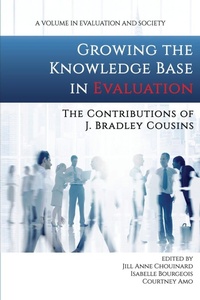
Growing the Knowledge Base in Evaluation
The Contributions of J. Bradley Cousins
Published on 13. September 2019
Book
Paperback/Softback
216 pages
978-1-64113-769-0 (ISBN)
Description
Evaluation use was identified by Henry and Mark (2003) as being the single most studied area in the field of evaluation. They refer with a sense of nostalgia to the 'golden age' of research on use perhaps almost implying that it came and went. Professor J. Bradley Cousins has had a longstanding and continuing commitment to advancing theory and practice regarding use through empirical research on evaluation, and through the professional development of students and practitioners within North America and internationally. The important influence and impact of the contributions of Cousins and associates is the focus of this edited book.
This book brings together a distinguished, international group of authors, to reflect on the areas of contribution of Professor Cousins, and situate his work within contemporary areas of evaluation research and practice. Each chapter describes how the study and practice of evaluation has weaved its way through our understanding of organizational learning, participatory evaluation, and evaluation capacity building. The book concludes with a reflection by Professor Cousins himself on what these insights mean for the field of evaluation, and what future areas of research and contribution can be planned for and anticipated.
This book brings together a distinguished, international group of authors, to reflect on the areas of contribution of Professor Cousins, and situate his work within contemporary areas of evaluation research and practice. Each chapter describes how the study and practice of evaluation has weaved its way through our understanding of organizational learning, participatory evaluation, and evaluation capacity building. The book concludes with a reflection by Professor Cousins himself on what these insights mean for the field of evaluation, and what future areas of research and contribution can be planned for and anticipated.
More details
Series
Language
English
Place of publication
Charlotte
United States
Publishing group
Emerald Publishing Inc
Target group
Professional and scholarly
Dimensions
Height: 234 mm
Width: 156 mm
Thickness: 12 mm
Weight
336 gr
ISBN-13
978-1-64113-769-0 (9781641137690)
Copyright in bibliographic data and cover images is held by Nielsen Book Services Limited or by the publishers or by their respective licensors: all rights reserved.
Schweitzer Classification
Other editions
Additional editions
E-Book
01/2019
1st Edition
Information Age Publishing
from
€62.33
Available for download
Persons
Jill Anne Chouinard, University of North Carolina at Greensboro.
Isabelle Bourgeois, Ecole Nationale D'administration Publique, Canada.
Courtney Amo, Independent Scholar.
Isabelle Bourgeois, Ecole Nationale D'administration Publique, Canada.
Courtney Amo, Independent Scholar.
Content
Introduction; Jill Anne Chouinard and Courtney Amo.
Chapter 1. On the Contributions of J. Bradley Cousins to Educational Administration and Their Influences on His Work in Program Evaluation; Peter Milley and Jill Anne Chouinard.
Chapter 2. Counting the Ways That Brad Cousins Shaped My Thinking About Evaluation; Jean A. King.
Chapter 3. Evaluation Theory Contributions of J. Bradley Cousins: Focus on Process Use; Michael Quinn Patton.
Chapter 4. The Many Facets Of Evaluation Capacity: Conceptual, Methodological, and Practical; Isabelle Bourgeois, Catherine Elliott, Swee Goh, and Robert E. Lahey.
Chapter 5. An Exploration of the Values Underpinning the Theory and Practice of Collaborative Approaches to Evaluation; Nathalie Gilbert, Hind Al Hudib, and Elizabeth Whitmore.
Chapter 6. Stakeholders Weigh in on Collaborative Approaches to Evaluation; Lyn M. Shulha, Michelle Searle, Cheryl N. Poth, and Agnieszka Chalas.
Chapter 7. Evaluation and Knowledge Mobilization: Advancing Integrated Knowledge Translation Through the Work of J. Bradley Cousins; Barbara Szijarto, Kate Svensson, and Peter Milley.
Chapter 8. Brad Cousins as a Brad: The Skillful Integration of Research on Evaluation, Evaluation Use, Conceptual Models, and Participatory Evaluation; Melvin M. Mark.
Chapter 9. Moving Forward, Look Back; Courtney Amo, Jill Anne Chouinard, Isabelle Bourgeois, and John Burrett.
Chapter 10. The Nature and Implications of an Evaluation Research Program; J. Bradley Cousins.
About the Authors.
Chapter 1. On the Contributions of J. Bradley Cousins to Educational Administration and Their Influences on His Work in Program Evaluation; Peter Milley and Jill Anne Chouinard.
Chapter 2. Counting the Ways That Brad Cousins Shaped My Thinking About Evaluation; Jean A. King.
Chapter 3. Evaluation Theory Contributions of J. Bradley Cousins: Focus on Process Use; Michael Quinn Patton.
Chapter 4. The Many Facets Of Evaluation Capacity: Conceptual, Methodological, and Practical; Isabelle Bourgeois, Catherine Elliott, Swee Goh, and Robert E. Lahey.
Chapter 5. An Exploration of the Values Underpinning the Theory and Practice of Collaborative Approaches to Evaluation; Nathalie Gilbert, Hind Al Hudib, and Elizabeth Whitmore.
Chapter 6. Stakeholders Weigh in on Collaborative Approaches to Evaluation; Lyn M. Shulha, Michelle Searle, Cheryl N. Poth, and Agnieszka Chalas.
Chapter 7. Evaluation and Knowledge Mobilization: Advancing Integrated Knowledge Translation Through the Work of J. Bradley Cousins; Barbara Szijarto, Kate Svensson, and Peter Milley.
Chapter 8. Brad Cousins as a Brad: The Skillful Integration of Research on Evaluation, Evaluation Use, Conceptual Models, and Participatory Evaluation; Melvin M. Mark.
Chapter 9. Moving Forward, Look Back; Courtney Amo, Jill Anne Chouinard, Isabelle Bourgeois, and John Burrett.
Chapter 10. The Nature and Implications of an Evaluation Research Program; J. Bradley Cousins.
About the Authors.