

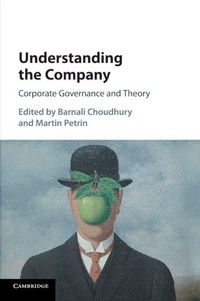
Understanding the Company
Corporate Governance and Theory
Published on 6. December 2018
Book
Paperback/Softback
350 pages
978-1-316-50936-4 (ISBN)
Description
What is the purpose of the company and its role in society? From their origin in medieval times to their modern incarnation as powerful transnational bodies, companies remain an important part of business and society at large. Drawing from a variety of perspectives, this book adopts a normative approach to understanding the modern company and provides insights into how companies should be conceptualized. It considers key topics such as the development of corporate theory, the rights and obligations of the company, and the means and ends of corporate governance. Written by leading experts of different jurisdictions, this book provides important international viewpoints on some of the most pressing corporate governance questions.
More details
Language
English
Place of publication
Cambridge
United Kingdom
Target group
Professional and scholarly
Product notice
Paperback (trade)
Illustrations
1 Tables, black and white; 1 Halftones, black and white; 7 Line drawings, black and white
Dimensions
Height: 229 mm
Width: 152 mm
Thickness: 19 mm
Weight
510 gr
ISBN-13
978-1-316-50936-4 (9781316509364)
Copyright in bibliographic data and cover images is held by Nielsen Book Services Limited or by the publishers or by their respective licensors: all rights reserved.
Schweitzer Classification
Other editions
Additional editions
Book
07/2017
Cambridge University Press
€96.50
Shipment within 15-20 days
Persons
Barnali Choudhury is a Senior Lecturer at University College London. She is the author of Public Services and International Trade Liberalization: Human Rights and Gender Implications (Cambridge, 2012) as well as over twenty articles and book chapters. She has delivered lectures internationally and her research has been cited by the UK House of Lords EU Select Committee, arbitral tribunals, and non-governmental organizations. Prior to joining academia she practiced corporate and international investment law. Martin Petrin is a Senior Lecturer at University College London and the Deputy Director of its Centre for Commercial Law. He holds an SJD specializing in corporate law from the University of California, Los Angeles, a PhD from Universitaet St Gallen, Switzerland, and an LLM from Columbia University, New York. Martin has practiced law with a leading international business law firm and has been admitted to the Bar in New York and Switzerland. He has been a visiting scholar at the University of Cambridge, Faculty of Law and Max-Planck-Institut fuer auslaendisches und internationales Privatrecht, Germany. Petrin has published and presented widely on corporate governance topics.
Content
1. Introduction Barnali Choudhury and Martin Petrin; Part I. Comparative and Historical Perspectives: 2. The four transformations of the corporate form Reuven S. Avi-Yonah; 3. Comparative corporate governance: old and new Martin Gelter; 4. The corporation's intrinsic attributes Christopher M. Bruner; Part II. The Company: Public or Private?: 5. Understanding the modern company through the lens of quasi-public power Marc T. Moore; 6. Reflections on the nature of the public corporation in an era of shareholder activism and stewardship Dionysia Katelouzou; 7. Regulating for corporate sustainability: why the public-private divide misses the point Beate Sjafjell; Part III. Rights or Duty Bearer?: 8. The constitutional rights of corporations in the United States Brandon L. Garrett; 9. Understanding corporate criminal liability Ian B. Lee; 10. Human rights and business: expectations, requirements and procedures for the responsible modern company Karin Buhmann; 11. A balancing approach to corporate rights and duties Martin Petrin; Part IV. Governing the Modern Company: 12. Corporate law reform in the era of shareholder empowerment William W. Bratton; 13. Board accountability and the entity maximization and sustainability approach Andrew Keay; 14. The corporation and the question of time Lynn Stout; 15. Epilogue: a look to the future Barnali Choudhury and Martin Petrin.