

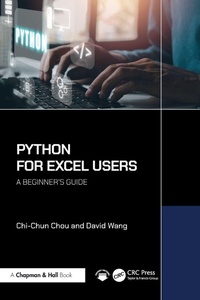
Python for Excel Users
A Beginner's Guide
1st Edition
Published on 6. October 2025
Book
Paperback/Softback
6 pages
978-1-032-93675-8 (ISBN)
Description
Introduction: Elevate Your Analytics with Python
In today's data-driven world, the ability to efficiently analyze and interpret information is more crucial than ever, especially in the business sector. Python for Excel Users: A Beginner's Guide is tailored for business students and professionals who are proficient in Microsoft Excel but are ready to embark on their Python journey. As a powerful and versatile programming language, Python has become indispensable in data analysis. This book bridges the gap between Excel and Python by providing parallel exercises that demonstrate how Python can amplify business analytics tasks with unmatched efficiency and flexibility.
Through its side-by-side comparisons, interactive Python exercises, and a "teachable moment" approach, this guide offers a unique and intuitive learning experience. By translating familiar Excel tasks into Python's dynamic and versatile ecosystem, you'll not only enhance your data analysis skills but also gain confidence in programming.
Why Python?
Did you know that Python powers cutting-edge technologies like ChatGPT? Indeed, Python forms the foundation of many machine learning algorithms, including large language models (LLMs). Python is more than a programming language; it's a tool for understanding and shaping the digital world. Despite its advanced capabilities, Python's simple, readable syntax makes it accessible to everyone - from professional software developers to citizen developers like you. Dubbed the "language of the people," Python is revolutionizing how we approach problem-solving and automation in the modern world.
Becoming Tomorrow's Tech- Savvy Leaders
The leaders of tomorrow are not just visionaries - they are innovators who harness the power of technology to drive change and inspire others. This book guides you through different scenarios to help you understand the connections between business questions and analytics steps we are taking.
As business students embracing Python, you're positioning yourselves as future-ready leaders equipped to navigate and excel in the complexities of modern business.
Welcome to a journey that will elevate your analytics, expand your technological fluency, and transform you into a tech-savvy leader of the future.
In today's data-driven world, the ability to efficiently analyze and interpret information is more crucial than ever, especially in the business sector. Python for Excel Users: A Beginner's Guide is tailored for business students and professionals who are proficient in Microsoft Excel but are ready to embark on their Python journey. As a powerful and versatile programming language, Python has become indispensable in data analysis. This book bridges the gap between Excel and Python by providing parallel exercises that demonstrate how Python can amplify business analytics tasks with unmatched efficiency and flexibility.
Through its side-by-side comparisons, interactive Python exercises, and a "teachable moment" approach, this guide offers a unique and intuitive learning experience. By translating familiar Excel tasks into Python's dynamic and versatile ecosystem, you'll not only enhance your data analysis skills but also gain confidence in programming.
Why Python?
Did you know that Python powers cutting-edge technologies like ChatGPT? Indeed, Python forms the foundation of many machine learning algorithms, including large language models (LLMs). Python is more than a programming language; it's a tool for understanding and shaping the digital world. Despite its advanced capabilities, Python's simple, readable syntax makes it accessible to everyone - from professional software developers to citizen developers like you. Dubbed the "language of the people," Python is revolutionizing how we approach problem-solving and automation in the modern world.
Becoming Tomorrow's Tech- Savvy Leaders
The leaders of tomorrow are not just visionaries - they are innovators who harness the power of technology to drive change and inspire others. This book guides you through different scenarios to help you understand the connections between business questions and analytics steps we are taking.
As business students embracing Python, you're positioning yourselves as future-ready leaders equipped to navigate and excel in the complexities of modern business.
Welcome to a journey that will elevate your analytics, expand your technological fluency, and transform you into a tech-savvy leader of the future.
More details
Language
English
Place of publication
United Kingdom
Publishing group
Taylor & Francis Ltd
Target group
College/higher education
Professional and scholarly
Academic, General, and Undergraduate Core
Illustrations
247 s/w Abbildungen, 89 s/w Photographien bzw. Rasterbilder, 158 s/w Zeichnungen, 4 s/w Tabellen
4 Tables, black and white; 158 Line drawings, black and white; 89 Halftones, black and white; 247 Illustrations, black and white
Dimensions
Height: 234 mm
Width: 156 mm
Thickness: 20 mm
Weight
550 gr
ISBN-13
978-1-032-93675-8 (9781032936758)
Copyright in bibliographic data and cover images is held by Nielsen Book Services Limited or by the publishers or by their respective licensors: all rights reserved.
Schweitzer Classification
Other editions
Additional editions
E-Book
10/2025
1st Edition
Chapman and Hall
€68.49
Available for download
E-Book
10/2025
1st Edition
Chapman and Hall
€68.49
Available for download
Book
10/2025
1st Edition
Chapman & Hall/CRC
€134.00
Shipment within 10-20 days
Persons
Dr. Chi-Chun Chou is a Professor of Accounting at the College of Business, California State University, Monterey Bay. His academic background encompasses both computer science and accounting, enabling him to broaden the scope of Accounting Information Systems (AIS), including Deep Learning, Large Language Models, Machine Learning, Data Analytics, Robotic Process Automation, and Blockchain. He has contributed scholarly articles incorporating various technologies to esteemed publications such as the Computers and Industrial Engineering, Journal of Information Systems, International Journal of Accounting Information Systems, and Journal of Emerging Technologies in Accounting and also serves as a Domain Editor for the Journal of Emerging Technologies in Accounting and is an Editorial Member for the Journal of Information Systems.
Tawei (David) Wang is a KPMG/Neil F. Casson Endowed Professor at DePaul University. He is currently an Associate Editor of Information and Management and the Co-Senior Editor of the Journal of Information Systems. His research interests are information security management and IT management, and his papers have appeared in several leading journals, including Accounting Horizons, Auditing: A Journal of Practice and Theory, Decision Support Systems, European Journal of Information Systems, Information and Management, Information Systems Journal, Information Systems Research, International Journal of Accounting Information Systems, Journal of Accounting and Public Policy, Journal of Banking and Finance, Journal of Information Systems, among others. He mainly teaches audit data analytics and has been invited by universities and conferences to discuss analytics teaching strategies. He was a Fulbright Specialist focusing on data analytics curriculum design in accounting programs.
Tawei (David) Wang is a KPMG/Neil F. Casson Endowed Professor at DePaul University. He is currently an Associate Editor of Information and Management and the Co-Senior Editor of the Journal of Information Systems. His research interests are information security management and IT management, and his papers have appeared in several leading journals, including Accounting Horizons, Auditing: A Journal of Practice and Theory, Decision Support Systems, European Journal of Information Systems, Information and Management, Information Systems Journal, Information Systems Research, International Journal of Accounting Information Systems, Journal of Accounting and Public Policy, Journal of Banking and Finance, Journal of Information Systems, among others. He mainly teaches audit data analytics and has been invited by universities and conferences to discuss analytics teaching strategies. He was a Fulbright Specialist focusing on data analytics curriculum design in accounting programs.
Content
Introduction
Chapter 1: Data Exploration and Cleaning
Chapter 2: Basic Computation
Chapter 3: Aggregating Data Using Group-By and Pivot Tables
Chapter 4: Data Visualization and Ranking
Chapter 5: Conditional Functions and What-if Analysis
Chapter 6: Record Lookup and Data Segmentation
Chapter 7: Processing
Chapter 8: Date Processing
Chapter 9: Table Join and Merge
Index
Chapter 1: Data Exploration and Cleaning
Chapter 2: Basic Computation
Chapter 3: Aggregating Data Using Group-By and Pivot Tables
Chapter 4: Data Visualization and Ranking
Chapter 5: Conditional Functions and What-if Analysis
Chapter 6: Record Lookup and Data Segmentation
Chapter 7: Processing
Chapter 8: Date Processing
Chapter 9: Table Join and Merge
Index