

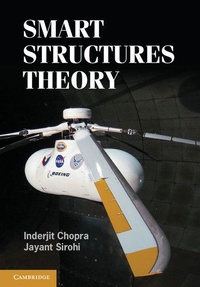
Smart Structures Theory
Published on 30. December 2013
Book
Hardback
920 pages
978-0-521-86657-6 (ISBN)
Description
The twenty-first century could be called the 'Multifunctional Materials Age'. The inspiration for multifunctional materials comes from nature, and therefore these are often referred to as bio-inspired materials. Bio-inspired materials encompass smart materials and structures, multifunctional materials and nano-structured materials. This is a dawn of revolutionary materials that may provide a 'quantum jump' in performance and multi-capability. This book focuses on smart materials, structures and systems, which are also referred to as intelligent, adaptive, active, sensory and metamorphic. The purpose of these materials from the perspective of smart systems is their ability to minimize life-cycle cost and/or expand the performance envelope. The ultimate goal is to develop biologically inspired multifunctional materials with the capability to adapt their structural characteristics (such as stiffness, damping and viscosity) as required, monitor their health condition, perform self-diagnosis and self-repair, morph their shape and undergo significant controlled motion over a wide range of operating conditions.
Reviews / Votes
'... one of the most comprehensive and extensive treatises on smart materials and structures published in the last two decades. ... This is a book that I strongly recommend.' Fabrizio Scarpa, The Aeronautical JournalMore details
Series
Language
English
Place of publication
Cambridge
United Kingdom
Target group
Professional and scholarly
Illustrations
59 Tables, unspecified; 40 Halftones, unspecified; 484 Line drawings, unspecified
Dimensions
Height: 260 mm
Width: 183 mm
Thickness: 54 mm
Weight
1896 gr
ISBN-13
978-0-521-86657-6 (9780521866576)
Copyright in bibliographic data and cover images is held by Nielsen Book Services Limited or by the publishers or by their respective licensors: all rights reserved.
Schweitzer Classification
Other editions
Additional editions
Inderjit Chopra | Jayant Sirohi
Smart Structures Theory
E-Book
01/2014
1st Edition
Cambridge University Press
€112.99
Available for download
Inderjit Chopra
Smart Structures Theory
E-Book
12/2013
Cambridge University Press
€100.99
Available for download
Persons
Dr Inderjit Chopra is an Alfred Gessow Professor in Aerospace Engineering and Director of the Alfred Gessow Rotorcraft Center at the University of Maryland. Dr Chopra works on fundamental problems related to aeromechanics of helicopters including aeromechanical stability, active vibration control, modeling of composite blades, rotor head health monitoring, aeroelastic optimization, smart structures, micro air vehicles and comprehensive aeromechanics analyses of bearingless, tilt-rotor, servo-flap, coaxial, compound, teetering and circulation control rotors. Dr Chopra has authored more than 160 archival journal papers and 260 conference proceedings papers. He has been an associate editor of the Journal of the American Helicopter Society (1987-91), the AIAA Journal of Aircraft (1987-present) and the Journal of Intelligent Materials and Systems (1997-present). He has been elected Fellow in the following societies: the American Institute of Aeronautics and Astronautics, the American Helicopter Society, the American Society of Mechanical Engineers, the Aeronautical Society of India and the National Institute of Aerospace. Dr Jayant Sirohi is an expert in high power density solid state actuators, multifunctional structures, multi-mission capable micro/unmanned aerial vehicles and rotorcraft design. He is a professor in the Aerospace Engineering and Engineering Mechanics Department at the University of Texas, Austin. Dr Sirohi had previously worked at Sikorsky Aircraft Corporation where he was a Staff Engineer in the Advanced Concept group.
Content
1. Introduction; 2. Piezos; 3. SMA; 4. Beams; 5. Plates; 6. Magnetostrictives and electrostrictives; 7. ERMR; 8. Applications.