

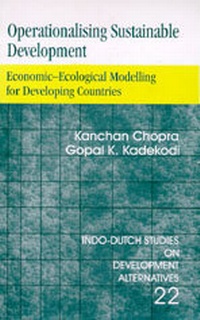
Operationalising Sustainable Development
Economic-Ecological Modelling for Developing Countries
1st Edition
Published on 18. May 1999
Book
Hardback
304 pages
978-0-7619-9330-8 (ISBN)
Description
This book applies the concept of sustainable development operationally to the development of the forest, water, agricultural and livestock sectors of one of India's most `underdeveloped' districts. In so doing, the authors undertake a detailed modelling of the linkages between the ecological and economic sectors, making this an original and significant study in methodological terms.
More details
Series
Edition
First Edition
Language
English
Place of publication
Thousand Oaks
United States
Target group
Professional and scholarly
Weight
480 gr
ISBN-13
978-0-7619-9330-8 (9780761993308)
Copyright in bibliographic data and cover images is held by Nielsen Book Services Limited or by the publishers or by their respective licensors: all rights reserved.
Schweitzer Classification
Content
Economic-Ecological Modelling
A Conceptual Framework
Palamau
Ecology, Economy and Development
A Resource-Based Ecology-Economy Model for Palamau District
Water in Palamau
Forest Resources of Palamau and Their Modelling
Livestock Resources and Linkages
The Agricultural Economy of Palamau
Consumption Pattern, Basic Needs and Investments
Implications for Resource and Livelihood Sustainability
Cyclic System of Development
An Institutional Approach to Sustainable Development
Sustainable Development with Policy Alternatives
Lessons from the Palamau Study
Summary and Conclusions
A Conceptual Framework
Palamau
Ecology, Economy and Development
A Resource-Based Ecology-Economy Model for Palamau District
Water in Palamau
Forest Resources of Palamau and Their Modelling
Livestock Resources and Linkages
The Agricultural Economy of Palamau
Consumption Pattern, Basic Needs and Investments
Implications for Resource and Livelihood Sustainability
Cyclic System of Development
An Institutional Approach to Sustainable Development
Sustainable Development with Policy Alternatives
Lessons from the Palamau Study
Summary and Conclusions