

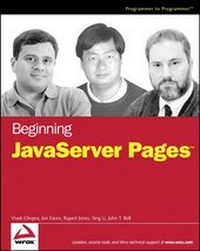
Beginning JavaServer Pages
Published on 1. February 2005
Book
Paperback/Softback
1296 pages
978-0-7645-7485-6 (ISBN)
Description
* JSP is one of the core technologies for server-side Java applications and the 2.0 release, which this book covers in detail, makes JSP an even more powerful tool
* Walks Java programmers and Web developers through JSP fundamentals, including JSP syntax and directives, JSP Expression Language, JSP Tag libraries, JSTL, and techniques for testing and debugging
* Shows how to use JSP in real-world Web applications along with open source frameworks such as Struts, WebWork, and Turbine, software design methodologies, and developer tools like Ant, jUnit, and CVS, as well as popular IDEs (integrated development environmnents)
* Each chapter has an exercise section with solutions on the companion Web site
* Walks Java programmers and Web developers through JSP fundamentals, including JSP syntax and directives, JSP Expression Language, JSP Tag libraries, JSTL, and techniques for testing and debugging
* Shows how to use JSP in real-world Web applications along with open source frameworks such as Struts, WebWork, and Turbine, software design methodologies, and developer tools like Ant, jUnit, and CVS, as well as popular IDEs (integrated development environmnents)
* Each chapter has an exercise section with solutions on the companion Web site
More details
Edition
1. Auflage
Language
English
Place of publication
United States
Publishing group
John Wiley & Sons Inc
Target group
College/higher education
Illustrations
Illustrations
Dimensions
Height: 23.3 cm
Width: 18.7 cm
Thickness: 5.8 cm
Weight
1662 gr
ISBN-13
978-0-7645-7485-6 (9780764574856)
Schweitzer Classification
Persons
Vivek Chopra has over ten years of experience as a software developer, architect, and team lead, with extensive experience with Web services, J2EE, and middleware technologies. He has worked and consulted at a number of Silicon Valley companies and startups and has (pending) patents on Web services. Vivek actively writes about technology and has coauthored half a dozen books on topics such as opensource software, Java, XML, and Web services. He contributes to open source, too, and has developed parts of the uddi4j library, an open-source Java API for UDDI.
Sing Li, first bit by the microcomputer bug in 1978, has grown up with the microprocessor age. His first personal computer was a do-it-yourself Netronics COSMIC ELF computer with 256 bytes of memory, mail-ordered from the back pages of Popular Electronics magazine. Currently, Sing is a consultant, system designer, open-source software contributor, and freelance writer. He writes for several popular technical journals and e-zines and is the creator of the Internet Global Phone, one of the very first Internet phones available. He has authored and coauthored numerous books across diverse technical topics, including JSP, Tomcat, servlets, XML, Jini, and JXTA.
Rupert Jones is a Technical Lead for J2EE projects at Internet Business Systems. Over the past six years, Rupert has provided software development and consulting services for blue-chip companies, both in Australia and internationally. He lives and works in Melbourne, Australia. Rupert can be contacted at rup@rupertjones.com.
Jon Eaves has been developing software in a variety of languages and domains for over 15 years. He is currently employed by ThoughtWorks, developing large-scale enterprise systems using J2EE. When he can find spare time, he develops J2ME/MIDP applications and works on the BouncyCastle Crypto APIs (www.bouncycastle.org). Jon can be reached at jon@eaves.org.
John T. Bell has more than 20 years of software development experience and currently serves as the lead software architect for the Web site of a major hospitality company based in Bethesda, Maryland. He is also an adjunct professor, teaching server-side Java technologies for the Center for Applied Information Technology at Towson State University. He has a master's degree in Computer Systems Management and a bachelor's degree in Electrical Engineering, both from the University of Maryland. This is Mr. Bell's third contribution to a Wrox title. He is also the author of The J2EE Open Source Toolkit.
Sing Li, first bit by the microcomputer bug in 1978, has grown up with the microprocessor age. His first personal computer was a do-it-yourself Netronics COSMIC ELF computer with 256 bytes of memory, mail-ordered from the back pages of Popular Electronics magazine. Currently, Sing is a consultant, system designer, open-source software contributor, and freelance writer. He writes for several popular technical journals and e-zines and is the creator of the Internet Global Phone, one of the very first Internet phones available. He has authored and coauthored numerous books across diverse technical topics, including JSP, Tomcat, servlets, XML, Jini, and JXTA.
Rupert Jones is a Technical Lead for J2EE projects at Internet Business Systems. Over the past six years, Rupert has provided software development and consulting services for blue-chip companies, both in Australia and internationally. He lives and works in Melbourne, Australia. Rupert can be contacted at rup@rupertjones.com.
Jon Eaves has been developing software in a variety of languages and domains for over 15 years. He is currently employed by ThoughtWorks, developing large-scale enterprise systems using J2EE. When he can find spare time, he develops J2ME/MIDP applications and works on the BouncyCastle Crypto APIs (www.bouncycastle.org). Jon can be reached at jon@eaves.org.
John T. Bell has more than 20 years of software development experience and currently serves as the lead software architect for the Web site of a major hospitality company based in Bethesda, Maryland. He is also an adjunct professor, teaching server-side Java technologies for the Center for Applied Information Technology at Towson State University. He has a master's degree in Computer Systems Management and a bachelor's degree in Electrical Engineering, both from the University of Maryland. This is Mr. Bell's third contribution to a Wrox title. He is also the author of The J2EE Open Source Toolkit.
Content
About the Authors.
Acknowledgments.
Introduction.
Part I: JSP Fundamentals.
Chapter 1: Getting Started with JavaServer Pages.
Chapter 2: JSP Basics 1: Dynamic Page Creation for Data Presentation.
Chapter 3: JSP Basics 2: Generalized Templating and Server Scripting.
Chapter 4: CSS, JavaScript, VBScript, and JSP.
Chapter 5: JSP and EL.
Chapter 6: JSP Tag Libraries and JSTL.
Chapter 7: JSP Directives.
Chapter 8: JSP Standard Actions.
Chapter 9: JSP and JavaBeans.
Chapter 10: Error Handling.
Chapter 11: Building Your Own Custom JSP Tag Library.
Chapter 12: Advanced Dynamic Web Content Generation.
Chapter 13: Internationalization and Localized Content.
Chapter 14: JSP Debugging Techniques.
Part II: JSP and Modern Web Server Software Development.
Chapter 15: JSPs and Servlets.
Chapter 16: The Role of JSP in the Wider Context: Web Applications.
Chapter 17: Model View Controller.
Chapter 18: Web Frameworks.
Chapter 19: Struts Framework.
Chapter 20: Layout Management with Tiles.
Chapter 21: JavaServer Faces.
Chapter 22: JSP in J2EE.
Chapter 23: Access to Databases.
Chapter 24: Security.
Chapter 25: Performance.
Chapter 26: Best Practices and Tools.
Part III: Spreading Your New Wings: Applying JSP in the Real World.
Chapter 27: JSP Project I: Personalized Portal.
Chapter 28: JSP Project II: Shopping Cart Application.
Part IV: Appendixes.
Appendix A: JSP Syntax Reference.
Appendix B: JSP Expression Language Reference.
Appendix C: JSTL Reference.
Appendix D: Exercise Solutions.
Index.
Acknowledgments.
Introduction.
Part I: JSP Fundamentals.
Chapter 1: Getting Started with JavaServer Pages.
Chapter 2: JSP Basics 1: Dynamic Page Creation for Data Presentation.
Chapter 3: JSP Basics 2: Generalized Templating and Server Scripting.
Chapter 4: CSS, JavaScript, VBScript, and JSP.
Chapter 5: JSP and EL.
Chapter 6: JSP Tag Libraries and JSTL.
Chapter 7: JSP Directives.
Chapter 8: JSP Standard Actions.
Chapter 9: JSP and JavaBeans.
Chapter 10: Error Handling.
Chapter 11: Building Your Own Custom JSP Tag Library.
Chapter 12: Advanced Dynamic Web Content Generation.
Chapter 13: Internationalization and Localized Content.
Chapter 14: JSP Debugging Techniques.
Part II: JSP and Modern Web Server Software Development.
Chapter 15: JSPs and Servlets.
Chapter 16: The Role of JSP in the Wider Context: Web Applications.
Chapter 17: Model View Controller.
Chapter 18: Web Frameworks.
Chapter 19: Struts Framework.
Chapter 20: Layout Management with Tiles.
Chapter 21: JavaServer Faces.
Chapter 22: JSP in J2EE.
Chapter 23: Access to Databases.
Chapter 24: Security.
Chapter 25: Performance.
Chapter 26: Best Practices and Tools.
Part III: Spreading Your New Wings: Applying JSP in the Real World.
Chapter 27: JSP Project I: Personalized Portal.
Chapter 28: JSP Project II: Shopping Cart Application.
Part IV: Appendixes.
Appendix A: JSP Syntax Reference.
Appendix B: JSP Expression Language Reference.
Appendix C: JSTL Reference.
Appendix D: Exercise Solutions.
Index.