

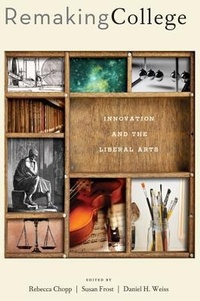
Remaking College
Innovation and the Liberal Arts
Published on 11. April 2016
Book
Paperback/Softback
232 pages
978-1-4214-1978-7 (ISBN)
Description
As one of the most successful educational enterprises in American history, the residential liberal arts college has long been emulated across all spectrums of undergraduate education in the United States and increasingly around the world. These schools are characterized by broad-based curricula, small class size, and interaction between students and faculty. Aimed at developing students' intellectual literacy and critical-thinking skills rather than specific professional preparation, the value proposition made by these colleges has recently come under intense pressure. Remaking College brings together a distinguished group of higher education leaders to define the American liberal arts model, to describe the challenges these institutions face, and to propose sustainable solutions. These essays elucidate the shifting economic and financial models for liberal arts colleges and consider the opportunities afforded by technology, globalism, and intercollegiate cooperative models. By exploring new ideas, offering bold proposals, and identifying emerging lessons, the authors consider the unique position these schools can play in their communities and in the larger world.
Reviews / Votes
Two presidents assert that higher education will have to address spiraling costs and that some college-particularly regional liberal arts colleges-will have trouble surviving if they don't. Philadelphia Inquirer Higher education is going under the microscope to prove its value. Add to that a growing chorus of pundits who believe that a liberal arts education is a waste of time and a relic of the past. But two college presidents argue in [ Remaking College] that a liberal arts education is, in fact, crucial to not just boosting the economy but to solving many of the world's problems. University Business This spirited collection of essays offers lessons in what the rhetorician Richard Lanham once called 'the oldest class in American education, the Seminar on the Future of the Liberal Arts.' Across varying discussions, these leaders argue that 'flexibility' will continue to characterize the agility and adaptability that the liberal arts college produces in its graduates and reflects in its own longevity. The Key ReporterMore details
Language
English
Place of publication
Baltimore, MD
United States
Target group
Professional and scholarly
Product notice
Paperback (trade)
Illustrations
3 s/w Zeichnungen
3 Line drawings, black and white
Dimensions
Height: 229 mm
Width: 152 mm
Thickness: 15 mm
Weight
318 gr
ISBN-13
978-1-4214-1978-7 (9781421419787)
DOI
10.1353/book.27239
Copyright in bibliographic data and cover images is held by Nielsen Book Services Limited or by the publishers or by their respective licensors: all rights reserved.
Schweitzer Classification
Other editions
Additional editions
Book
02/2014
Johns Hopkins University Press
€52.00
Article not available at the moment
E-Book
02/2014
Johns Hopkins University Press
€22.49
Available for download
Persons
Rebecca Chopp is the chancellor of the University of Denver, where she is leading a comprehensive effort to transform the student experience, expand the design of knowledge, and engage with the liberal arts in new ways. Previously she served as the president of Swarthmore College and Colgate University. Susan Frost is a consultant and researcher who works with college and university leaders to help them form and execute strategic plans, engage faculty in shaping their institutions' futures, and develop academic programs as major fundraising targets. Daniel H. Weiss is the president of the Metropolitan Museum of Art. For over a decade, he led liberal arts institutions, serving as the president of Haverford College and Lafayette College.
Content
Preface
Acknowledgments
Introduction. Updating the Liberal Arts Mission for the Twenty-First Century
Part I: Reimagining the Liberal Arts College in America
Chapter 1. Remaking, Renewing, Reimagining: The Liberal Arts College Takes Advantage of Change
Chapter 2. Challenges and Opportunities in the Changing Landscape
Part II: An Opportunity to Lead
Chapter 3. Economics and Affordability
Chapter 4. Using Governance to Strengthen the Liberal Arts
Chapter 5. Orchestrating Shared Governance
Part III: Knowledge, Learning, and New Technologies
Chapter 6. Breaking Barriers and Building Bridges in Teaching
Chapter 7. Interdisciplinary Perspectives and the Liberal Arts
Chapter 8. Technology in Education: Revolution or Evolution?
Chapter 9. You Can Run, but You Can't Hide
Chapter 10. Technology, Learning, and Campus Culture
Part IV: Collaboration and Partnerships
Chapter 11. The Future of Liberal Arts Colleges Begins with Collaboration
Chapter 12. The College without Walls: Partnerships at Home and Abroad
Chapter 13. The Networked College-Local, Global, Virtual
Part V: Residential Communities and Social Purpose
Chapter 14. The Liberal Arts College Unbound
Chapter 15. "Glowing against the Gray, Sober against the Fire": Residential Academic Communities in the Twenty-First Century
Chapter 16. The Intercultural Connection: Students and the Liberal Arts
Part VI: Future Prospects for the Liberal Arts College
Chapter 17. More to Hope Than to Fear: The Future of the Liberal Arts College
Contributors
Index
Acknowledgments
Introduction. Updating the Liberal Arts Mission for the Twenty-First Century
Part I: Reimagining the Liberal Arts College in America
Chapter 1. Remaking, Renewing, Reimagining: The Liberal Arts College Takes Advantage of Change
Chapter 2. Challenges and Opportunities in the Changing Landscape
Part II: An Opportunity to Lead
Chapter 3. Economics and Affordability
Chapter 4. Using Governance to Strengthen the Liberal Arts
Chapter 5. Orchestrating Shared Governance
Part III: Knowledge, Learning, and New Technologies
Chapter 6. Breaking Barriers and Building Bridges in Teaching
Chapter 7. Interdisciplinary Perspectives and the Liberal Arts
Chapter 8. Technology in Education: Revolution or Evolution?
Chapter 9. You Can Run, but You Can't Hide
Chapter 10. Technology, Learning, and Campus Culture
Part IV: Collaboration and Partnerships
Chapter 11. The Future of Liberal Arts Colleges Begins with Collaboration
Chapter 12. The College without Walls: Partnerships at Home and Abroad
Chapter 13. The Networked College-Local, Global, Virtual
Part V: Residential Communities and Social Purpose
Chapter 14. The Liberal Arts College Unbound
Chapter 15. "Glowing against the Gray, Sober against the Fire": Residential Academic Communities in the Twenty-First Century
Chapter 16. The Intercultural Connection: Students and the Liberal Arts
Part VI: Future Prospects for the Liberal Arts College
Chapter 17. More to Hope Than to Fear: The Future of the Liberal Arts College
Contributors
Index