

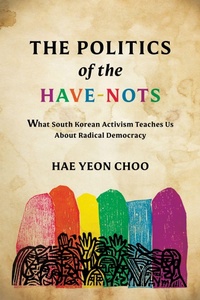
The Politics of the Have-Nots
What South Korean Activism Teaches Us About Radical Democracy
Will be published approx. on 9. February 2027
Book
Hardback
184 pages
978-1-5036-4898-2 (ISBN)
Description
Social change requires the emergence of a collective subject that can foster solidarity within and across national boundaries. But how can such a collective come together in our current era of liberal individualism and the pursuit of maximum profit? In The Politics of the Have-Nots, Hae Yeon Choo theorizes how this collective might cohere and mobilize, drawing on deep engagement with grassroots movements in South Korea and its diaspora over the past two decades.
Disillusionment has grown across the globe from the 2000s to the present. Wealth inequalities have consigned the marginalized to the shadows even as economies have expanded. By bridging five separate instances of mass mobilization during this period, Choo demonstrates the convergence of the collective political sensibility of the Have-nots. These are people who have experienced distinct but overlapping forms of violent dispossession, whether by evictions, layoffs, sexual harassment, immigration raids, and even mass shootings. Confronting these diverse forms of violence, the politics of the Have-nots challenge the cultural and material hegemony of neoliberal capitalism. They propose a critical theory of radical democracy based on expansive solidarity, taking on the struggles of others as their own.
While the mobilizations chronicled in this book are geographically centered in South Korea, many were transnational and linked by the collective vision of the Have-nots. Together, Choo shows, they become a powerful vision of the promise of radical democracy and emancipation from the margins.
Disillusionment has grown across the globe from the 2000s to the present. Wealth inequalities have consigned the marginalized to the shadows even as economies have expanded. By bridging five separate instances of mass mobilization during this period, Choo demonstrates the convergence of the collective political sensibility of the Have-nots. These are people who have experienced distinct but overlapping forms of violent dispossession, whether by evictions, layoffs, sexual harassment, immigration raids, and even mass shootings. Confronting these diverse forms of violence, the politics of the Have-nots challenge the cultural and material hegemony of neoliberal capitalism. They propose a critical theory of radical democracy based on expansive solidarity, taking on the struggles of others as their own.
While the mobilizations chronicled in this book are geographically centered in South Korea, many were transnational and linked by the collective vision of the Have-nots. Together, Choo shows, they become a powerful vision of the promise of radical democracy and emancipation from the margins.
More details
Language
English
Place of publication
Palo Alto
United States
Target group
Professional and scholarly
Product notice
Cloth
Illustrations
4 illustrations - 4 halftones
Dimensions
Height: 229 mm
Width: 152 mm
ISBN-13
978-1-5036-4898-2 (9781503648982)
Copyright in bibliographic data and cover images is held by Nielsen Book Services Limited or by the publishers or by their respective licensors: all rights reserved.
Schweitzer Classification
Person
Hae Yeon Choo is an Associate Professor of Sociology at the University of Toronto. She is the author of Decentering Citizenship (Stanford 2016). She has translated works of critical social theory into Korean, including those by Audre Lorde, Patricia Hill Collins, and Judith Butler.