

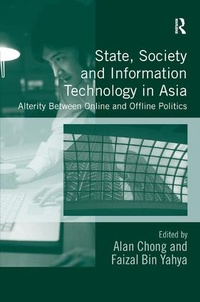
State, Society and Information Technology in Asia
Alterity Between Online and Offline Politics
1st Edition
Published on 31. December 2014
Book
Hardback
248 pages
978-1-4724-4379-3 (ISBN)
Description
Many maintain that the arrival of computers networked across sovereign borders and physical barriers is a liberating force that will produce a global dialogue of liberal hues but this book argues that this dominant paradigm needs to be supplemented by the perspective of alterity in the impact of Information Technology in different regions. Local experts draw upon a range of Asian cases to demonstrate how alterity, defined here as a condition of privileging the hitherto marginal and subterranean aspects of a capitalist world order through the capabilities of information and communications technologies, offers an alternative to the paradigm of inevitable material advances and political liberalization. Calling attention to the unique social and political uses being made of IT in Asia in the service of offline and online causes predominantly filtered by pre-existing social milieus the contributors examine the multiple dimensions of Asian differences in the sociology and politics of IT and show how present trends suggest that advanced electronic media will not necessarily be embraced in a smooth, unilinear fashion throughout Asia. This book will appeal to any reader interested in the nexus between society and IT in Asia.
Reviews / Votes
'This book offers a theoretically fresh and empirically contextualized analysis of the implications of the close and often turbulent nexus between politics, policies and technology in Asia. Its rich and multi-layered account of the contestations between state and society, precipitated by the development of internet technology, is a major accomplishment.' Edmund Terence Gomez, University of Malaya, Malaysia 'This book carries forward the work of scholars such as Manuel Castells who argued almost 20 years ago that The Internet Galaxy? is composed of many cultures pushing it in different directions. The chapters in this book add an Asian and contemporary touch to this discourse, by highlighting models such as state capitalism and newer digital platforms. As enablers and industries, ICTs open up a new frontier of research and policy in Asia, and this book will help the next generation of pioneers in the region grapple with these diverse issues.' Madanmohan Rao, Editor of The Asia-Pacific Internet HandbookMore details
Language
English
Place of publication
London
United Kingdom
Publishing group
Taylor & Francis Ltd
Target group
College/higher education
Dimensions
Height: 234 mm
Width: 156 mm
Weight
620 gr
ISBN-13
978-1-4724-4379-3 (9781472443793)
Copyright in bibliographic data and cover images is held by Nielsen Book Services Limited or by the publishers or by their respective licensors: all rights reserved.
Schweitzer Classification
Other editions
Additional editions
Alan Chong | Faizal bin Yahya
State, Society and Information Technology in Asia
Alterity Between Online and Offline Politics
E-Book
04/2016
Routledge
€60.99
Available for download
Alan Chong | Faizal bin Yahya
State, Society and Information Technology in Asia
Alterity Between Online and Offline Politics
E-Book
04/2016
Routledge
€60.99
Available for download
Persons
Alan Chong is Associate Professor at the S. Rajaratnam School of International Studies in Singapore. He has published widely on the notion of soft power and the role of ideas in constructing the international relations of Singapore and Asia. His interest in soft power has also led to inquiry into the sociological and philosophical foundations of international communication. In tandem, he has pursued a fledgling interest in researching cyber security issues. He has frequently been interviewed in the Asian media and consulted in think-tank networks in the region. Faizal Bin Yahya is a Research Fellow at the Institute of Policy Studies, Lee Kuan Yew School of Public Policy, National University of Singapore and his main research interests are on human capital flows, state owned enterprises (SOEs), small and medium enterprises (SMEs) knowledge based industries, regional trade and economic linkages.
Content
Introduction, Alan Chong, Faizal Bin Yahya; Part I Social Politics of IT; Chapter 1 National Contexts and the Negotiation of Islamic Internet Identity by Southeast Asian Undergraduate Students, Nasya Bahfen; Chapter 2 Migrants, Mobiles and Money: Alterity and the Confluence of Three Transnational Flows, Fernando Paragas; Chapter 3 Blogging Singapore: Control and Excess between Offline and Online Worlds, Kwoh-Jack Tan; Chapter 4 Grassroots Democratic Movements' Dependency on New Media in Contemporary Malaysia: Prospects and Limitations, Pui Yee Choong; Part II Governmental Steering and Policy Alterity; Chapter 5 Hacking, Nationalism, Democracy and Cyberwarfare in the People's Republic of China: A Centre/Margin Perspective, Kay Hearn; Chapter 6 'Global City Foreign Policy': The Propaganda of Enlargement and Integration of an IT-Connected Asian City, Alan Chong; Chapter 7 Biting Back Against Civil Society: IT, Media and Communication Regulations in South Korea, Byoung Won Min; Chapter 8 Growth and Government: The Rise of Information Technology Enabled Services' Centres in India and the Philippines, Joefe B. Santarita; Chapter 9 The Political Economy of Data Security in the BPO Industry in India, Faizal Bin Yahya; Chapter 10 Conclusion, Alan Chong, Faizal Yahya;