

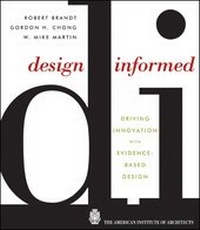
Design Informed
Driving Innovation with Evidence-Based Design
1st Edition
Published on 20. August 2010
Book
Hardback
352 pages
978-0-470-39562-2 (ISBN)
Description
Co-written by a former AIA national president and the chair of architecture at UC-Berkeley, this book is a collection of key case studies of evidence-based design applied to architectural design primarily for healthcare and office buildings. Research in issues such as lighting, acoustics, and color is applied to human performance data and other metrics. Evidence-Based Architectural Design digs deeply into factual specifics and builds upon the research that the authors have completed as winners of the 2005 $100,000 Latrobe Fellowship, awarded by the AIA College of Fellows.
More details
Product info
GB
Edition
1., Auflage
Language
English
Place of publication
Chichester
United Kingdom
Publishing group
John Wiley and Sons Ltd
Target group
Professional and scholarly
Dimensions
Height: 23.6 cm
Width: 20.9 cm
Thickness: 3 cm
Weight
1200 gr
ISBN-13
978-0-470-39562-2 (9780470395622)
Schweitzer Classification
Persons
Robert Brandt, AIA, LEED AP, a real estate planner for Intuit, has more than thirty years of design/ behavior and strategic planning experience with Stantec, Chong Partners, and as a managing partner at HLW International. His clients have included News Corporation, General Motors, University of California, San Francisco, and Amgen. Brandt was a team leader for the 2005-2007 AIA Latrobe Research Fellowship.
Gordon H. Chong, FAIA, served as the national president of The American Institute of Architects in 2002 and president of The Academy of Neuroscience for Architecture from 2007 to 2009. As a founder of Chong Partners Architecture, he led the team that received the 2005-2007 AIA Latrobe Research Fellowship.
W. Mike Martin, PhD, FAIA, Professor Emeritus, University of California, Berkeley, has served as the undergraduate dean of the College of Environmental Design and chair of the Architecture Department. A co-recipient of the 2005-2007 AIA Latrobe Research Fellowship for Research, Martin served as president-elect of the San Francisco chapter of the AIA and as the editor of Architecture California (AIACC).
Gordon H. Chong, FAIA, served as the national president of The American Institute of Architects in 2002 and president of The Academy of Neuroscience for Architecture from 2007 to 2009. As a founder of Chong Partners Architecture, he led the team that received the 2005-2007 AIA Latrobe Research Fellowship.
W. Mike Martin, PhD, FAIA, Professor Emeritus, University of California, Berkeley, has served as the undergraduate dean of the College of Environmental Design and chair of the Architecture Department. A co-recipient of the 2005-2007 AIA Latrobe Research Fellowship for Research, Martin served as president-elect of the San Francisco chapter of the AIA and as the editor of Architecture California (AIACC).
Content
Preface.
Acknowledgments.
Chapter 1 Transformation.
Chapter 2 Models, Simulation, and Data Mining.
Background and Context.
Interviews of Experts and Case Studies.
William Mitchell, MIT Media Lab.
Susan Ubbelohde and George Loisos.
William Sharples and Christopher Sharples, SHoP.
Tom Wiscombe, EMERGENT.
Chris Luebkeman, ARUP.
Phillip Bernstein, Autodesk.
John Kouletsis and Barbara Denton, Kaiser Permanente.
Martin Fischer, Stanford University CIFE.
Lessons Learned.
Chapter 3 The Social Sciences.
Background and Context.
Interviews of Experts and Case Studies.
Andrew Laing and David Craig, DEGW.
Joyce Bromberg, Steelcase.
Kevin Powell, GSA.
Paco Underhill, Envirosell.
John Zeisel, The HearthStone.
Sherry Ahrentzen, Arizona State University.
Lessons Learned.
Chapter 4 The Natural and Physical Sciences.
Background and Context.
Interviews of Experts and Case Studies.
Sheila Kennedy, Kennedy and Violich.
James Timberlake, Kieran Timberlake.
Vivian Loftness, Carnegie Mellon University.
Edward Arens, University of California.
Gail Brager, University of California.
Fred Gage, Salk Institute.
Esther Sternberg, National Institute of Mental Health.
Lessons Learned.
Chapter 5 Putting It All Together.
Chapter 6 The 2005 Latrobe Fellowship.
Chapter 7 Applying What We've Learned.
Index.
Acknowledgments.
Chapter 1 Transformation.
Chapter 2 Models, Simulation, and Data Mining.
Background and Context.
Interviews of Experts and Case Studies.
William Mitchell, MIT Media Lab.
Susan Ubbelohde and George Loisos.
William Sharples and Christopher Sharples, SHoP.
Tom Wiscombe, EMERGENT.
Chris Luebkeman, ARUP.
Phillip Bernstein, Autodesk.
John Kouletsis and Barbara Denton, Kaiser Permanente.
Martin Fischer, Stanford University CIFE.
Lessons Learned.
Chapter 3 The Social Sciences.
Background and Context.
Interviews of Experts and Case Studies.
Andrew Laing and David Craig, DEGW.
Joyce Bromberg, Steelcase.
Kevin Powell, GSA.
Paco Underhill, Envirosell.
John Zeisel, The HearthStone.
Sherry Ahrentzen, Arizona State University.
Lessons Learned.
Chapter 4 The Natural and Physical Sciences.
Background and Context.
Interviews of Experts and Case Studies.
Sheila Kennedy, Kennedy and Violich.
James Timberlake, Kieran Timberlake.
Vivian Loftness, Carnegie Mellon University.
Edward Arens, University of California.
Gail Brager, University of California.
Fred Gage, Salk Institute.
Esther Sternberg, National Institute of Mental Health.
Lessons Learned.
Chapter 5 Putting It All Together.
Chapter 6 The 2005 Latrobe Fellowship.
Chapter 7 Applying What We've Learned.
Index.