

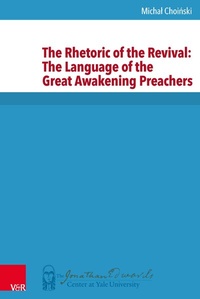
The Rhetoric of the Revival: The Language of the Great Awakening Preachers
The Language of the Great Awakening Preachers
1st Edition
Published on 18. April 2016
Book
Hardback
212 pages
978-3-525-56023-5 (ISBN)
Description
Michal Choinski explores the language of the key preachers of the "Great Awakening" of the mid-eighteenth century, and seeks to explain the impact their sermons exerted upon colonial American audiences. The revival of the 1739-43 is recognized as an important event in American colonial history, formative for the shaping of the culture of New England and beyond. Choinski highlights a variety of inventive rhetorical mechanisms employed by these ministers evolved into what came to be called the rhetoric of the revival," became commonplace for American revivalism, and were fundamental for the persuasive power of Great Awakening preaching and the communicative success of the "New Light" ministers. "
All prices
More details
Other editions
Additional editions
E-Book
04/2016
1st Edition
Vandenhoeck & Ruprecht
€95.00
Available for download
Person
Content
Michal Choinski explores the language of the key preachers of the "Great Awakening" of the mid-eighteenth century, and seeks to explain the impact their sermons exerted upon colonial American audiences. The revival of the 1739-43 is recognized as an important event in American colonial history, formative for the shaping of the culture of New England and beyond. Choinski highlights a variety of inventive rhetorical mechanisms employed by these ministers evolved into what came to be called the 'rhetoric of the revival,' became commonplace for American revivalism, and were fundamental for the persuasive power of Great Awakening preaching and the communicative success of the 'New Light' ministers.>