

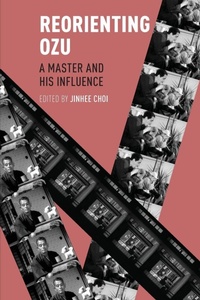
Reorienting Ozu
A Master and His Influence
Published on 1. February 2018
Book
Paperback/Softback
328 pages
978-0-19-025498-8 (ISBN)
Description
Considered by many film critics and scholars as a master of Japanese Cinema, director Ozu Yasujiro still inspires filmmakers both within and outside of Japan. With fifteen never before published chapters in English by contributors from North America, Europe, and Japan, Reorienting Ozu explores the Japanese director's oeuvre and his lasting impact on global art cinema. Exploring major theoretical frameworks that characterize Ozu studies, chapters consider the various cultural factors that influenced the director's cinematic output, such as the anxiety of middleclass Japan in the 1930s, the censorship imposed by the US-occupation after World War II, and women's rights in Ozu's late work such as Tokyo Twilight (1957). Ultimately, chapters illuminate Ozu's influence on the directors of Japan and beyond. With the recent restoration and re-release of Ozu's early and late films, this volume provides an opportunity to examine not only the auteur's major works but also the relationshipsboth cultural and aestheticthat are forged among directors across the world.
Reviews / Votes
One of the many strengths of this collection is that it examines the concept taking into account both Ozu and his international influence. The book features an almost dizzying array of major scholars in the field. * David Desser, Chapman University, Monumenta Nipponica * A timely intervention by an impressive array of scholars that recalibrates Ozu Yasujiross oeuvre and the notion of the Ozuesque sensibility for the globalised cinema world of the twenty-first century. * Isolde Standish, Emerita Reader in Film and Media studies, SOAS University of London * There will never be a definitive book on Ozu Yasujiro, and this impressive collection proves it. That's because the director's work is so wondrously complex -- so baffling with cinematic riches -- that the powerful analyses of these writers are revelatory while never giving the sense that anyone has had the last word. On the contrary, I expect this project to mark a new era in the endless study of Ozu. * Markus Nornes, Professor of Asian Cinema, University of Michigan *More details
Language
English
Place of publication
New York
United States
Target group
Professional and scholarly
Illustrations
43 halftone
Dimensions
Height: 234 mm
Width: 156 mm
Thickness: 18 mm
Weight
500 gr
ISBN-13
978-0-19-025498-8 (9780190254988)
Copyright in bibliographic data and cover images is held by Nielsen Book Services Limited or by the publishers or by their respective licensors: all rights reserved.
Schweitzer Classification
Other editions
Additional editions
Book
01/2018
Oxford University Press Inc
€195.90
Shipment within 15-20 days
E-Book
12/2017
1st Edition
OUP eBook
€27.49
Available for download
E-Book
12/2017
1st Edition
OUP eBook
€27.49
Available for download
Person
Jinhee Choi is Reader in Film Studies at Kings College London
Content
Introduction
Jinhee Choi
Branding Ozu
1. Watch Again! Look Well! Look! David Bordwell
2. Ozu, The Ineffable Darrell W Davis
3. Ozu to Asia via Hasumi Aaron Gerow
4. A Dialogue with 'Memory' in Hou Hsiao-hsien's Cafe Lumiere - Mitsuyo Wada-Marciano
5. Ozuesque as a Sensibility: or On the notion of Influence Jinhee Choi
Historicizing Ozu
6. A New Form of Silent Cinema: Intertitles and Interlocutions in Ozu Yasujiro's Late Silent Films Michael Raine
7. Ozu and the Aesthetics of Shadow: Lighting and Cinematography in There Was a Father (Chichi ariki, 1942)Daisuke Miyao
8. Modernity, Shoshimin Films and the Proletarian-Film Movement: Ozu in Dialogue with Vertov Yuki Takinami
9. Laughing in the Shadows of Empire: Humor in Ozu's Brothers and Sisters of the Toda Family (1941) Junji Yoshida
Tracing Ozu
10. Autumn Afternoons: Negotiating the Ghost of Ozu in Iguchi Nami's Dogs and Cats - Adam Bingham
11. Playing the Holes: Notes on the Ozuesque Gags Manuel Garin & Albert Elduque
12. Rhythm, Texture, Moods: Ozu Yasujiro, Claire Denis and a Vision of a Post-colonial Aesthetic Kate Taylor-Jones
13. Wenders Travels with Ozu Mark Betz
14. Look? Optical / Sound Situations and Interpretation: Ozu - (Deleuze) - Kiarostami David Deamer
15. Sparse or Slow: Ozu and Joanna Hogg William Brown
Jinhee Choi
Branding Ozu
1. Watch Again! Look Well! Look! David Bordwell
2. Ozu, The Ineffable Darrell W Davis
3. Ozu to Asia via Hasumi Aaron Gerow
4. A Dialogue with 'Memory' in Hou Hsiao-hsien's Cafe Lumiere - Mitsuyo Wada-Marciano
5. Ozuesque as a Sensibility: or On the notion of Influence Jinhee Choi
Historicizing Ozu
6. A New Form of Silent Cinema: Intertitles and Interlocutions in Ozu Yasujiro's Late Silent Films Michael Raine
7. Ozu and the Aesthetics of Shadow: Lighting and Cinematography in There Was a Father (Chichi ariki, 1942)Daisuke Miyao
8. Modernity, Shoshimin Films and the Proletarian-Film Movement: Ozu in Dialogue with Vertov Yuki Takinami
9. Laughing in the Shadows of Empire: Humor in Ozu's Brothers and Sisters of the Toda Family (1941) Junji Yoshida
Tracing Ozu
10. Autumn Afternoons: Negotiating the Ghost of Ozu in Iguchi Nami's Dogs and Cats - Adam Bingham
11. Playing the Holes: Notes on the Ozuesque Gags Manuel Garin & Albert Elduque
12. Rhythm, Texture, Moods: Ozu Yasujiro, Claire Denis and a Vision of a Post-colonial Aesthetic Kate Taylor-Jones
13. Wenders Travels with Ozu Mark Betz
14. Look? Optical / Sound Situations and Interpretation: Ozu - (Deleuze) - Kiarostami David Deamer
15. Sparse or Slow: Ozu and Joanna Hogg William Brown